


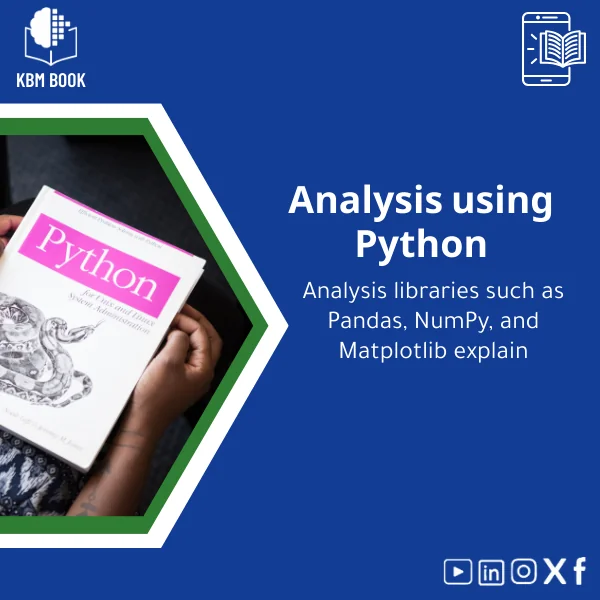
Comprehensive Guide to Data Analysis with Python
Original price was: 179.00 $.139.00 $Current price is: 139.00 $.
A hierarchical, ready-to-use Knowledge Base Module (KBM) that converts practical data analysis workflows into searchable, structured assets — focused on Pandas, NumPy, and Matplotlib to help students, researchers, and professionals find reliable solutions fast.
Key benefits & value for buyers
This KBM converts the broad topic of Data Analysis with Python into modular, searchable knowledge units so you can:
- Save time: access proven Pandas patterns (loading, merging, groupby, pivoting) and Matplotlib layouts without trial-and-error.
- Reduce cognitive load: hierarchical organization means relevant methods and caveats are one click away.
- Improve reproducibility: project templates and exportable code blocks speed up report generation and peer reviews.
- Learn faster: concise explanations paired with minimal, ready-to-run examples accelerate concept-to-practice learning.
- Integrate easily: formats and indexes designed for popular research and note-taking tools make adoption frictionless.
Use cases & real-life scenarios
Student project — from data to presentation in one workflow
Use the KBM to find a clean, annotated example for CSV import, data cleaning (dropna, fillna, type casting), aggregation with groupby, and a Matplotlib-ready plot. Export the code block into your notebook and produce a reproducible figure for submission.
Researcher — repeatable analysis for experiments
Researchers can copy standardized preprocessing steps and numerical stability tips for NumPy-based calculations, ensuring consistency across datasets and collaborators. The KBM includes notes on versioning and expected runtime behaviour for typical dataset sizes.
Professional analyst — accelerate business reporting
Analysts extract dashboard-ready aggregates using pre-built aggregation templates, then use plotting recipes to generate consistent visuals for stakeholders. The KBM reduces ad-hoc scripting and speeds delivery.
Who is this product for?
This KBM is designed for:
- Undergraduate and graduate students learning practical data analysis.
- Academic researchers who need reproducible workflows and concise code references.
- Junior and mid-level data analysts who require reliable templates to standardize outputs.
- Trainers and instructors building lesson plans focused on Pandas, NumPy, and Matplotlib.
If you value structured, searchable knowledge over lengthy unstructured tutorials, this KBM is tailored to your workflow.
How to choose the right version
The KBM is structured by depth and integration format. Choose based on your immediate needs:
- Compact (quick-start): concise recipes and essential code snippets — best for fast learning and coursework.
- Comprehensive: full hierarchical coverage with edge-case notes, performance tips, and expanded examples — ideal for researchers and analysts.
- Integrable: includes SQLite index and markdown export for integration with your note system or shared repo — recommended for teams and trainers.
If unsure, start with Comprehensive if you plan long-term use; Compact is suitable for a fast, lower-cost introduction.
Quick comparison with typical alternatives
Traditional books and long-form articles provide narrative explanations but lack immediate searchability and modular templates. Free tutorials often lack structure and reproducibility standards. This KBM combines:
- Concise instructional content like a tutorial,
- Searchable, hierarchical indexing like a database, and
- Practical templates and exports like a toolkit — ready to integrate with your workflow.
Best practices & tips to get maximum value
- Integrate the SQLite index into your research folder to search across concepts and examples quickly.
- Use the template blocks directly in Jupyter/Colab to test variations; change one parameter at a time to learn effects.
- Combine visualization recipes with style templates to keep reports consistent.
- Keep the KBM as the canonical reference in your team to avoid duplicated ad-hoc scripts.
Common mistakes when buying/using similar products — and how to avoid them
- Buying an unfocused collection: choose structured KBMs that map learning paths; avoid scattershot bundles.
- Ignoring integration: pick formats that match your tools (markdown, CSV index, or SQLite) to avoid manual reformatting.
- Overlooking reproducibility: use provided templates and version notes to ensure others can run your analyses.
Product specifications
- Title: Comprehensive Guide to Data Analysis with Python
- Primary coverage: Pandas, NumPy, Matplotlib
- Content structure: Hierarchical modules, subtopics, code examples, caveats, and templates
- Formats included: searchable SQLite index, CSV/JSON index, structured Markdown export, PDF table of contents
- Typical file size: 10–40 MB depending on version (Compact → Comprehensive)
- Usage notes: One-time download; license for individual use (team licensing available)
- Compatibility: Designed for common research environments (Jupyter, Colab, VS Code)
FAQ
What exactly is included for Pandas, NumPy, and Matplotlib?
Each library section contains: core functions and patterns, minimal working examples, performance and memory tips, common pitfalls with sample fixes, and visualization templates. The structure moves from basics to advanced patterns with references.
Can I integrate the KBM with my existing notes or repository?
Yes. The Integrable version provides Markdown exports and a searchable SQLite index designed to be imported into Obsidian, Notion, or a project repo. CSV/JSON indexes allow automated syncing.
How are updates handled?
KBMBook provides periodic updates for the Comprehensive and Integrable versions (minor corrections and new patterns). Update policy and version notes are included with your download.
Is this suitable for absolute beginners?
The Compact and Comprehensive structures start with fundamentals, but learners with no Python background should pair the KBM with an introductory Python resource. The KBM focuses on data analysis patterns rather than language syntax basics.
Ready to accelerate your Data Analysis with Python workflow?
Get a structured, searchable, and practical knowledge base that saves hours of trial-and-error and standardizes your analysis. Choose the version that fits your needs and integrate it with your environment today.
Related products
Astronomy Observational Techniques Guide for Celestial Motion
Biochemistry Book: Understanding Chemical Processes in Living Systems
Cosmology Book: Guide to Big Bang and Galaxy Evolution
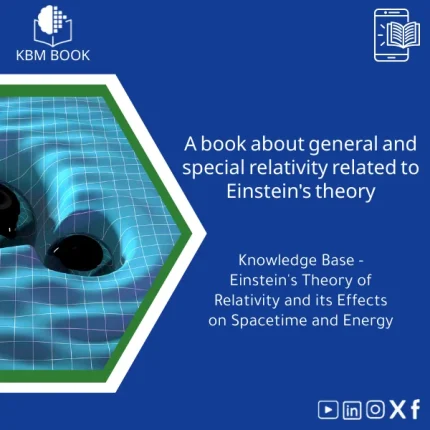
General and Special Relativity Book on Einstein’s Theory
A structured, searchable Knowledge Base Module (KBM) that converts Einstein's General and Special Relativity into a clear, hierarchical reference: formulas, derivations, worked examples, practical applications (GPS, astrophysics), and a compact research bibliography — ready to download and integrate into study, teaching, or research workflows.
General Biology Book: A Guide to Cells, Genetics & Taxonomy
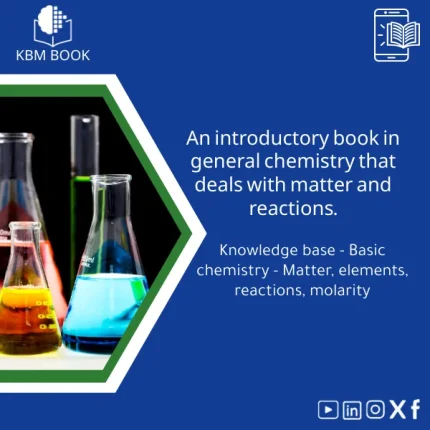
Introductory General Chemistry Book on Matter and Reactions
A structured, searchable Knowledge Base Module (KBM) that converts core general chemistry concepts — matter, elements, reactions, stoichiometry and molarity — into a hierarchical reference you can query, teach from, or integrate into study workflows. Ideal as a concise General Chemistry book alternative for students, researchers, and professionals who need accurate, practical chemistry knowledge fast.
Modern Physics Book: Quantum, Relativity, and Tech Applications Guide
A structured, searchable Knowledge Base Module (KBM) that turns modern physics — quantum mechanics, special & general relativity, and contemporary technological applications — into a hierarchical, practical reference for students, researchers, and professionals who need quick, reliable access to advanced concepts and formulas.
Reviews
Clear filtersThere are no reviews yet.