


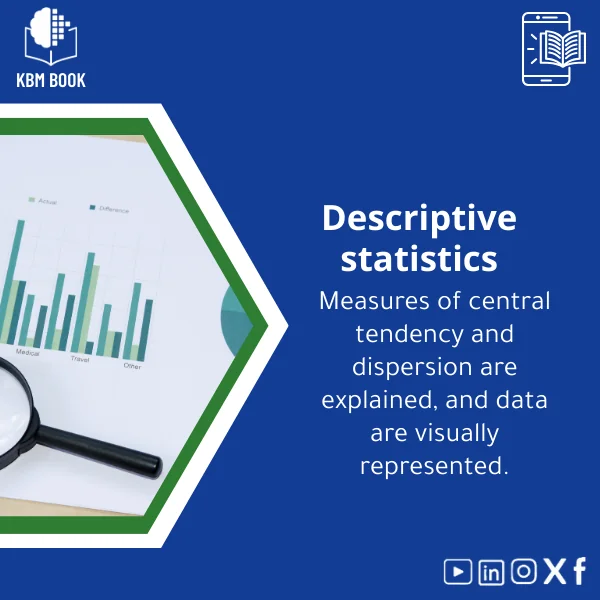
Descriptive Statistics Guide: Central Tendency and Dispersion
Original price was: 139.00 $.99.00 $Current price is: 99.00 $.
A compact, searchable knowledge base module for descriptive statistics that turns formulas, definitions, and visualization rules into practical, ready-to-use references — ideal for students, researchers, and professionals who need fast, reliable answers when analyzing data.
Key benefits & value for the buyer
This descriptive statistics KBM translates core concepts into searchable, re-usable building blocks. Instead of a narrative textbook, you get a hierarchical module that answers specific questions quickly — “How to compute trimmed mean?”, “When to use IQR instead of standard deviation?”, or “Histogram binning rules for small samples?” — with verified formulas, short examples, and citation pointers.
Features translated into benefits
- Structured formulas and definitions: Save time by copying ready formulas into assignments, scripts, or documentation.
- Practical visualization rules: Improve dashboards and reports with recommended chart types and parameter suggestions for different data shapes.
- Multi-format downloads: Use the content directly in spreadsheets, SQL loaders, or note systems—no manual reformatting.
- Searchable taxonomy: Navigate from central tendency measures to dispersion and visualization guidelines without sifting through chapters.
Use cases & real-life scenarios
Concrete examples show how the KBM is used across workflows:
Students
When preparing lab reports or homework, students use the module to verify calculations (sample vs population variance), copy step-by-step worked examples, and generate recommended plots for their datasets to include in reports.
Researchers
Researchers summarizing experimental results use the module to choose robust measures (median & IQR for skewed data), document the exact formulas used in methods sections, and export summary tables that match journal requirements.
Professionals & analysts
Data analysts use the KBM to standardize summary metrics in recurring reports, incorporate visualization rules directly into dashboards, and reduce review cycles by referencing a single authoritative source for definitions and edge-case handling.
Example workflow
Open dataset → consult taxonomy for “dispersion” → copy formula for trimmed mean → follow R/Python snippet to compute and plot → export CSV summary for stakeholders. Complete in under 10 minutes for small datasets.
Who is this product for?
Designed for anyone who needs reliable, quickly accessible guidance on descriptive statistics:
- Undergraduate and graduate students in statistics, psychology, economics, and engineering.
- Academic researchers preparing methods and results sections.
- Business analysts and data scientists creating summary reports and dashboards.
- Trainers and instructors who want a concise reference to teach central tendency measures and measures of dispersion.
How to choose the right edition & format
KBM editions differ by depth and file format. Choose by how you intend to use the content:
- Quick Reference (PDF + Markdown): If you need readable summaries and printable examples for classroom or handouts.
- Developer Edition (CSV + JSON): If you plan to programmatically load tables into analysis pipelines or dashboards.
- Complete KBM (all formats + sample scripts): For researchers and teams who want both human-readable guides and machine-ready tables.
If unsure, the Complete KBM gives the broadest compatibility and the best long-term value.
Quick comparison with typical alternatives
Common alternatives are traditional textbooks, online articles, or fragmented cheat-sheets. This KBM differs by offering:
- Hierarchical, non-redundant organization — not chapter-based prose.
- Downloadable, machine-readable tables for direct use in analysis tools.
- Concise worked examples tailored to short attention spans (no fluff).
Result: faster decision-making, fewer errors when implementing formulas, and a single source of truth for teams.
Best practices & tips to get maximum value
- Integrate the CSV tables with your data pipeline to standardize summary metrics across reports.
- Use the visualization rules as checklist items when building charts—this reduces revision cycles with stakeholders.
- Keep the KBM module versioned with your project repository so methods sections remain reproducible.
- When comparing groups, consult the module’s recommendations on robust measures (median/IQR) for non-normal distributions.
Common mistakes when buying/using similar products and how to avoid them
- Mistake: Buying a long textbook that is hard to search. Fix: Choose a structured KBM with searchable nodes.
- Mistake: Using population formulas on sample data. Fix: Follow the KBM’s clear distinction and examples.
- Mistake: Choosing the wrong visualization for skewed data. Fix: Apply the KBM’s decision rules for plot selection.
- Mistake: Assuming formats are compatible. Fix: Pick the edition that matches your toolchain (CSV/JSON/Markdown).
Product specifications
- Title: Descriptive Statistics Guide — Central Tendency & Dispersion
- Contents: Definitions, formulas, worked examples, visualization rules, R/Python snippets, citation list
- Organizational structure: Hierarchical nodes (topics → subtopics → examples)
- Formats: PDF, Markdown, CSV, JSON (downloadable); sample script files (.py, .R)
- Compatibility: Spreadsheet import, code-ready JSON/CSV, note apps that accept Markdown
- License: Single-user digital use with permitted classroom sharing (see terms)
- Update policy: Periodic content reviews and versioned updates
Frequently Asked Questions
Is this a textbook or an interactive file I can import?
This is a Knowledge Base Module: a structured set of entries (definitions, formulas, examples) delivered in multiple formats. You get human-readable PDFs and Markdown plus machine-ready CSV/JSON that you can import into analysis tools or note systems.
Will this cover both sample and population measures?
Yes. The KBM explicitly separates sample vs population formulas, shows when to apply each, and provides worked examples so you can avoid common calculation errors.
What support or previews are available before purchase?
Each product page includes a table of contents and a short sample file. If you need clarification about compatibility with a specific tool or workflow, contact support listed on the site before purchasing.
Is the content suitable for publication methods sections?
Yes. The module provides precise formula statements and citation-ready wording to describe descriptive statistics methods in papers and reports.
Ready to streamline your descriptive statistics work?
Download a structured, practical KBM that saves time and reduces errors when calculating and visualizing central tendency and dispersion. Includes ready-to-use formats and short code snippets for immediate integration.
Secure download | Instant access | Versioned updates
Related products
Atomic Physics Guide: Understanding Atomic and Electron Properties
Knowledge Base — Atomic/Electron Properties & Electromagnetic Interactions. A structured, searchable KBM for students, researchers, and professionals who need an authoritative atomic physics reference that organizes concepts, formulas, experiments, and practical applications from basics of atomic physics to advanced electron properties.
Cell Biology Guide: Structure, Division, and Transport Insights

Classical Mechanics Guide: Newton’s Laws and Dynamics
A searchable, hierarchical Knowledge Base Module (KBM) that turns classical mechanics into a practical, ready-to-use reference for fast problem solving, lecture preparation, and applied engineering. Designed for students, researchers, and professionals who need precise access to Newton’s laws, rotational motion, and applied dynamics without the noise of textbooks.
Comprehensive Botany Book on Plant Taxonomy and Photosynthesis
A structured, searchable botany book designed as a Knowledge Base Module (KBM) — an end-to-end reference on plant taxonomy, organ structure, and the biochemistry of photosynthesis. Built for students, researchers, and professionals who need reliable, hierarchical knowledge they can search, cite, and apply immediately.

Comprehensive Microbiology Book on Bacteria, Viruses, and Fungi
Comprehensive Nuclear Physics Book on Structure and Radioactivity
Physical Chemistry Guide: Energy, Thermodynamics & Interactions
A structured Knowledge Base Module (KBM) for Physical Chemistry that converts core theory, worked examples, and applied datasets into a searchable, hierarchical database — ideal for students, researchers, and professionals who need fast, reliable access to chemical thermodynamics basics and molecular interaction models.

Reviews
Clear filtersThere are no reviews yet.