


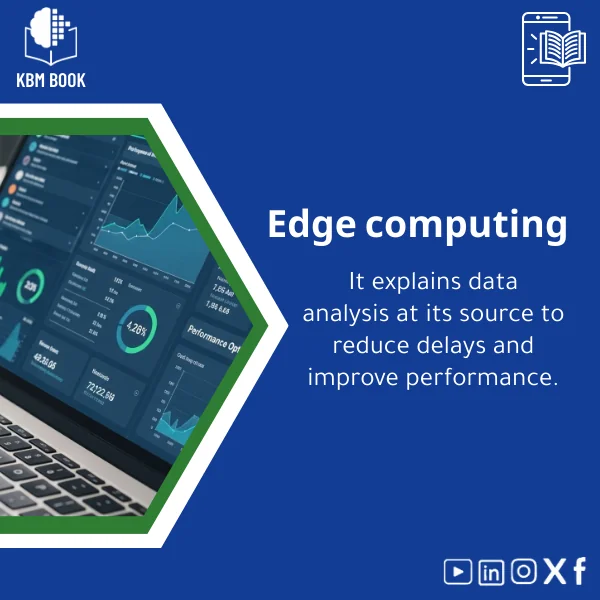
Edge Computing Guide: Data Processing at the Source
Original price was: 199.00 $.159.00 $Current price is: 159.00 $.
A compact, structured Knowledge Base Module (KBM) that teaches edge computing concepts, edge analytics methods, deployment checklists, and practical code examples — designed for students, researchers, and professionals who need reliable, searchable reference material to build and operate edge-enabled systems.
Key benefits & value for students, researchers, and professionals
This KBM converts core edge computing knowledge into an immediately usable database rather than a conventional book. The result is faster access to actionable information, less time wasted wading through narratives, and lower friction when you need to implement or teach concepts.
What you get — benefits translated from features
- Hierarchical structure: Find the “why” in 1–2 clicks and the “how” with step-by-step examples beneath each concept.
- Edge analytics guide: Algorithms, data pipelines, and sample workflows that reduce time-to-proof-of-concept.
- Interoperable files: PDF for reading, JSON/CSV for importing terms and mappings into your notes or tools.
- Research-ready citations: Curated references and versioned updates you can cite in papers or technical reports.
- Practical ROI: Cut debugging and design time by providing ready checklists and validated configurations.
Use cases & real-life scenarios
Examples of how this edge computing book pdf KBM is used in practice:
- University lab: A professor uses the KBM to structure a semester module: theory slides, lab exercises (sensor ingestion → local filtering → model inference), and grading rubric.
- Research team: Researchers prototype an edge analytics pipeline for anomaly detection on manufacturing lines using included pseudocode and evaluation metrics.
- Startup engineering: DevOps engineers follow the deployment checklist to set up Kubernetes at the edge and adopt the suggested monitoring metrics to reduce incident time.
- Industry training: A consultant builds a two-day workshop from the KBM, leveraging diagrams and hands-on tasks to upskill staff quickly.
- Policy & planning: Planners assess data sovereignty and privacy trade-offs using the compliance decision tree included in the KBM.
Who is this product for?
Concise target segments: students learning distributed systems, academic researchers in edge analytics, system architects designing low-latency solutions, data engineers working on IoT, and instructors preparing technical courses. If you need structured, citation-ready reference material for edge computing rather than long-form narrative, this KBM is built for you.
How to choose the right format & license
Format choices
- PDF (recommended): Readable offline, printable, ideal for individual study and citation.
- JSON/CSV metadata: Import terms, chapter indexes, and code snippets into knowledge managers or LMS.
- Supplemental diagrams: High-resolution PNG/SVG for slides and documentation.
License options
Choose a single-user license for personal use and study; pick a team license for group access or classroom distribution. Licensing is transparent and designed to be cost-effective compared with training fees or multi-volume textbooks.
Quick comparison with typical alternatives
Compared with a conventional book or scattered online articles, this KBM gives:
- Faster lookup: Database-style structure vs. book chapters.
- Reusable assets: Exportable metadata vs. locked PDF-only content.
- No fluff: Focus on patterns, examples, and checklists — not extended background history.
- Versioned updates: Regular KBM updates keep pace with emerging technologies unlike most printed resources.
Best practices & tips to get maximum value
- Start with the “Quick Architecture” diagram to map your project before diving into code examples.
- Use the included CSV terms file to create a personal glossary in your note-taking app.
- Run the sample pipelines on small datasets first to validate assumptions before full-scale deployment.
- Adopt the monitoring KPIs in the KBM as baseline metrics for edge performance evaluations.
- Keep the KBM updated in team repositories; treat it as living documentation, not a one-time read.
Common mistakes when buying/using similar products and how to avoid them
- Buying a general-purpose book: Problem: long narratives and little actionable guidance. Solution: choose a KBM structured for immediate application.
- Ignoring update policy: Problem: outdated configs. Solution: pick KBMs with version history and update notes.
- Overlooking formats: Problem: cannot import key terms into tools. Solution: ensure JSON/CSV metadata is included.
- Skipping licensing checks: Problem: classroom redistribution limits. Solution: confirm team licenses for instructional use.
Product specifications
- Title: Edge Computing Guide: Data Processing at the Source
- Main keyword: edge computing; secondary keywords included for search and export metadata.
- Formats: PDF (printable), JSON index, CSV glossary, PNG/SVG diagrams.
- Length & structure: ~120 pages equivalent; 10 core modules (fundamentals → deployment → analytics → governance).
- Includes: deployment checklists, code pseudocode (Python/JS), sample configuration fragments, monitoring KPIs, references list.
- Language: English; notes in Arabic about KBM structure available on request.
- Licenses: single-user and team editions (institutional license available).
- Delivery: Instant download after purchase; versioned updates included for 12 months.
- Usage notes: Compatible with knowledge managers; images and code snippets reusable under the license.
Frequently asked questions
Can I get this as an “edge computing book pdf” and import its glossary into a notes app?
Is this suitable as an “introduction to edge computing” for students?
How often will I receive updates?
What if I’m unsure this is the right resource for my project?
Ready to accelerate your edge projects?
Convert learning into action with a KBM designed for rapid implementation. Download the structured edge analytics guide, integrate the searchable assets with your workflow, and reduce design and debugging time.
Instant download. Single-user and team licenses available. 12-month updates included.
Related products

Astronomy Observational Techniques Guide for Celestial Motion

Astrophysics Book: Understanding Stars, Galaxies, and Dark Energy
A searchable, hierarchical Knowledge Base Module (KBM) that converts astrophysics and cosmology into a practical, exam-ready and research-ready reference. Designed for students, researchers, and professionals who need immediate access to reliable explanations, equations, and data models for stars, galaxies, and dark energy.

Comprehensive Microbiology Book on Bacteria, Viruses, and Fungi

Comprehensive Nuclear Physics Book on Structure and Radioactivity

Introductory General Chemistry Book on Matter and Reactions
A structured, searchable Knowledge Base Module (KBM) that converts core general chemistry concepts — matter, elements, reactions, stoichiometry and molarity — into a hierarchical reference you can query, teach from, or integrate into study workflows. Ideal as a concise General Chemistry book alternative for students, researchers, and professionals who need accurate, practical chemistry knowledge fast.

Reviews
Clear filtersThere are no reviews yet.