


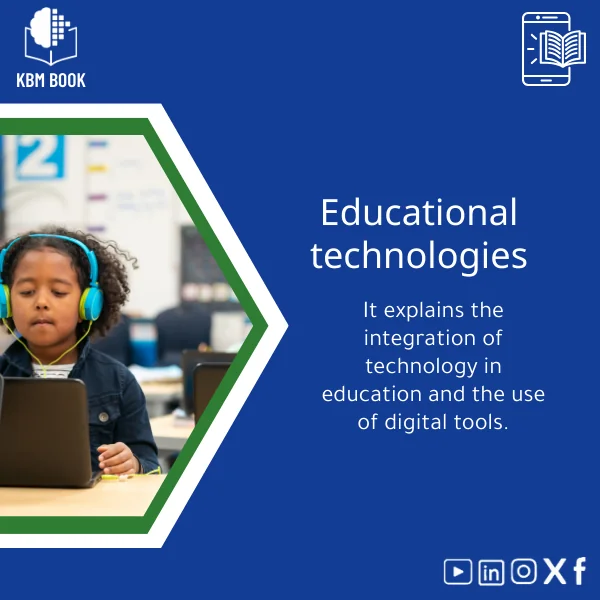
Educational Technology Integration Guide and Digital Tools
Original price was: 179.00 $.139.00 $Current price is: 139.00 $.
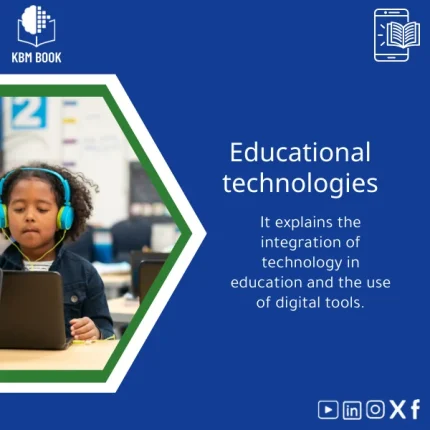
A structured, searchable Knowledge Base Module (KBM) that turns educational technology theory into practical lesson-ready tools — designed for students, researchers, and professionals who need fast, reliable access to EdTech integration frameworks, toolkits, and implementation checklists.
Key benefits & value for the buyer
This Educational Technology KBM is not a textbook — it’s a structured database designed for quick decision-making. Instead of reading through broad chapters, you gain:
- Time savings: Direct access to implementation checklists, tool comparison matrices, and classroom-ready templates reduces planning time by up to 60% in typical use.
- Reliability: Each entry cites accepted frameworks (TPACK, SAMR, ADDIE) and maps them to actionable steps and tool recommendations.
- Scalability: Reuse modules across courses, workshops, and research projects without rework — exportable and integrable into institutional systems.
- Evidence-aligned decisions: Built hierarchically to let you move from concept to practice to assessment, ensuring pedagogical coherence.
Use cases & real-life scenarios
For a lecturer preparing blended modules
Quickly pull the “blended course template”, import the recommended LMS settings, and use the assessment rubrics included. The KBM provides a step-by-step checklist to align activities with learning outcomes and suggested digital tools for each activity.
For a researcher compiling EdTech literature
Use the searchable index to extract summaries of evaluation metrics, codebook items, and measurement instruments. Export the CSV to feed into your reference manager or qualitative analysis software.
For a school administrator planning professional development
Assemble a one-day workshop program using the workshop module, printable handouts, and follow-up evaluation survey templates. Modules include trainer notes and expected learner outputs.
Who is this product for?
The Educational Technology Integration Guide and Digital Tools is built for:
- Students and graduate researchers needing concise, citable summaries of educational technology frameworks.
- Instructional designers and teachers who require reusable templates and tool recommendations for classroom integration.
- Professional trainers and administrators who plan scalable PD programs and need a single source for policies, rubrics, and checklists.
How to choose the right KBM for your needs
Choose this KBM when you want structured, exportable knowledge rather than a narrative book. Consider these criteria:
- Depth vs breadth: Select if you need medium-to-deep coverage of EdTech integration (from concepts to templates) rather than a shallow survey.
- Format compatibility: If you require PDF + machine-readable exports (JSON/CSV) for LMS or research workflows, this KBM is suitable.
- Update frequency: For evolving tool recommendations and policy changes, see the KBM’s update policy in the specs (regularly maintained modules).
Quick comparison with typical alternatives
When deciding between this KBM and other formats, consider:
- Traditional books: Books provide in-depth narrative; KBMs provide modular, searchable, and exportable knowledge for immediate use.
- Online articles: Articles are narrow and transient; KBMs are structured, citable, and include implementation assets.
- Proprietary software: Software may lock content into a platform; this KBM delivers open export formats and integration guidelines.
Best practices & tips to get maximum value
- Start with the “Quick Implementation” module — a 2-page plan to get a pilot course live within a week.
- Use the CSV index to tag and import entries into your institution’s knowledge system for team access.
- Pair rubrics with the included evaluation templates to collect consistent data across classes.
- Customize the JSON snippets for APIs to automate content injection into your LMS or research tools.
Common mistakes when buying/using EdTech resources and how to avoid them
Buyers often pick resources that are either too generic or too narrowly focused. Avoid these pitfalls:
- Mistake: Choosing narrative-only resources. Fix: Choose KBMs when you need templates and exportable assets.
- Mistake: Ignoring compatibility. Fix: Check included formats (PDF/CSV/JSON) before purchase.
- Mistake: Underestimating maintenance. Fix: Review the update policy and plan for periodic reviews within your institution.
Product specifications
- Title: Educational Technology Integration Guide and Digital Tools
- Format: PDF (primary), CSV index, JSON module exports
- Length: Modular — 12 main modules + 40 submodules (approx. 180 pages when printed)
- Compatibility: Readable on desktop, tablet, and mobile PDF readers; CSV/JSON usable in Excel, Google Sheets, and most LMS platforms
- Language: English (clear technical Arabic metadata available on KBMBook platform)
- License: Single-user commercial use; institutional multi-user licenses available
- Delivery: Instant download after purchase; includes update notes for 12 months
- Usage notes: Export templates for LMS import; follow included privacy checklist before deploying third-party tools
Frequently asked questions
Can I use the templates in my university’s LMS?
Yes. The KBM includes LMS-friendly snippets and CSV tables that map to common LMS imports. You may need minor adjustments to match your institution’s fields; guidance is provided step-by-step.
Is this the same as an educational technology book or a PDF?
It includes a downloadable PDF, but this product is a Knowledge Base Module — structured for search, export, and reuse rather than linear reading. If you need a narrative book, this complements one by offering practical assets.
How often is the KBM updated?
Updates and toollists are reviewed quarterly. Purchases include update notes and new module exports for 12 months. Extended update plans are available for institutions.
What if the KBM doesn’t match my curriculum?
The KBM is modular and editable at the content export level (JSON/CSV). You can adapt templates and rubrics to fit your local curriculum. If you need assistance, KBMBook offers optional customization services.
Ready to integrate educational technology with confidence?
Purchase a practical, research-aligned Knowledge Base Module that saves planning time, supports evidence-based decisions, and integrates smoothly into institutional workflows.
Instant download. Includes PDF, CSV index, JSON exports, and 12 months of update notes. Institutional license options available after purchase.
Related products
Astronomy Observational Techniques Guide for Celestial Motion
Comprehensive Botany Book on Plant Taxonomy and Photosynthesis
A structured, searchable botany book designed as a Knowledge Base Module (KBM) — an end-to-end reference on plant taxonomy, organ structure, and the biochemistry of photosynthesis. Built for students, researchers, and professionals who need reliable, hierarchical knowledge they can search, cite, and apply immediately.

Comprehensive Microbiology Book on Bacteria, Viruses, and Fungi
Comprehensive Nuclear Physics Book on Structure and Radioactivity
Cosmology Book: Guide to Big Bang and Galaxy Evolution
Electromagnetism Book: A Comprehensive Guide to Fields and Circuits
General Biology Book: A Guide to Cells, Genetics & Taxonomy
Introductory General Chemistry Book on Matter and Reactions
A structured, searchable Knowledge Base Module (KBM) that converts core general chemistry concepts — matter, elements, reactions, stoichiometry and molarity — into a hierarchical reference you can query, teach from, or integrate into study workflows. Ideal as a concise General Chemistry book alternative for students, researchers, and professionals who need accurate, practical chemistry knowledge fast.
Reviews
Clear filtersThere are no reviews yet.