


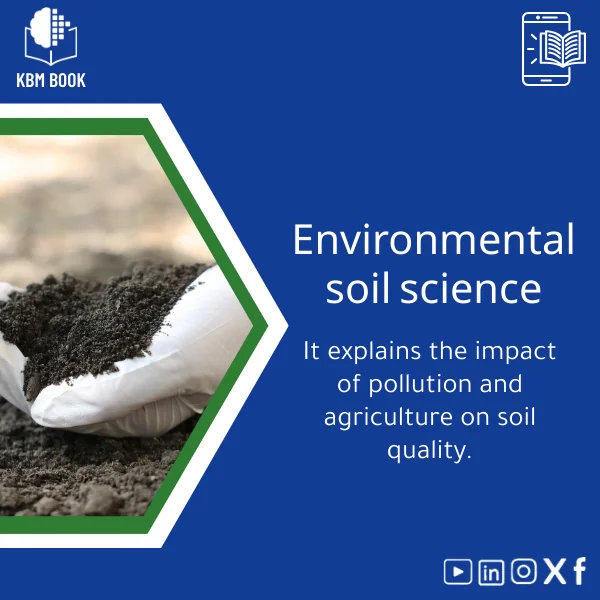
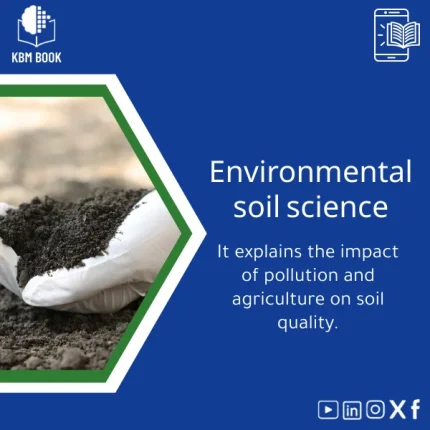
Environmental Soil Science Guide to Soil Quality Impact
Original price was: 179.00 $.139.00 $Current price is: 139.00 $.
A searchable, hierarchical Knowledge Base Module (KBM) that maps how pollution and agricultural practices affect soil quality — designed for students, researchers, and professionals who need fast, reliable access to applied Environmental Soil Science knowledge.
Key benefits & value for the buyer
This Environmental Soil Science KBM turns dispersed academic content and field protocols into an actionable, searchable knowledge database. Every feature is designed to reduce ambiguity and speed decision-making:
From features to real benefits
- Hierarchical taxonomy: Locate concepts (e.g., organic matter fractions → measurement methods → interpretation thresholds) in seconds, not hours.
- Standardized indicators: Use consistent soil quality metrics across reports to improve comparability and credibility in publications.
- Protocol-driven content: Field sampling steps and lab methods are included as checklists, reducing errors and rework during data collection.
- Export-ready formats: Import lists and tables directly into spreadsheets, GIS, or statistical software for instant analysis.
Use cases & real-life scenarios
Graduate student preparing a thesis
Scenario: You need a clear set of soil quality indicators and citation-ready measurement methods for your methodology chapter. The KBM provides a curated list of indicators (pH, CEC, heavy metals thresholds), sample preparation protocols, and primary references — saving days of literature synthesis.
Environmental consultant performing impact assessments
Scenario: You must produce comparable baseline and post-construction soil reports. Use the KBM’s standardized templates and field checklists to ensure consistent sampling, then export clean data for statistical analysis or regulatory reporting.
Agronomist evaluating soil quality in farming
Scenario: Decide which agricultural practices reduce soil quality. The KBM links farming activities (tillage, fertilizer regimes, pesticide use) to measured outcomes (bulk density, organic carbon, nutrient runoff), with actionable guidance to prioritize interventions.
Who is this product for?
This resource is specifically built for:
- Students and instructors in Environmental Soil Science courses looking for an organized teaching/reference module.
- Researchers needing reproducible definitions and protocols for soil pollution and agriculture studies.
- Professionals (consultants, agronomists, environmental officers) who require rapid access to validated soil quality indicators in the field.
How to choose the right KBM version
KBMBook offers the Environmental Soil Science KBM in several packaging options. Choose based on your workflow:
- Student edition: Compact module with core indicators, classroom-ready summaries, and annotated references.
- Research edition: Full taxonomy, raw dataset templates, and extended bibliographies for systematic reviews.
- Professional edition: Includes field checklists, export templates (CSV/Excel), and a team license for multi-user access.
If unsure, select the Research edition for the most comprehensive content — all versions are downloadable and come with clear format descriptions.
Quick comparison with typical alternatives
How this KBM compares to books, scattered articles, and online courses:
- Traditional textbooks: Deep but linear; harder to extract discrete protocols and datasets. KBM provides modular access and direct data exports.
- Journal articles: Specific and narrow. KBM consolidates validated methods and thresholds across studies for practical use.
- Online courses: Interactive learning is valuable, but courses rarely provide ready-to-use hierarchical databases and exportable templates the way KBMs do.
Best practices & tips to get maximum value
- Start with the taxonomy: map your project goals to the KBM’s sections to avoid redundant data collection.
- Use the field checklists verbatim during sampling to ensure reproducibility.
- Export templates early: configure the KBM CSV to match your lab’s data entry format and avoid reformatting later.
- Reference the included primary sources in reports — the KBM is built to make citation simpler, not replace original literature.
Common mistakes when buying/using similar products and how to avoid them
- Mistake: Buying a broad textbook expecting ready-to-use datasets. Fix: Choose the KBM for structured data and export formats.
- Mistake: Ignoring field protocols and relying on summary metrics. Fix: Follow the included sampling checklists to avoid invalid data.
- Mistake: Assuming single-format delivery. Fix: Verify format compatibility (CSV/Excel/JSON) before purchase — our spec list shows formats.
Product specifications
- Product type: Knowledge Base Module (KBM) — Environmental Soil Science
- Topic focus: Soil pollution and agriculture; soil quality in farming; measurement protocols; indicator taxonomy
- Formats included: CSV, XLSX (Excel), KBM JSON (structured), printable PDF summaries
- Language: English
- Delivery: Instant download after purchase (zip file with all formats)
- Compatibility: Importable to Excel, R, Python (pandas), QGIS and common database tools
- License options: Single-user, multi-user/team license (details at checkout)
- File size: Approximately 4–25 MB depending on edition
- Updates: Periodic updates and errata published via KBMBook update channel
Frequently asked questions
What formats are included and will they work with my analysis tools?
The KBM includes CSV and XLSX files for immediate use in Excel, R, Python (pandas), and most GIS tools. The KBM JSON is structured for programmatic import into databases and custom apps.
How reliable and up-to-date is the content?
Content is curated from peer-reviewed studies, standard methods, and regulatory guidance. We maintain an update log; Research and Professional editions receive periodic updates when key methods or thresholds change.
Can I use KBM content in a report or publish it?
Yes — the KBM is designed for practical use. You may include data and methods in reports; please follow the license terms and cite KBMBook and the primary sources included in each module.
What if the format doesn’t fit my workflow?
Choose the edition that best matches your needs (Student, Research, Professional). If you need a custom format for a team, contact support for assistance before purchase to confirm compatibility.
Ready to streamline your Environmental Soil Science work?
Download a structured, citation-ready knowledge base that maps soil pollution and agricultural impacts to measurable soil quality indicators. Immediate access — no waiting for shipping or scanning dense textbooks.
Still unsure? Review the product specifications above and choose the Student or Research edition to test the KBM structure before upgrading.
Related products
Biological Anthropology Study Guide on Human Evolution
Cell Biology Guide: Structure, Division, and Transport Insights

Comprehensive Nuclear Physics Book on Structure and Radioactivity

Electromagnetism Book: A Comprehensive Guide to Fields and Circuits

General Physics Book: Fundamentals of Force, Motion, Energy
Introductory General Chemistry Book on Matter and Reactions
A structured, searchable Knowledge Base Module (KBM) that converts core general chemistry concepts — matter, elements, reactions, stoichiometry and molarity — into a hierarchical reference you can query, teach from, or integrate into study workflows. Ideal as a concise General Chemistry book alternative for students, researchers, and professionals who need accurate, practical chemistry knowledge fast.
Reviews
Clear filtersThere are no reviews yet.