


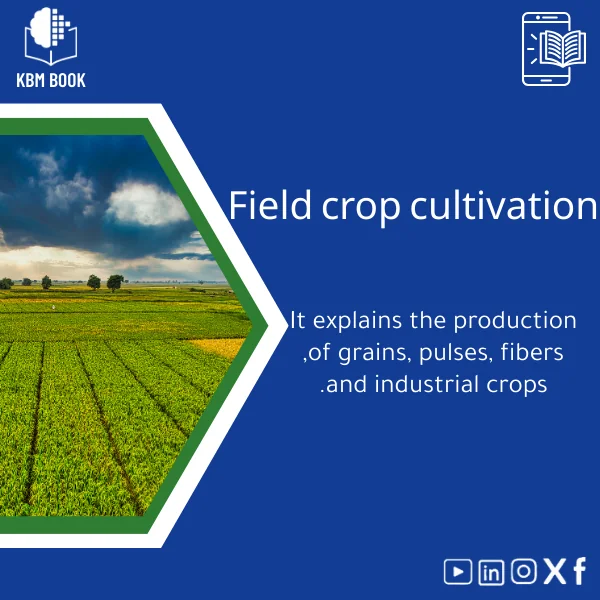
Field Crop Production Guide for Cereal and Legume Farming
Original price was: 179.00 $.139.00 $Current price is: 139.00 $.
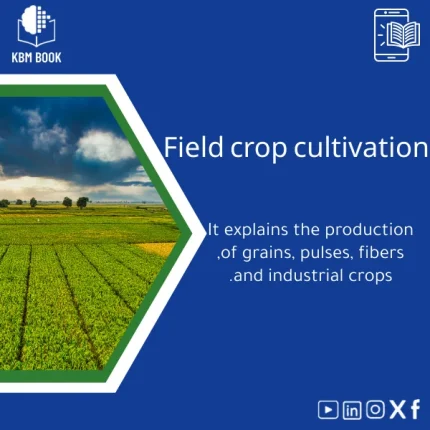
A structured, searchable knowledge base module for field crop production: clear, hierarchical coverage of cereals, legumes, fibers, and industrial crops so students, researchers, and professionals can find reliable technical guidance fast and apply it in the field, lab, or classroom.
Key benefits & value for the buyer
The Field Crop Production KBM translates technical knowledge into tools you can use immediately. Features are framed as benefits so you know what you get and why it matters:
Fast retrieval — less time searching, more time implementing
Because the content is organized hierarchically and tagged, you can locate sowing depth, fertilizer rate, or pest thresholds in seconds — a major advantage for field visits, lab sessions, or literature reviews.
Actionable protocols — reduce decision uncertainty
Step-by-step planting schedules, integrated pest management (IPM) decision trees, and post-harvest handling checklists let practitioners move from guidelines to action without reinterpreting academic prose.
Reliable references — use in reports and teaching
Every technical recommendation is cross-referenced to primary sources and trial results, making this KBM suitable for coursework, research methods sections, and extension bulletins.
Use cases & real-life scenarios
Undergraduate and graduate coursework
Instructors can pull module sections to build lectures (e.g., cereal physiology), export CSV tables for lab exercises, or assign specific KBM submodules for student projects.
Field research and trials
Researchers use the KBM to standardize plot layout, sampling frequency, and statistical note templates — improving repeatability across seasons and sites.
Extension and farm advisory
Extension agents rely on compact checklists and decision trees (e.g., nitrogen split timing, inoculation protocols for legumes) to give consistent, evidence-based advice to growers.
Commercial agronomy and supply chain
Crop managers and agronomists integrate the KBM’s pest thresholds and quality metrics into monitoring systems and post-harvest SOPs for fiber and industrial crops.
Who is this product for?
This KBM was designed specifically for students, researchers, and professionals who need a reliable, searchable repository of field crop production knowledge.
- Undergraduate and graduate students studying agronomy, crop science, or plant production.
- Researchers conducting trials with cereals, legumes, fibers, or industrial crops.
- Agronomists, extension officers, and farm managers needing quick access to protocols on the job.
- Trainers and curriculum designers looking for modular teaching materials.
How to choose the right KBM version
We provide tiered KBM packages to match the scope of your work. Choose based on depth, file formats, and licensing needs:
Compact (Student)
Core concepts, summary tables, printable checklists — best for coursework and quick revision.
Standard (Research & Practice)
Full protocols, data templates, and references — ideal for researchers and extension services.
Comprehensive (Institutional)
Includes editable CSVs, bulk export, and multi-user license suitable for departments, training centers, or consultancies.
If price or format is a concern, choose the Standard edition — it balances depth and cost for most professionals. Institutional buyers can request a sample module before committing.
Quick comparison with typical alternatives
How this KBM differs from books, articles, or online courses:
- Versus textbooks: More modular and searchable; textbooks are linear, KBMs are database-style and ready to extract into workflows.
- Versus journal articles: Articles are specific; the KBM synthesizes multiple studies into practical protocols and decision aids.
- Versus courses: Courses teach; KBMs provide the durable reference materials and templates you continue to use after training ends.
Best practices & tips to get maximum value
- Start with the decision-tree modules for pest and nutrient management to set your seasonal plan.
- Export CSV templates into your trial software to standardize data collection across sites.
- Use the printable checklists for field crews — reduce variability in operations and sampling.
- Cross-reference KBM citations when writing reports to improve credibility and reproducibility.
Common mistakes when buying or using crop production resources — and how to avoid them
Buyers often choose materials that are too general, not actionable, or too fragmented. Avoid these mistakes:
- Purchasing single-topic PDFs only — prefer modular KBMs that cover linked topics (e.g., soil fertility + crop rotation).
- Assuming one-size-fits-all recommendations — use the KBM’s localized adjustment notes and sampling guidelines.
- Ignoring data export formats — if you plan to analyze field data, ensure CSV/Excel templates are included (they are, in Standard and Comprehensive editions).
Product specifications
- Title: Field Crop Production Guide for Cereal and Legume Farming
- Scope: Cereals, legumes, fiber crops, and selected industrial crops — physiology, agronomy, pest & disease, post-harvest.
- Structure: Hierarchical KBM with modules, submodules, decision trees, and cross-references.
- Formats: PDF (textbook export), CSV/Excel data templates, printable checklists (PDF), and indexed HTML for on-screen search.
- Language: English (technical Arabic notes available in selected modules on request).
- License: Single-user (Student/Standard) or multi-user institutional license (Comprehensive).
- Delivery: Instant download after purchase; sample preview available.
- Updates: One year of free content updates with Standard and Comprehensive editions.
Frequently asked questions
Is this a traditional book or a database?
This is a Knowledge Base Module (KBM): a structured, searchable database with a textbook-style PDF export. It is designed to be both a reference and a set of practical tools (templates, checklists, decision trees).
Can I use the templates for field trial data collection?
Yes. The KBM includes CSV/Excel templates and sampling plans intended for field trials. The Comprehensive edition includes editable templates for integration with most data-collection platforms.
How current is the evidence and can I cite it?
Content is synthesized from applied research and extension literature. Modules include citations and recommended reading so you can cite primary sources in reports and publications.
What if I need regional adaptation (climate, varieties)?
The KBM contains adjustment index tables and guidance on calibrating recommendations to local climate zones and crop varieties. For institutional purchases, we offer consultancy add-ons to localize content.
What if I’m unsure which edition to buy?
Download the free sample module to evaluate the structure. For most users, the Standard edition delivers full practical value at a reasonable price; upgrade if you need multi-user licensing or editable bulk exports.
Ready to streamline your field crop production knowledge?
Get a KBM that works like a professional reference and an operational toolkit. Trusted by instructors, researchers, and agronomists who need fast, reliable access to crop production guidance.
Prefer a sample or institutional quote? Contact KBMBook support for a preview or license consultation before purchasing.
Related products
Biological Anthropology Study Guide on Human Evolution

Cell Biology Guide: Structure, Division, and Transport Insights
Comprehensive Genetics Book: DNA, Mendelian Genetics & Engineering
A structured, searchable knowledge base module (KBM) that turns genetics theory and practice into an immediately usable digital reference — from DNA structure to Mendelian genetics and contemporary genetic engineering techniques — optimized for students, researchers, and professionals who need reliable answers fast.

Electromagnetism Book: A Comprehensive Guide to Fields and Circuits

General Physics Book: Fundamentals of Force, Motion, Energy

Materials Physics Guide: Understanding Solid-State Properties

Molecular Biology Guide: Transcription, Translation & Repair
Thermal Physics Guide: Understanding Heat, Energy, and Entropy
A downloadable, hierarchically structured Knowledge Base Module (KBM) that converts university-level thermodynamics into a searchable, practical digital database. Ideal for students, researchers, and professionals who need fast, reliable access to fundamentals and advanced topics in thermal physics.
Reviews
Clear filtersThere are no reviews yet.