


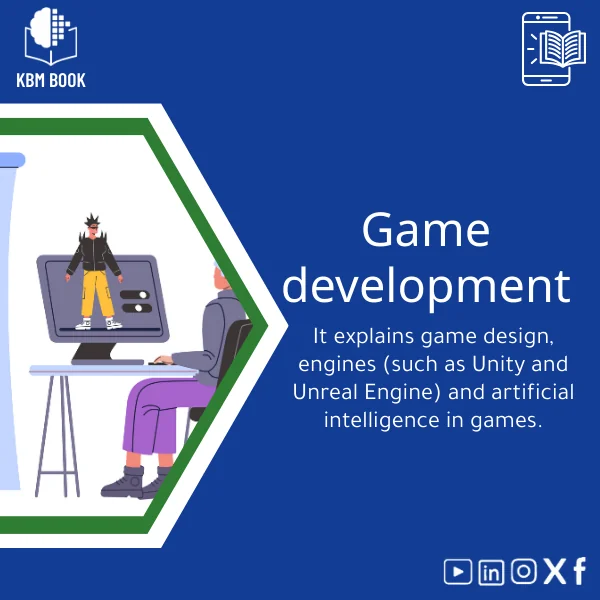
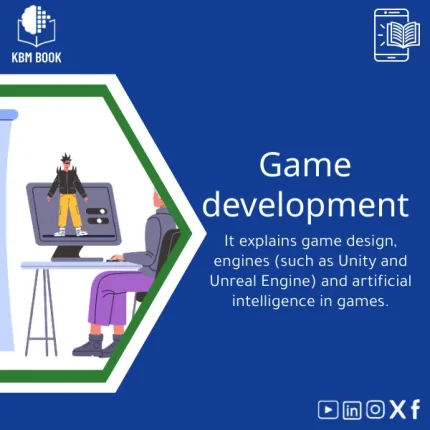
Game Development Guide: Design, Unity, Unreal, and AI Techniques
Original price was: 199.00 $.159.00 $Current price is: 159.00 $.
A structured, searchable knowledge base module that teaches practical game development: from core game design principles to Unity and Unreal workflows and game AI fundamentals — organized for fast lookup, project implementation, and teaching.
Key benefits & value for the buyer
This KBM converts scattered resources into a single, accurate, and searchable knowledge database for game development. Each feature below is mapped to the buyer benefit so you can decide quickly whether it fits your workflow.
From theory to implementation
Instead of a long narrative, the KBM breaks down game design into practical decision trees: mechanics, balancing, player feedback loops, and iterative playtesting templates — so you implement faster and avoid common design dead-ends.
Engine-ready guidance
Unity and Unreal sections provide step-by-step setups, recommended project structures, and code snippets for common systems (input, camera, UI, save/load). Benefit: reduce setup time and standardize projects across teams or courses.
Game AI made actionable
Game AI fundamentals are presented as patterns (finite state machines, behavior trees, steering, pathfinding) with practical pseudo-code and tuning checklists — useful for both academic experiments and production prototypes.
Searchable, exportable, and reusable
Delivered in searchable PDF and machine-readable JSON/CSV, the KBM is built to be imported into IDE helpers, LMS platforms, or your personal knowledge manager — saving you hours of manual extraction.
Use cases & real-life scenarios
Student preparing a practical assignment
Use the “Project checklist” module to scope a prototype in one afternoon: design brief, minimal viable mechanics, engine selection guide, and a sprint plan with deliverables.
Researcher building a reproducible experiment
The KBM supplies reproducible AI experiments: environment setups, parameter tables, data-collection templates, and suggested evaluation metrics — so you can replicate or extend studies without rebuilding infrastructure.
Professional developer or instructor
Integrate engine workflows into your studio’s onboarding or your course syllabus. Reuse the lesson outlines, lab tasks, and grading rubrics already organized in the KBM.
Who is this product for?
- Computer science and game design students who want a practical companion to classroom theory.
- Researchers needing structured documentation and reproducible experiment blueprints in game AI.
- Indie and professional developers looking for engine-specific best practices and quick reference snippets.
- Instructors and trainers building curricula or workshops on game development.
How to choose the right KBM for your needs
This module is focused on multi-disciplinary coverage: design, Unity, Unreal, and AI. Choose it if:
- You need both engine-specific implementation and general game design theory in one package.
- You want exportable formats to integrate with tools or courseware.
- You prefer hierarchical learning (beginner → intermediate → advanced) rather than long-form prose.
If your work is exclusively engine-specific (only Unity or only Unreal), check that the KBM sections map to your exact version or toolchain; export snippets in the provided formats for quick import.
Quick comparison with typical alternatives
Typical options: textbooks, scattered tutorials, or forum threads. How this KBM differs:
- Textbooks: deep but linear and hard to search. KBM offers the same depth with a search-first structure.
- Tutorials: quick fixes but inconsistent. KBM provides validated, repeatable workflows and checklists.
- Forum threads: fragmented and temporary. KBM is curated, versioned, and exportable for long-term use.
Best practices & tips to get maximum value
- Start with the project checklist to scope prototype goals before diving into engine details.
- Use the JSON export to import snippets into your IDE snippets manager or continuous integration docs.
- Follow the “design → prototype → test” pathway in the KBM for each new mechanic to keep iterations small and measurable.
- Pair AI pattern examples with the included tuning tables to avoid common performance pitfalls in simulations.
Common mistakes when buying or using similar products — and how to avoid them
- Buying a single-engine guide when you work across engines: choose a multi-engine KBM like this one to maintain consistency.
- Expecting a tutorial instead of a structured database: KBMs are reference-first; start with checklists before following full examples.
- Not checking formats: confirm the KBM exports (PDF/JSON/CSV) match your tooling — this product includes those formats to avoid compatibility surprises.
Product specifications
- Title: Game Development Guide: Design, Unity, Unreal, and AI Techniques
- Format: Searchable PDF + structured JSON and CSV export (engine snippets, checklists, metadata)
- Scope: Design principles, Unity workflows, Unreal workflows, Game AI fundamentals and patterns
- Content size: Hierarchical KBM with chapters and submodules (design templates, 40+ engine recipes, 30+ AI patterns)
- Delivery: Instant digital download with usage instructions
- License: Single-user and optional team license (details included in download)
- Updates: Includes minor content updates for 6 months from purchase
- Usage notes: Compatible with knowledge managers and can be integrated into LMS/IDE via JSON import
Frequently asked questions
Is this a book or a searchable database? Can I get a PDF?
This product is a Knowledge Base Module (KBM): a structured, searchable database packaged with a readable PDF. You get both — the PDF for quick reading and the JSON/CSV for integration and search.
Can I use the code snippets in my commercial projects?
Yes — snippets and checklists are provided under a permissive license for implementation. See the license file included in your download for exact terms, and consider the optional team license if you plan wide distribution.
Which engine versions are supported for Unity and Unreal guidance?
The KBM focuses on current common workflows (Unity 2020+ and Unreal 4/5 patterns). Code is written in version-agnostic style where possible and includes notes on version-specific adjustments.
What if I need updates or further support?
Purchase includes 6 months of minor content updates and a setup guide. Technical support and extended update plans are available as paid options.
Ready to accelerate your game development workflow?
Get the Game Development KBM now and replace scattered resources with a single, reusable knowledge base that speeds up prototyping, teaching, and research.
Instant download — includes searchable PDF and structured exports (JSON/CSV). Secure checkout and immediate access.
Related products
Biochemistry Book: Understanding Chemical Processes in Living Systems
Classical Mechanics Guide: Newton’s Laws and Dynamics
A searchable, hierarchical Knowledge Base Module (KBM) that turns classical mechanics into a practical, ready-to-use reference for fast problem solving, lecture preparation, and applied engineering. Designed for students, researchers, and professionals who need precise access to Newton’s laws, rotational motion, and applied dynamics without the noise of textbooks.

Comprehensive Botany Book on Plant Taxonomy and Photosynthesis
A structured, searchable botany book designed as a Knowledge Base Module (KBM) — an end-to-end reference on plant taxonomy, organ structure, and the biochemistry of photosynthesis. Built for students, researchers, and professionals who need reliable, hierarchical knowledge they can search, cite, and apply immediately.
Cosmology Book: Guide to Big Bang and Galaxy Evolution
General and Special Relativity Book on Einstein’s Theory
A structured, searchable Knowledge Base Module (KBM) that converts Einstein's General and Special Relativity into a clear, hierarchical reference: formulas, derivations, worked examples, practical applications (GPS, astrophysics), and a compact research bibliography — ready to download and integrate into study, teaching, or research workflows.

Materials Physics Guide: Understanding Solid-State Properties

Molecular Biology Guide: Transcription, Translation & Repair
Physical Chemistry Guide: Energy, Thermodynamics & Interactions
A structured Knowledge Base Module (KBM) for Physical Chemistry that converts core theory, worked examples, and applied datasets into a searchable, hierarchical database — ideal for students, researchers, and professionals who need fast, reliable access to chemical thermodynamics basics and molecular interaction models.
Reviews
Clear filtersThere are no reviews yet.