


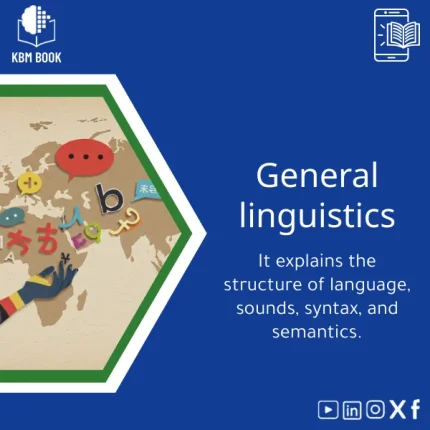
General Linguistics Guide: Understanding Sounds, Structure, and Meaning
Original price was: 199.00 $.159.00 $Current price is: 159.00 $.
A searchable, hierarchical Knowledge Base Module (KBM) that condenses general linguistics — phonetics, phonology, morphology, syntax, semantics, and pragmatics — into a structured, practice-ready database for students, researchers, and professionals who need fast, reliable access to language knowledge.
Key benefits & value for the buyer
This KBM transforms “general linguistics” knowledge into a usable tool rather than a static text. Benefits translate features into measurable outcomes:
- Faster study and revision: Locate definitions, paradigms, and worked examples in seconds versus scanning multiple chapters.
- Reliable academic support: Entries include sources and recommended readings so you can cite or verify claims quickly.
- Reusable data for projects: Export morphological tables, phoneme inventories, and syntactic templates directly into analysis workflows.
- Consistent learning path: Hierarchical modules guide beginners to advanced topics in logical order — useful for self-study or syllabus design.
Use cases & real-life scenarios
Students — exam prep and assignments
A BA or MA student can extract concise summaries of phonological rules, download example sets for problem sets, and produce citation-ready notes for essays.
Researchers — reference and reproducibility
Researchers designing an experiment can quickly pull standardized feature lists (e.g., vowel formant categories), reference original sources, and export structured data for computational models.
Professionals — language technology and pedagogy
Speech technologists and curriculum designers use the KBM to populate annotation schemas, build training data categories, or construct modular lesson plans aligned by competence level.
Trainers & instructors
Lecturers can assemble a syllabus by combining KBM modules, avoid repeating content, and provide students with a single, organized resource that scales with class needs.
Who is this product for?
Designed for anyone who needs dependable, structured knowledge in linguistics rather than narrative textbooks:
- Undergraduate and graduate students preparing for exams or writing theses.
- Academic researchers requiring compact references and exportable data.
- Language technology developers needing standardized feature sets.
- Teachers and trainers building course materials without starting from scratch.
How to choose the right KBM (scope & format)
Since KBMs come in different depths and file formats, pick based on your workflow:
- Level: Choose “Introductory” if you need core principles and examples; “Comprehensive” if you require advanced paradigms, cross-linguistic databases, and extended citations.
- Format: Use CSV/JSON for computational work, Excel for manual data manipulation, Notion import for teaching, and PDF for quick printable references.
- Integration: If you use code or corpora, prefer the JSON/SQLite export to plug into processing scripts directly.
Not sure which to pick? The product page includes format details and a sample file — inspect the preview to confirm fit before purchase.
Quick comparison with typical alternatives
How this KBM differs from common options:
- Traditional textbooks: Textbooks provide narrative depth but are not searchable databases. The KBM provides modular, queryable entries and exportable data.
- Lecture slides and notes: Often fragmented and instructor-specific. The KBM is organized, cross-referenced, and citation-backed.
- Online articles and wikis: Good for single topics but lack structured hierarchy and reliable export formats. KBM consolidates verified content into a consistent taxonomy.
Best practices & tips to get maximum value
- Start with the “Foundations” module for a clear roadmap; then layer advanced modules as needed.
- Use the internal tags (phonetics, morphology, syntax, semantics, pragmatics) to quickly filter entries for assignments.
- Export relevant tables into your analysis environment before data cleaning — the KBM uses normalized fields to speed this step.
- Cross-link this KBM with related KBMs (e.g., Sociolinguistics or Psycholinguistics modules) to build a discipline-wide reference system.
Common mistakes when buying/using linguistics resources — and how to avoid them
- Buying unfocused collections: Avoid bundles without hierarchy. Prefer KBMs with clear scope and modular navigation.
- Ignoring format needs: Confirm export formats before purchase if you plan to run scripts or import to a learning platform.
- Skipping source checks: Choose KBMs that include references so you can verify claims in academic work.
Product specifications
- Title: General Linguistics Guide — hierarchical KBM
- Scope: Phonetics, Phonology, Morphology, Syntax, Semantics, Pragmatics, Typology, Applied notes
- Depth: Introductory → Advanced modules (multi-level hierarchy)
- Formats included: CSV, JSON, Excel (.xlsx), SQLite export, Markdown summary, PDF quick-reference
- Entries: Definitions, formal rules, worked examples, cross-linguistic tables, source citations
- Compatibility: Import-ready for Notion, Excel, common database tools, and research scripts
- License: Single-user academic and professional use (export and citation allowed); commercial site redistribution requires a separate license (see product terms)
- Delivery: Immediate digital download with sample preview available
FAQ
Is this KBM suitable as an “introduction to linguistics” for beginners?
Yes. The KBM includes a Foundations module that covers core definitions, key distinctions (e.g., phonetics vs. phonology), and stepwise examples. Beginners can follow the structured learning path; advanced users can skip to specific modules.
What sources and references are used? Are entries citable?
Each entry includes concise citations and recommended readings drawn from established textbooks and peer-reviewed sources. The KBM is designed to be citation-ready for academic work; always follow your institution’s citation policies.
Which file formats work with my tools (Notion, Excel, Python)?
Exports include CSV and Excel for spreadsheets, JSON and SQLite for programmatic use, and Markdown/PDF for documentation. Notion imports work via CSV/Markdown. If you need a custom format, contact support for options.
What is the refund or update policy?
Digital purchases include immediate download and access to minor updates for 12 months. Refunds are handled case-by-case if the product does not match the described features; see the product page terms for details.
Ready to turn linguistics knowledge into usable data?
Purchase the General Linguistics KBM to get a searchable, exportable, and citation-ready database that saves study time and supports research workflows.
Instant digital download. Includes CSV, JSON, Excel, SQLite, Markdown, and PDF exports — plus a sample preview so you can inspect structure before you commit.
Related products
Astronomy Observational Techniques Guide for Celestial Motion
Atomic Physics Guide: Understanding Atomic and Electron Properties
Knowledge Base — Atomic/Electron Properties & Electromagnetic Interactions. A structured, searchable KBM for students, researchers, and professionals who need an authoritative atomic physics reference that organizes concepts, formulas, experiments, and practical applications from basics of atomic physics to advanced electron properties.
Classical Mechanics Guide: Newton’s Laws and Dynamics
A searchable, hierarchical Knowledge Base Module (KBM) that turns classical mechanics into a practical, ready-to-use reference for fast problem solving, lecture preparation, and applied engineering. Designed for students, researchers, and professionals who need precise access to Newton’s laws, rotational motion, and applied dynamics without the noise of textbooks.
Comprehensive Evolutionary Biology Book on Natural Selection
Comprehensive Nuclear Physics Book on Structure and Radioactivity
General and Special Relativity Book on Einstein’s Theory
A structured, searchable Knowledge Base Module (KBM) that converts Einstein's General and Special Relativity into a clear, hierarchical reference: formulas, derivations, worked examples, practical applications (GPS, astrophysics), and a compact research bibliography — ready to download and integrate into study, teaching, or research workflows.

Reviews
Clear filtersThere are no reviews yet.