


General Programming Basics Guide: Data Types, Loops, and Conditionals
Original price was: 139.00 $.99.00 $Current price is: 99.00 $.
A compact, hierarchically organized Knowledge Base Module (KBM) that turns core General Programming concepts into a searchable, practical database — ideal for students, researchers, and professionals who need quick, reliable access to programming fundamentals: data types, loops, and conditionals explained with examples and ready-to-use references.
Key benefits & value for the buyer
This KBM condenses “General Programming” fundamentals into an actionable, non-redundant reference. Instead of reading long chapters or scattered blog posts, you get:
- Time savings: Instant lookup for types, loop patterns, and conditional logic across popular languages.
- Clarity: Concise definitions followed by canonical examples and pitfalls to avoid.
- Practical outcomes: Exercises and mini-project prompts you can reuse in courses or research labs.
- Portability: Download a general programming book pdf style file for offline study and a structured dataset for integration into tools.
The KBM approach reduces repetition and presents content in a layered sequence: concept → example → pattern → practice.
Use cases & real-life scenarios
For students
When preparing for exams or labs, use the KBM to review type systems (primitive vs composite), compare loop constructs (for, while, foreach), and rehearse condition combinations with truth tables and short exercises.
For researchers
Integrate the structured database into note-taking tools or experiment logs to standardize how algorithms are prototyped and described across teams.
For professionals & instructors
Reuse examples as starter code, embed the KBM’s exercise sets in training, or extract CSV tables to populate learning management systems. The KBM is especially handy for onboarding new hires to a team’s coding standards.
Example scenario: a lecturer converts the KBM snippet on loop invariants into a 15-minute in-class exercise, saving preparation time while ensuring accuracy.
Who is this product for?
- Students learning to learn programming from scratch — clear building blocks and exercises.
- Researchers documenting experiments where reproducible code patterns are required.
- Professionals teaching or packaging training materials for junior engineers.
- Self-learners who want a reliable programming basics for beginners resource without fluff.
How to choose the right format & license
The KBM is available in multiple delivery formats. Choose based on your workflow:
- Searchable PDF (recommended): Best for offline study, printing, and citation. Ideal for students and lecturers.
- Structured CSV / JSON export: For researchers and developers who want to import the KBM into tools, LMS, or local databases.
- Single-user license: Personal study and internal research use.
- Team license: Multi-seat use in classrooms or professional teams — includes redistribution rights for course materials.
Not sure which to pick? Start with the PDF for immediate learning; upgrade to a structured export if you need integration.
Quick comparison with typical alternatives
Alternatives include textbooks, blog tutorials, and video courses. Compared to each:
- Textbooks: Often broader but less searchable; KBM focuses on concise, hands-on modules.
- Blogs: Fragmented and inconsistent; KBM provides a curated, consistent taxonomy with verified examples.
- Video courses: Great for demonstrations but slow to skim; KBM excels at quick lookups and reuse of snippets.
If you need a practical, reusable reference rather than a long narrative, the KBM is the more efficient choice.
Best practices & tips to get maximum value
- Start with the “Core Concepts” module, then move to “Patterns” and “Exercises”.
- Use the searchable PDF for quick reminders during coding; extract CSV tables when building a course syllabus.
- Integrate KBM snippets into version-controlled documentation to keep examples consistent across projects.
- Practice one small exercise daily from the KBM to solidify habits — five focused repetitions produce faster retention than passive reading.
Common mistakes when buying/using similar resources and how to avoid them
- Mistake: Choosing a resource that’s too broad. Fix: Pick this KBM for core discipline-focused coverage without unnecessary topics.
- Mistake: Relying solely on videos for exam prep. Fix: Combine the KBM’s concise examples with short coding exercises.
- Mistake: Ignoring format compatibility. Fix: Verify the required delivery format (PDF vs structured export) before purchasing.
Product specifications
- Title: General Programming Basics Guide — Data Types, Loops, and Conditionals
- Format options: Searchable PDF, CSV export, JSON export
- Length: ~60 modular pages (concise modules and examples)
- Language: English (clear technical English for international students)
- Delivery: Instant download after purchase
- Licensing: Single-user and multi-user team licenses available
- Usage notes: Code examples are language-agnostic with annotations for Python, Java/C-style, and pseudocode
Frequently asked questions
Can I get this KBM as a general programming book pdf?
Yes. A searchable PDF version is available for immediate download. It is optimized for fast lookup and printing, and includes a linked table of contents and indexed terms for quick access.
Is the content suitable for absolute beginners who want to learn programming from scratch?
Yes. Modules begin with fundamentals (types, control flow) and include step-by-step examples and exercises labeled for beginner, intermediate, and advanced levels. The KBM is ideal as a first structured reference for self-learners.
What if I need updates or corrections later?
Purchases include minor updates for six months. Larger revisions or additional modules are offered as discounted upgrades. Each listing specifies the update policy at checkout.
Will examples work in my preferred programming language?
Examples are presented in language-agnostic pseudocode plus annotated versions in common languages (Python and C-style syntax). The KBM focuses on concepts that translate across languages.
Ready to stop searching and start building?
Purchase the KBM now to get an instantly downloadable, well-structured reference for programming basics that saves time, reduces errors, and supports teaching and research workflows.
Not sure yet? The PDF preview includes the full table of contents and one complete module so you can verify depth and style before committing.
Related products
Analytical Chemistry Book: Qualitative and Quantitative Methods Guide
Atomic Physics Guide: Understanding Atomic and Electron Properties
Knowledge Base — Atomic/Electron Properties & Electromagnetic Interactions. A structured, searchable KBM for students, researchers, and professionals who need an authoritative atomic physics reference that organizes concepts, formulas, experiments, and practical applications from basics of atomic physics to advanced electron properties.
Classical Mechanics Guide: Newton’s Laws and Dynamics
A searchable, hierarchical Knowledge Base Module (KBM) that turns classical mechanics into a practical, ready-to-use reference for fast problem solving, lecture preparation, and applied engineering. Designed for students, researchers, and professionals who need precise access to Newton’s laws, rotational motion, and applied dynamics without the noise of textbooks.
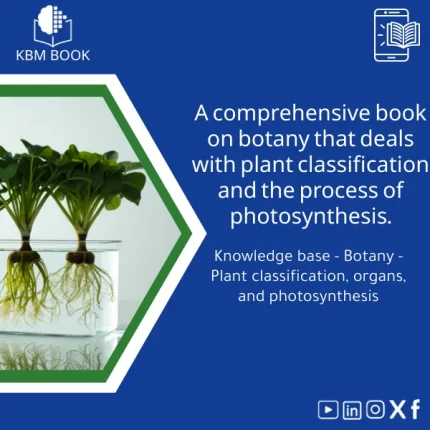
Comprehensive Botany Book on Plant Taxonomy and Photosynthesis
A structured, searchable botany book designed as a Knowledge Base Module (KBM) — an end-to-end reference on plant taxonomy, organ structure, and the biochemistry of photosynthesis. Built for students, researchers, and professionals who need reliable, hierarchical knowledge they can search, cite, and apply immediately.
Electromagnetism Book: A Comprehensive Guide to Fields and Circuits
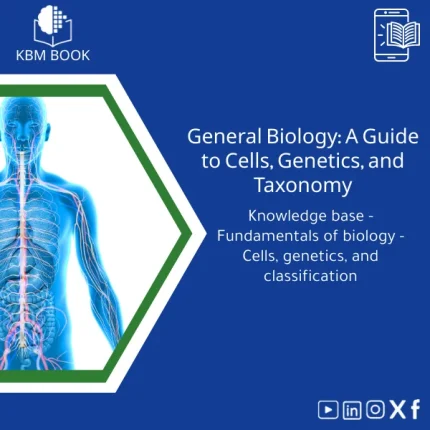
General Biology Book: A Guide to Cells, Genetics & Taxonomy
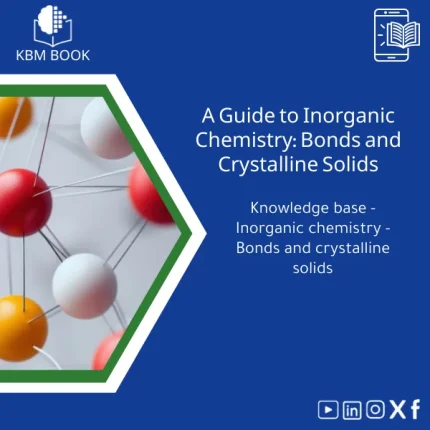
Inorganic Chemistry Guide: Bonding and Crystal Solids
A structured, searchable Knowledge Base Module (KBM) that converts inorganic chemistry fundamentals and advanced topics—bonding models, lattice structures, defects, and solid-state properties—into a practical digital reference for students, researchers, and professionals who need fast, reliable answers without wading through textbooks.
Reviews
Clear filtersThere are no reviews yet.