


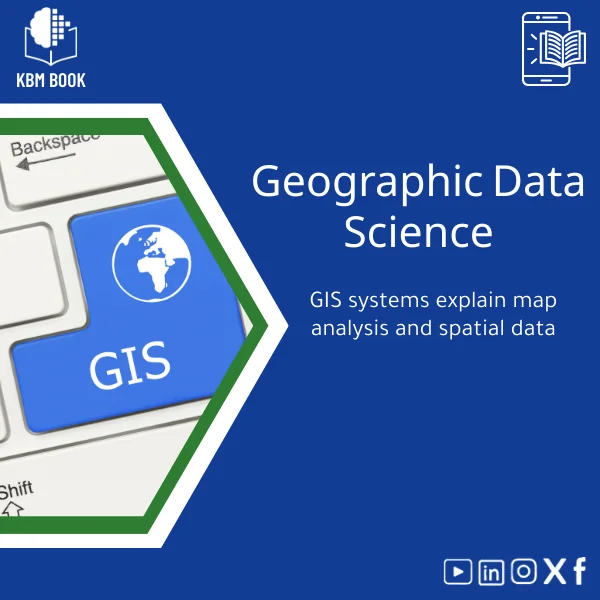
Geospatial Data Science Course: Master GIS and Spatial Analysis
Original price was: 179.00 $.139.00 $Current price is: 139.00 $.
A structured, searchable Knowledge Base Module (KBM) that turns Geospatial Data Science — GIS, spatial data, mapping and spatial analysis — into a practical, step-by-step digital reference you can use for coursework, research, or production projects.
Key benefits & value for the buyer
The Geospatial Data Science KBM is built to reduce time-to-insight. Instead of reading multiple books or searching scattered blog posts, you get a compact, validated database of knowledge that supports both learning and practical application.
What you gain (feature → benefit)
- Hierarchical, linked entries → Find the right concept quickly, from “coordinate reference systems” to “spatial join algorithms”.
- Code + expected output → Run Python/SQL snippets and verify results without hunting for sample data.
- Compact, exportable modules → Integrate sections directly into your notes, LMS, or lab assignments.
- Applied examples → Real datasets and step-by-step case studies (urban planning, ecology, network analysis) so you can replicate workflows.
Use cases & real-life scenarios
The KBM is designed to be used immediately in tasks where accuracy and speed matter.
Student thesis or coursework
Extract a literature-backed methodology for spatial interpolation, copy reproducible code to preprocess your sample, and cite the procedure — saving weeks of trial-and-error.
Research & reproducible analysis
Standardise geoprocessing steps (projection, resampling, validation) across collaborators by sharing KBM modules. Use the documented test cases to verify that results match expected outputs.
Professional projects
Analysts and consultants can use ready templates for network accessibility, site suitability, and hazard mapping — reducing delivery time and ensuring consistent quality.
Who is this product for?
Geospatial Data Science is for anyone who needs structured, reliable GIS knowledge without sifting through dense textbooks or fragmented online tutorials.
- Undergraduate & graduate students in computer science, geography, environmental science.
- Researchers needing reproducible spatial workflows and quick references.
- Data analysts, GIS specialists, urban planners, and environmental consultants.
- Trainers and instructors building lab exercises or course curricula.
How to choose the right version
KBMs are organized by depth. Choose based on your time, prior knowledge, and intended use.
- Essentials: Core concepts, coordinate systems, basic QGIS & GeoPandas recipes — ideal for beginners or course supplements.
- Comprehensive: Adds intermediate spatial analysis, raster/vector workflows, and case studies — suitable for thesis work and applied research.
- Professional: Full set with advanced modelling, PostGIS optimization, automation scripts, and enterprise-ready templates — for production teams and consultants.
If unsure, start with Essentials and upgrade — KBM modules are modular and designed to combine without duplication.
Quick comparison with typical alternatives
Choose the KBM when you need searchable, reusable knowledge rather than passive reading.
- Books: Deep, but linear and slow to search. KBM is structured for lookup and re-use.
- MOOCs: Great for guided learning but often lack compact reference material you can import into projects.
- Blog posts/StackOverflow: Fragmented and sometimes contradictory. KBM provides vetted, consistent entries with testing notes.
- Raw datasets: Useful for experimentation but lack the procedural knowledge KBM provides.
Best practices & tips to get maximum value
- Start with the concept map in the KBM to identify the minimal subset you need for a task.
- Run the included sample scripts and compare outputs with the provided validation cases.
- Integrate modules into your version control (Git) and document any local changes for reproducibility.
- Use the exportable GeoJSON/CSV examples to test GIS tools before applying them to production data.
Common mistakes when buying or using similar resources — and how to avoid them
- Buying a single-format PDF: Avoid if you need machine-readable snippets. Choose KBM with exportable code and data samples.
- Skipping validation: Many tutorials lack expected results. Use KBM’s test cases to ensure correctness.
- Mixing inconsistent sources: Relying on fragmented guides leads to errors (wrong CRS handling, double-projection). KBM resolves these with consistent, hierarchical rules.
Product specifications
- Product type: Knowledge Base Module (KBM) — Geospatial Data Science
- Formats included: Searchable JSON, Markdown sections, downloadable code snippets (Python, SQL), sample GeoJSON/CSV
- Structure: Hierarchical topics (Beginner → Advanced) with linked references and practical exercises
- Language: English (technical terms standardized)
- Delivery: Instant digital download after purchase
- License: Personal and educational use; contact KBMBook for site-wide or commercial team licenses
- Compatibility: Works with any text editor, standard GIS tools (QGIS, ArcGIS, GeoPandas, PostGIS)
Frequently asked questions
Is this KBM suitable if I have no GIS background?
Yes. The Essentials module explains spatial fundamentals, coordinate systems and basic mapping before moving to hands-on recipes. If you’re a complete beginner, start with Essentials and use the exercises to build practical skills.
Can I use the code examples in my research or professional projects?
Yes. Code snippets and templates are provided for immediate use. The KBM is designed to be incorporated into research workflows; check the license for commercial deployments and contact KBMBook for team licensing options.
Do you provide sample datasets?
Each practical module includes small sample GeoJSON/CSV files and links to public datasets. These are sized for quick testing and demonstration of workflows.
How often is the KBM updated?
Core modules are reviewed and updated periodically to reflect tool changes and best practices. Purchasers receive update notifications and can download revisions from their KBMBook account.
Ready to reduce research time and increase reproducibility?
Get a structured Geospatial Data Science reference that works as a textbook, code library, and project template combined. The KBM format saves time, reduces errors, and makes knowledge reusable across projects.
Immediate download. Includes sample datasets and code. Contact KBMBook for institutional licenses or custom module bundles.
Related products
Astronomy Observational Techniques Guide for Celestial Motion
Astrophysics Book: Understanding Stars, Galaxies, and Dark Energy
A searchable, hierarchical Knowledge Base Module (KBM) that converts astrophysics and cosmology into a practical, exam-ready and research-ready reference. Designed for students, researchers, and professionals who need immediate access to reliable explanations, equations, and data models for stars, galaxies, and dark energy.
Biological Anthropology Study Guide on Human Evolution
Classical Mechanics Guide: Newton’s Laws and Dynamics
A searchable, hierarchical Knowledge Base Module (KBM) that turns classical mechanics into a practical, ready-to-use reference for fast problem solving, lecture preparation, and applied engineering. Designed for students, researchers, and professionals who need precise access to Newton’s laws, rotational motion, and applied dynamics without the noise of textbooks.
Comprehensive Microbiology Book on Bacteria, Viruses, and Fungi
Introductory General Chemistry Book on Matter and Reactions
A structured, searchable Knowledge Base Module (KBM) that converts core general chemistry concepts — matter, elements, reactions, stoichiometry and molarity — into a hierarchical reference you can query, teach from, or integrate into study workflows. Ideal as a concise General Chemistry book alternative for students, researchers, and professionals who need accurate, practical chemistry knowledge fast.
Organic Chemistry Guide: Carbon Chains and Reactions
Physical Chemistry Guide: Energy, Thermodynamics & Interactions
A structured Knowledge Base Module (KBM) for Physical Chemistry that converts core theory, worked examples, and applied datasets into a searchable, hierarchical database — ideal for students, researchers, and professionals who need fast, reliable access to chemical thermodynamics basics and molecular interaction models.
Reviews
Clear filtersThere are no reviews yet.