


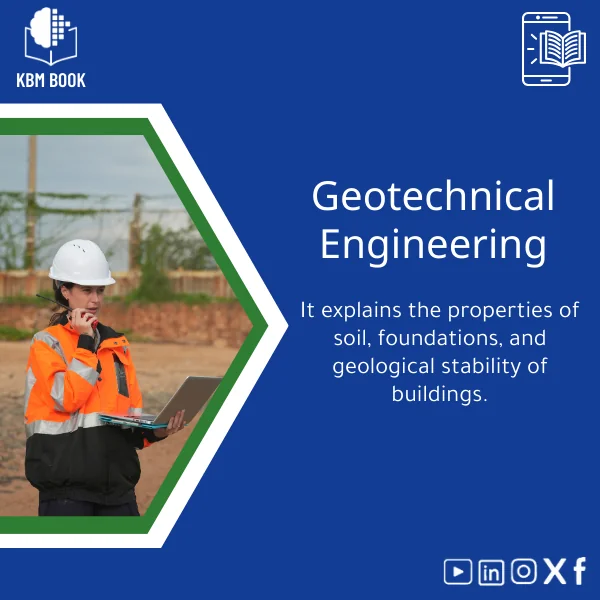
Geotechnical Engineering Guide for Soils and Foundations
Original price was: 179.00 $.139.00 $Current price is: 139.00 $.
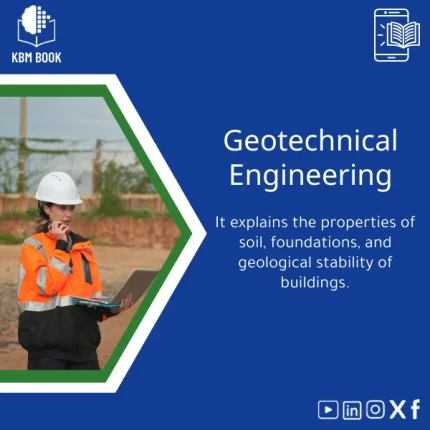
A structured, searchable knowledge base module (KBM) that converts geotechnical engineering — soil mechanics, foundation design, and geological stability — into a hierarchical, practical reference you can query, cite, and apply on projects, assignments, and research.
Key benefits & value for the buyer
This Geotechnical Engineering KBM transforms dispersed content (papers, code snippets, lecture slides) into an ordered, reliable knowledge database so you can:
- Find answers fast: Indexed rules-of-thumb, design equations, and decision flowcharts cut look-up time during design and exams.
- Work from fundamentals to application: Sequential modules cover soil classification, shear strength models, bearing capacity, settlement analysis, and foundation systems.
- Use validated content: Each entry links back to standard references and includes concise notes about assumptions and limits of applicability.
- Integrate with workflows: DB exports (CSV/JSON) let you import tables and parameters into spreadsheets, structural software, and scripts.
- Reduce error risk: Checklists and worked examples demonstrate common pitfalls in site investigation and calculation steps.
Use cases & real-life scenarios
Undergraduate & graduate study
Use the KBM to prepare for exams, assemble lecture notes, and produce homework solutions with clear references to governing equations and assumptions.
Research and literature reviews
Researchers can extract parameter ranges, compare constitutive models, and export curated datasets for meta-analysis without re-collecting scattered tables.
Site engineers & consultants
On-site decisions (e.g., preliminary bearing capacity checks, allowable settlement estimates, or slope stability quick checks) become faster with ready checklists and decision trees.
Teaching & training
Trainers can use the KBM as a classroom module to build exercises, assessments, and step-by-step lab guides that follow a single, consistent taxonomy.
Who is this product for?
This KBM is tailored to:
- Students and exam candidates needing a compact geotechnical engineering book pdf-style reference.
- Researchers consolidating soil mechanics and foundations literature into reuseable datasets.
- Practicing geotechnical and civil engineers who require a reliable reference for routine checks and reports.
- Educators and trainers building structured curricula and lab materials.
How to choose the right format for your needs
The KBM is delivered in multiple formats so you can match content to your workflow:
- Searchable PDF — best if you want a printable, citation-ready geotechnical engineering book pdf that’s easy to read offline.
- CSV/Excel tables — ideal for importing parameter tables, soil classification charts, and test results into spreadsheets.
- JSON/SQLite — recommended for researchers and developers who want programmatic access to the KBM.
- Combined package — choose the complete bundle for maximum flexibility: read, query, and integrate.
If you’re unsure, download the sample index (free) to inspect the structure and a sample table before purchasing.
Quick comparison with typical alternatives
How the KBM differs from traditional books, lecture notes, and scattered web sources:
- Traditional books: Deep but linear — KBM adds searchable structure, database exports, and modular reuse.
- Lecture notes: Often fragmented — KBM consolidates and removes duplication while keeping context and references.
- Web searches: Fast but inconsistent — KBM provides curated, validated content with clear assumptions and limits.
Best practices & tips to get maximum value
- Start with the index and system taxonomy to understand how modules map to your curriculum or project stages.
- Use the CSV exports to build parameter libraries for recurring soil types on your projects.
- Reference the worked examples when you prepare designs — they highlight typical boundary conditions and common simplifications.
- Keep the PDF as your quick on-site reference and import database files into your office tools for analysis.
Common mistakes when buying or using similar products (and how to avoid them)
- Buying a static PDF only: If you need to reuse tables programmatically, ensure you select the bundle with CSV/JSON exports.
- Assuming universal applicability: Verify the KBM’s assumptions for each formula — the guide flags limits and recommended contexts.
- Skipping the index: Without the taxonomy you may duplicate effort — use the hierarchical map to navigate efficiently.
Product specifications
- Product: Geotechnical Engineering Guide for Soils and Foundations (KBM)
- Formats included: Searchable PDF, CSV tables, JSON export, optional SQLite package
- Coverage: Soil classification, laboratory tests, shear strength, permeability, consolidation, bearing capacity, settlement analysis, shallow & deep foundations, slope stability, ground improvement techniques
- Deliverables: Index & taxonomy, checklists, worked examples, parameter tables, reference list
- License: Single-user commercial license included; team and institutional licenses available on request
- Delivery: Instant download after purchase (ZIP package)
- Usage notes: Attribution required for derivative published work; contact support for redistribution rights
FAQ
Is this KBM the same as a geotechnical engineering book PDF?
It includes a searchable PDF formatted like a reference book, but it also provides structured database exports (CSV/JSON) and an index so you can integrate content into spreadsheets and scripts — more flexible than a single PDF.
Will the formulas and examples match regional codes?
The KBM focuses on fundamental methods and standard formulas; where code-specific parameters or factors vary by jurisdiction, the KBM notes these differences and points to commonly used standards. For mandatory code compliance, consult local regulations in addition to this KBM.
How is the content validated?
Content is compiled from established textbooks and peer-reviewed references, organized by subject-matter experts, and annotated with assumptions and references. If you find an inconsistency, KBMBook support maintains an errata/update channel.
Can I get updates after purchase?
Yes — purchasers receive minor updates. Major revisions are offered as discounted upgrades. Team/institutional licenses can include update support; contact sales for terms.
Get the Geotechnical Engineering KBM and start saving time
Ready to replace scattered notes and slow searches with a single, structured reference for soils and foundations? The KBM is optimized for students, researchers, and professionals who need reliable, fast access to geotechnical knowledge.
Related products
Astronomy Observational Techniques Guide for Celestial Motion
Astrophysics Book: Understanding Stars, Galaxies, and Dark Energy
A searchable, hierarchical Knowledge Base Module (KBM) that converts astrophysics and cosmology into a practical, exam-ready and research-ready reference. Designed for students, researchers, and professionals who need immediate access to reliable explanations, equations, and data models for stars, galaxies, and dark energy.
Atomic Physics Guide: Understanding Atomic and Electron Properties
Knowledge Base — Atomic/Electron Properties & Electromagnetic Interactions. A structured, searchable KBM for students, researchers, and professionals who need an authoritative atomic physics reference that organizes concepts, formulas, experiments, and practical applications from basics of atomic physics to advanced electron properties.
Classical Mechanics Guide: Newton’s Laws and Dynamics
A searchable, hierarchical Knowledge Base Module (KBM) that turns classical mechanics into a practical, ready-to-use reference for fast problem solving, lecture preparation, and applied engineering. Designed for students, researchers, and professionals who need precise access to Newton’s laws, rotational motion, and applied dynamics without the noise of textbooks.
Reviews
Clear filtersThere are no reviews yet.