


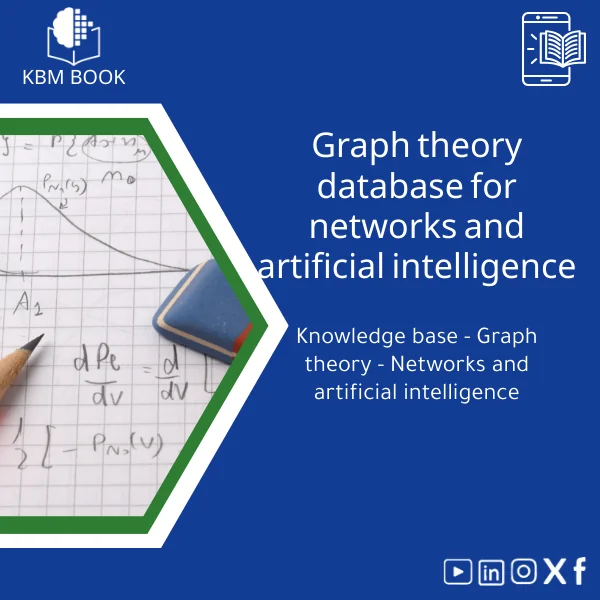
Graph Theory Knowledge Base for Networks and AI
Original price was: 179.00 $.139.00 $Current price is: 139.00 $.
A professionally structured, searchable Knowledge Base Module (KBM) that converts Graph Theory into a step-by-step digital reference for students, researchers, and professionals working on networks, algorithms, and AI systems.
Key benefits & value for the buyer
This KBM translates Graph Theory into a practical, reusable knowledge database that saves time and reduces errors when you need authoritative, focused information. Instead of searching multiple sources or reading a long graph theory book pdf, you get directly searchable modules: definitions, theorems, proofs, algorithms, complexity notes, datasets, and code examples.
Practical benefits
- Speed: Find the proof sketch, algorithm, or property in seconds with indexed sections and cross-links.
- Reliability: Curated references and citations to standard texts and research papers reduce ambiguity when you reference results.
- Adoptability: Ready-to-use snippets for teaching, lab work, and integrating into AI pipelines (including graph neural network primitives).
- Reusability: Export data subsets for experiments, slides, or reproducible notebooks.
Use cases & real-life scenarios
Whether you are preparing for a lecture, designing a research experiment, or building a production model, this KBM provides structured support.
Examples
- Student preparing for an exam: follow the “Introduction to Graph Theory” path with prioritized topics and worked examples for efficient revision.
- Researcher prototyping an algorithm: extract algorithm pseudocode, complexity bounds, and neighboring literature to build and benchmark quickly.
- Data scientist integrating graphs into ML: copy tested preprocessing steps for graph datasets, adjacency encoding options, and GNN architecture notes.
- Instructor creating course materials: export sections into a “graph theory for beginners” module with slides, exercises, and answer keys.
Who is this product for?
Designed for:
- Undergraduate and graduate students needing a concise and complete “graph theory book pdf” alternative that is searchable and modular.
- Researchers in networks, combinatorics, and AI requiring reliable references and reproducible examples.
- Professionals in network engineering, cybersecurity, and ML who need quick access to algorithms and trade-offs.
- Instructors and trainers who want structured course-ready material without redundant content.
How to choose the right edition & format
Our KBM is offered in three delivery formats so you can pick what fits your workflow:
- Student Edition (Compact PDF + KBM index): Focused overview with exercises and solved examples — ideal for coursework and exam prep.
- Research Edition (Full KBM + JSON/CSV exports): Full theorem catalogue, proofs, references, datasets and code snippets — best for reproducible research.
- Professional Edition (Integratable DB + API mapping): Schema-ready modules for integration into knowledge systems, with licensing for team deployment.
Choose PDF if you prefer a portable “graph theory book pdf” style; choose KBM/JSON if you need integration and fast querying. Licenses vary by edition — see the product specifications below.
Quick comparison with typical alternatives
Common alternatives: textbooks, scattered lecture notes, or raw research papers. How the KBM differs:
- Textbooks: Thorough but linear and slow to search. KBM provides modular access and quick lookup without losing depth.
- Lecture notes: Often incomplete or inconsistent. KBM is curated, cross-referenced, and continuous across topics.
- Research papers: Deep but narrow and hard to navigate for practical reuse. KBM synthesizes and points to sources with actionable notes.
Best practices & tips to get maximum value
- Start with the “Introduction to Graph Theory” pathway if you’re new — it prepares the concepts used in advanced modules.
- Use the export feature to extract datasets and algorithm templates into your codebase to avoid transcription errors.
- Cross-reference proofs with the provided citations when using results in formal publications.
- Keep the KBM locally indexed for instant queries during experiments or teaching sessions.
Common mistakes when buying/using similar products and how to avoid them
- Mistake: Buying a single-format PDF and expecting easy integration. Fix: Choose the KBM/JSON edition for integration needs.
- Mistake: Assuming all resources are equally curated. Fix: Check citations, update notes, and sample entries before buying.
- Mistake: Underestimating practical examples. Fix: Use the Research or Professional edition for code and dataset exports.
Product specifications
- Product: Graph Theory Knowledge Base (KBM)
- Coverage: Fundamentals → Advanced topics (graph connectivity, coloring, flows, spectral graph theory, random graphs, graph neural networks)
- Formats: KBM native (searchable), PDF export, JSON, CSV, SQL-ready schema
- Includes: Exercises, worked solutions, algorithm pseudocode, code snippets (Python-style), dataset links, curated references
- Compatibility: Integratable with knowledge managers, notebooks, and local search tools
- Licensing: Single-user academic, multi-user institutional, and enterprise integration options
- Updates: Versioned updates with changelog for two years (longer with institutional license)
FAQ
Is this KBM the same as a “graph theory book pdf”?
No. While a PDF export is available for portability, the KBM is a structured, searchable database with modular entries, cross-references, and export options that make it more useful for applied work and research than a static book.
Does it include introductory material for beginners?
Yes. The “Introduction to Graph Theory” pathway is designed for beginners and includes definitions, core theorems, simple proofs, and step-by-step examples labeled for “graph theory for beginners.”
Can I use code snippets in my own projects?
Yes. Code snippets and pseudocode are provided for instructional and prototyping use. Review the license terms for redistribution or commercial deployment—professional and institutional licenses include broader permissions.
How do updates work?
Purchases include documented updates for two years. Institutional licenses include extended support and priority updates aligned with major research developments.
Ready to stop searching and start building?
Get the Graph Theory Knowledge Base and convert theory into reproducible, searchable knowledge you can use in class, research, and production.
Need a team license or a sample module to evaluate? Contact support after purchase or choose the Research Edition to preview a subset before committing.
Related products
Analytical Chemistry Book: Qualitative and Quantitative Methods Guide
Classical Mechanics Guide: Newton’s Laws and Dynamics
A searchable, hierarchical Knowledge Base Module (KBM) that turns classical mechanics into a practical, ready-to-use reference for fast problem solving, lecture preparation, and applied engineering. Designed for students, researchers, and professionals who need precise access to Newton’s laws, rotational motion, and applied dynamics without the noise of textbooks.
Comprehensive Botany Book on Plant Taxonomy and Photosynthesis
A structured, searchable botany book designed as a Knowledge Base Module (KBM) — an end-to-end reference on plant taxonomy, organ structure, and the biochemistry of photosynthesis. Built for students, researchers, and professionals who need reliable, hierarchical knowledge they can search, cite, and apply immediately.
Comprehensive Nuclear Physics Book on Structure and Radioactivity
Cosmology Book: Guide to Big Bang and Galaxy Evolution
General Physics Book: Fundamentals of Force, Motion, Energy
Introductory General Chemistry Book on Matter and Reactions
A structured, searchable Knowledge Base Module (KBM) that converts core general chemistry concepts — matter, elements, reactions, stoichiometry and molarity — into a hierarchical reference you can query, teach from, or integrate into study workflows. Ideal as a concise General Chemistry book alternative for students, researchers, and professionals who need accurate, practical chemistry knowledge fast.
Modern Physics Book: Quantum, Relativity, and Tech Applications Guide
A structured, searchable Knowledge Base Module (KBM) that turns modern physics — quantum mechanics, special & general relativity, and contemporary technological applications — into a hierarchical, practical reference for students, researchers, and professionals who need quick, reliable access to advanced concepts and formulas.
Reviews
Clear filtersThere are no reviews yet.