


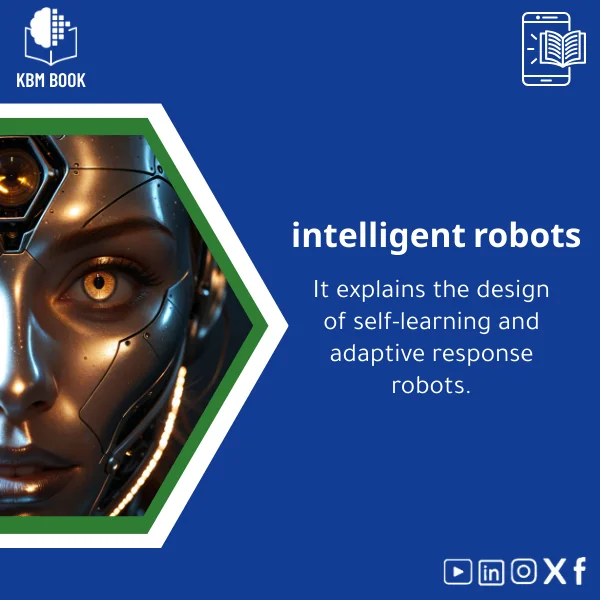
Intelligent Robotics Guide to Self-Learning Adaptive Robots
Original price was: 199.00 $.159.00 $Current price is: 159.00 $.
A structured, searchable Knowledge Base Module (KBM) that converts intelligent robotics theory into practical, step-by-step design and implementation resources for self‑learning and adaptive robotics systems — ideal for students, researchers, and professionals who need fast access to reliable, hierarchical knowledge.
Key benefits & value for the buyer
The Intelligent Robotics KBM transforms scattered resources into a single, authoritative, hierarchical database. Instead of reading dozens of papers or tutorials, you get:
- Time savings: Find validated designs, pseudocode, and evaluation metrics in seconds via the built-in index and structured nodes.
- Reproducibility: Implementation recipes, parameter tables, and test harnesses reduce trial-and-error in prototypes.
- Practical depth: From supervised self-learning techniques to reinforcement learning for adaptive behaviors, each topic is scoped from fundamentals to applied examples.
- Cross-discipline links: Connect control theory, perception, and software engineering nodes for integrated system design.
These benefits convert directly into faster thesis completion, more reliable lab prototypes, and clearer training materials for teams.
Use cases & real-life scenarios
Student: Thesis & coursework
A master’s student uses the KBM to assemble a literature review, generate a comparative table of adaptive algorithms, and extract a small dataset + starter code for experiments — all without hunting across repositories.
Researcher: Rapid prototyping
A robotics researcher copies validated pseudocode for a self‑learning controller, applies the included validation checklist, and logs reproducible experiments. The KBM’s hierarchical structure helps identify missing assumptions quickly.
Professional: Product R&D & training
An R&D engineer adapts an adaptive robotics systems recipe to product constraints and exports the module’s hardware–software mapping for the build team. Trainers use the KBM to create modular course units with clear learning outcomes.
Who is this product for?
The KBM is tailored for:
- Graduate students needing a reliable, structured source for research and projects.
- Researchers requiring reproducible experiment descriptions and algorithmic baselines.
- Engineers and product teams building adaptive robotics systems who need concise design patterns and checklists.
- Lecturers and trainers who want modular course materials and lab exercises.
If you need a searchable, reusable knowledge database rather than a narrative book, this KBM is designed for you.
How to choose the right KBM for your project
Use this quick checklist before purchase:
- Scope match: Does the KBM include the algorithms or hardware platforms you work with? (e.g., RL & adaptive control, ROS integration)
- Deliverable format: Need PDF, JSON, or CSV extracts for automated pipelines?
- Licensing and reuse: Can code snippets be integrated into your project under the included license?
- Update frequency: Do you want periodic updates for fast-moving topics?
The Intelligent Robotics KBM specifies supported formats and update policy in the product specifications below.
Quick comparison with typical alternatives
Alternatives: textbooks, individual research papers, online course videos, and code repositories. How this KBM differs:
- Textbooks provide depth but are static and often lack implementation recipes; KBM provides modular, exportable implementation nodes.
- Research papers present novel methods but require synthesis; KBM synthesizes multiple sources into validated design patterns.
- Video courses teach concepts but are linear; KBM is searchable and hierarchical for targeted retrieval.
- Code repositories contain implementations but lack curated validation and contextual theory; KBM pairs code with evaluation templates and design rationale.
Best practices & tips to get maximum value
- Start with the design checklist to define constraints (sensors, actuators, compute budget) before diving into algorithms.
- Use the KBM’s evaluation templates to standardize experiments and compare results fairly.
- Export only the modules you need (JSON/CSV) and integrate them into your version control for reproducibility.
- Cross-reference KBM nodes when preparing reports or lectures to maintain traceability of claims and parameters.
Common mistakes when buying or using similar products — and how to avoid them
- Mistake: Buying a narrow tutorial when you need an integrated reference. Fix: Confirm the KBM covers both theory and implementation layers.
- Mistake: Assuming code snippets are turnkey. Fix: Use the included hardware–software mapping and test harness before deployment.
- Mistake: Overpaying for repeated content across sources. Fix: KBMbook’s modules are de-duplicated and hierarchically organized to minimize overlap.
Product specifications
- Format: Downloadable KBM package (PDF guide, JSON modules, CSV tables, example code in Python/ROS).
- Coverage: Fundamentals → Supervised self-learning → Reinforcement/adaptive control → Perception pipelines → Integration patterns.
- Size: ~1200+ hierarchical nodes, 30+ code examples, 8 evaluation templates.
- Language: English (technical glossary included).
- License: Research & internal commercial use permitted (see license file for redistribution limits).
- Compatibility: Designed for ROS, Python 3.8+, common ML frameworks; exportable to research pipelines.
- Delivery: Instant digital download after purchase; includes update feed for 12 months.
- Support: Email support + update notifications for methodological changes.
Frequently asked questions
Can I use the code snippets in commercial projects?
Yes — the KBM includes a clear license file. Code snippets are intended for integration into research and internal commercial projects; redistribution or resale of the raw KBM package is restricted. Check the license shipped with the download for full terms.
Is this a book or a database? How is it different from an intelligent robotics book?
This product is a Knowledge Base Module (KBM): a structured, hierarchical database that includes narrative explanations (like a book) plus exportable data, code, and validation templates. It is optimized for lookup and reuse, unlike a traditional linear book.
What formats are included if I want to “buy intelligent robotics pdf” specifically?
A searchable PDF is included for reading and citation. Additionally, JSON and CSV exports allow you to integrate content into pipelines or learning management systems.
How often is the KBM updated with new methods?
The purchase includes 12 months of update notifications and at least two content refreshes per year for major methodological changes. You can opt for extended update plans if needed.
Ready to streamline your intelligent robotics projects?
Download a practical, structured knowledge base that accelerates learning, reduces prototyping risk, and standardizes experiments. Perfect for building self-learning and adaptive robotics systems with confidence.
Instant download. Includes PDF, JSON modules, example code, and 12 months of updates and support.
Related products
Analytical Chemistry Book: Qualitative and Quantitative Methods Guide
Biochemistry Book: Understanding Chemical Processes in Living Systems
Classical Mechanics Guide: Newton’s Laws and Dynamics
A searchable, hierarchical Knowledge Base Module (KBM) that turns classical mechanics into a practical, ready-to-use reference for fast problem solving, lecture preparation, and applied engineering. Designed for students, researchers, and professionals who need precise access to Newton’s laws, rotational motion, and applied dynamics without the noise of textbooks.

Comprehensive Evolutionary Biology Book on Natural Selection
Cosmology Book: Guide to Big Bang and Galaxy Evolution
General and Special Relativity Book on Einstein’s Theory
A structured, searchable Knowledge Base Module (KBM) that converts Einstein's General and Special Relativity into a clear, hierarchical reference: formulas, derivations, worked examples, practical applications (GPS, astrophysics), and a compact research bibliography — ready to download and integrate into study, teaching, or research workflows.
Introductory General Chemistry Book on Matter and Reactions
A structured, searchable Knowledge Base Module (KBM) that converts core general chemistry concepts — matter, elements, reactions, stoichiometry and molarity — into a hierarchical reference you can query, teach from, or integrate into study workflows. Ideal as a concise General Chemistry book alternative for students, researchers, and professionals who need accurate, practical chemistry knowledge fast.
Reviews
Clear filtersThere are no reviews yet.