


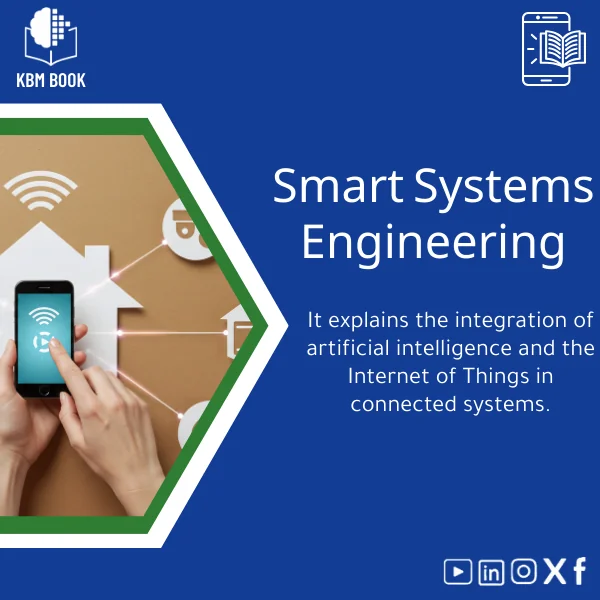
Intelligent Systems Engineering Guide for AI and IoT Integration
Original price was: 349.00 $.279.00 $Current price is: 279.00 $.
A hierarchical, searchable Knowledge Base Module (KBM) that converts Intelligent Systems Engineering theory into a practical, reusable database for designing connected AI + IoT systems — built for students, researchers, and professionals who need fast access to reliable, structured knowledge.
Key benefits & value for the buyer
The Intelligent Systems Engineering KBM turns dispersed, technical knowledge into a compact, queryable repository. Instead of reading multiple papers and fragmented tutorials, you get:
- Speed: complete design checklists and reference patterns reduce discovery time by hours or days in each project phase.
- Reliability: curated, referenced entries that distinguish proven practices versus experimental ideas.
- Practicality: ready-made interface templates for sensors, data pipelines, edge/ cloud partitioning, and model lifecycle management.
- Reusability: modular entries you can export and embed in reports, slides, or internal documentation.
- Scalability: hierarchical organization supports learning from basics through system-level integration.
Use cases & real-life scenarios
University coursework and labs
Instructors use the KBM as a structured syllabus: lessons map to KBM modules (sensors, embedded ML, communication stacks), lab tasks reference exact checklists and expected outcomes, and students quickly access concise design examples.
Research and prototyping
Researchers compiling literature can export metadata and reference lists directly to cite, compare architectures, and build baseline implementations. Prototype teams map requirements to tested integration patterns to accelerate MVPs.
Enterprise R&D and consulting
Engineering teams adopt modules as internal standards—using deployment workflows and security checklists to ensure consistent, auditable designs across projects.
Who is this product for?
This KBM is designed for:
- Students (undergraduate and graduate) needing a clear, structured path through Intelligent Systems Engineering topics.
- Researchers consolidating AI & IoT knowledge for literature reviews and reproducible experiments.
- Professionals—embedded engineers, data scientists, system architects—needing immediate, practical reference material.
- Trainers and course authors building curricula or labs for connected systems.
How to choose the right KBM for your needs
When deciding whether to buy this Intelligent Systems Engineering KBM, consider:
- Depth vs breadth: this module emphasizes system design and integration; if you need only introductory AI theory, supplement with a focused ML KBM.
- Format compatibility: we provide exports (JSON, CSV, Markdown). Ensure your tools accept these formats for smooth integration.
- Use intent: for teaching and reproducible research, choose a KBM with versioned references and exportable artifacts — both included here.
Quick comparison with typical alternatives
Before you buy, compare core trade-offs:
- Traditional textbooks: deep narrative but static; KBM is modular, searchable, and exportable for practical workflows.
- Scattered online articles: up-to-date but inconsistent; KBM offers curated, cross-checked entries and avoids duplication.
- Video courses: good for demonstrations but hard to extract concise checklists or exportable artifacts; KBM provides text-based, reusable resources.
Best practices & tips to get maximum value
- Start with the system checklist: use the top-level architecture checklist to define scope before diving into modules.
- Integrate with version control: import KBM snapshots into your project repo to track changes and annotations.
- Customize exports: filter modules for course packs or client deliverables to avoid information overload.
- Use as canonical references: link KBM entries in your reports to ensure teams follow the same validated practices.
Common mistakes when buying/using similar products and how to avoid them
- Buying a generic bundle: avoid products that lack domain-specific depth. This KBM focuses on Intelligent Systems Engineering with curated integration patterns.
- Ignoring format needs: check exports before purchase; we provide multiple formats to fit real workflows.
- Skipping verification: validate KBM references against your project’s regulatory or security requirements — the KBM highlights compliance-relevant entries.
- Not customizing: if you treat the KBM as a one-size-fits-all manual, you’ll miss efficiencies; tailor modules to project constraints.
Product specifications
- Product type: Knowledge Base Module (KBM) — Intelligent Systems Engineering
- Primary focus: AI and IoT systems design, integration, deployment
- Structure: Hierarchical modules — Fundamentals → Components → Integration Patterns → Deployment & Maintenance
- Formats included: JSON, CSV, Markdown, PDF summary
- Content size: ~420 indexed entries, 120+ diagrams and blueprints, 60+ checklists and templates
- Language: English
- Delivery: Instant digital download
- License: Single-user commercial and educational use (details included in download)
FAQ
What file formats are included and how do I use them?
The KBM includes JSON for programmatic access, CSV for spreadsheets, Markdown for quick editing, and a PDF summary for reading and printing. Use JSON to integrate entries into notebooks or internal tools; CSV is ideal for importing lists into spreadsheets; Markdown can be adapted into LMS content.
Will I receive updates or new editions?
KBMBook provides periodic content updates for major revisions. When we release a relevant update, registered buyers receive instructions and access to the new export files. Minor corrections are pushed as patch files you can apply to your local copy.
Can I use the KBM in commercial projects?
Yes — the KBM is licensed for single-user commercial and educational use. If you need multi-user or redistribution rights for clients, contact KBMBook for extended licensing options.
What if the KBM doesn’t fit my immediate needs?
Before purchase, review the product specifications and sample index. If it still doesn’t match, contact support for guidance — we can recommend complementary KBMs or refund options according to our policy.
Ready to work faster on AI + IoT systems?
Get a structured, production-focused Knowledge Base Module that helps you design, document, and deploy Intelligent Systems Engineering solutions with less friction and more confidence.
Immediate download, multiple export formats, and structured content designed to be integrated into your research, teaching, or production workflows.
Related products
Astronomy Observational Techniques Guide for Celestial Motion
Astrophysics Book: Understanding Stars, Galaxies, and Dark Energy
A searchable, hierarchical Knowledge Base Module (KBM) that converts astrophysics and cosmology into a practical, exam-ready and research-ready reference. Designed for students, researchers, and professionals who need immediate access to reliable explanations, equations, and data models for stars, galaxies, and dark energy.

Comprehensive Microbiology Book on Bacteria, Viruses, and Fungi
General Physics Book: Fundamentals of Force, Motion, Energy

Molecular Biology Guide: Transcription, Translation & Repair

Organic Chemistry Guide: Carbon Chains and Reactions
Physical Chemistry Guide: Energy, Thermodynamics & Interactions
A structured Knowledge Base Module (KBM) for Physical Chemistry that converts core theory, worked examples, and applied datasets into a searchable, hierarchical database — ideal for students, researchers, and professionals who need fast, reliable access to chemical thermodynamics basics and molecular interaction models.
Thermal Physics Guide: Understanding Heat, Energy, and Entropy
A downloadable, hierarchically structured Knowledge Base Module (KBM) that converts university-level thermodynamics into a searchable, practical digital database. Ideal for students, researchers, and professionals who need fast, reliable access to fundamentals and advanced topics in thermal physics.
Reviews
Clear filtersThere are no reviews yet.