


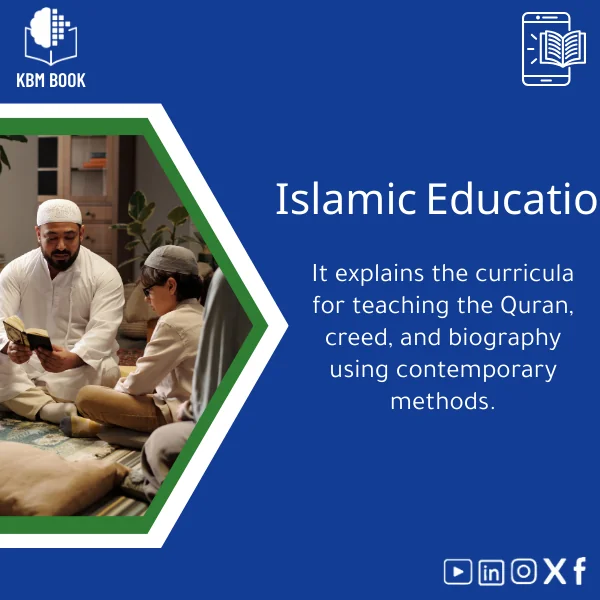
Islamic Education Pedagogy Guide: Qur’an, Creed, Seerah
Original price was: 179.00 $.139.00 $Current price is: 139.00 $.
A structured, searchable Knowledge Base Module (KBM) that translates classical and contemporary Islamic education pedagogy into clear lesson frameworks, assessment tools, and teaching strategies for Qur’an, creed (aqidah) and seerah — designed for students, researchers, and educators who need fast access to reliable, organized content.
Key benefits & value for the buyer
This Islamic education KBM converts fragmented pedagogical knowledge into a single, coherent, and reusable digital resource. Each feature is designed to produce measurable outcomes in teaching and research:
From features to outcomes
- Structured curriculum maps: reduce planning time by providing sequenced topics, learning objectives, and recommended activities for each class level.
- Assessment blueprints: standardized rubrics and formative/summative assessment templates speed up evaluation and ensure consistent learning outcomes.
- Evidence-backed methods: integrates classical scholarship with modern pedagogy (active learning, spaced repetition) so teachers can justify methods academically and practically.
- Research-ready format: organized citations and exportable datasets support thesis work, literature reviews, and comparative studies.
Use cases & real-life scenarios
The KBM is designed to be immediately useful across daily tasks and long-term projects:
Example scenarios
- University lecturer: Quickly assemble a semester plan on Qur’an interpretation that aligns objectives with assessment tasks and reading lists.
- Madrasah teacher: Use ready-made lesson sequences and classroom activities for memorization and tajweed practice that respect age-appropriate pacing.
- Education researcher: Export topic taxonomies and citation maps to support systematic literature reviews on seerah pedagogy.
- Training provider: Build certification modules and workshop outlines for creed courses using the KBM’s competency-based frameworks.
Who is this product for?
This Islamic education book in KBM form targets:
- Students and postgraduate researchers in Islamic studies and education looking for structured reference material.
- Professional educators, curriculum developers, and school leaders seeking tested teaching methods for Qur’an, creed, and seerah.
- Educational content creators and instructional designers who need modular learning units to adapt into LMS courses.
How to choose the right KBM depth
KBMs come in layers: core (introductory), intermediate (methodology + examples), and advanced (research tools + full pedagogical sequences). Choose based on your role:
- Student / New teacher: start with core + intermediate — enough to plan lessons and understand methods.
- Experienced educator / Trainer: select intermediate + advanced to access assessments and module-level outcomes for certification design.
- Researcher: advanced depth provides exportable taxonomies, source annotation, and comparative frameworks.
Quick comparison with typical alternatives
How this KBM differs from books, articles, or video courses:
- Compared to books: KBM is searchable, modular, and exportable — not a single linear narrative.
- Compared to articles: Aggregates and synthesizes many sources with pedagogical templates and assessments included.
- Compared to video courses: Focuses on reusable knowledge structures and metadata (learning outcomes, rubrics) that can be embedded in your LMS.
Best practices & tips to get maximum value
- Integrate the KBM with your lesson planner: import topic lists and rubrics into your LMS or spreadsheet to standardize across classes.
- Use the assessment templates as living documents — adapt rubrics to local context and save versions for accreditation.
- Leverage the source maps: assign readings and primary texts directly from cited lists to strengthen academic rigor.
- Create a personal index: tag KBM sections you use frequently (e.g., tajweed drills, seerah timelines) for one-click retrieval.
Common mistakes when buying/using similar resources and how to avoid them
- Buying a generic guide: Avoid resources without explicit learning outcomes — choose KBMs that map objectives to assessments.
- Ignoring adaptability: Ensure the KBM’s templates are exportable and editable; don’t rely on locked formats.
- Underusing citations: Use the KBM’s source maps to verify content and deepen lectures rather than treating materials as final authority.
Product specifications
- Format: Downloadable Knowledge Base Module (KBM) — layered HTML/CSV/JSON export and printable PDFs
- Language: English (content designed with references to classical Arabic sources)
- Coverage: Qur’an pedagogy, creed (aqidah), seerah — each with learning outcomes, lesson sequences, and assessment tools
- Compatibility: Usable in common tools (Excel, Notion, SQLite, LMS platforms)
- Delivery: Instant digital download after purchase
- Usage notes: Editable templates; research citations included for academic use
Frequently asked questions
Is this an Islamic education book or a software package?
The product is a Knowledge Base Module — a downloadable, structured database of pedagogical content. Think of it as a searchable, exportable book plus curriculum tools (lesson templates, rubrics, source maps) rather than a single printed book.
Can I adapt the lesson plans to local curricula and age groups?
Yes. Templates and learning outcomes are editable and designed to be adapted. The KBM includes guidance for adapting pacing and assessment to different age groups and institutional standards.
What formats are included and how do I use them?
Included formats typically are HTML for browsing, CSV/JSON for data import, and PDF for printable materials. These work with Excel, Notion, LMS platforms, and basic database tools.
How reliable are the sources used in the KBM?
The KBM compiles classical and contemporary sources with annotations and citations. Each module indicates primary references so you can verify and expand your research.
Ready to streamline your Islamic education planning?
Purchase a professionally structured KBM that turns pedagogy into practice. Designed for educators, students, and researchers who need clarity, speed, and academic rigor.
Related products
Astronomy Observational Techniques Guide for Celestial Motion
Atomic Physics Guide: Understanding Atomic and Electron Properties
Knowledge Base — Atomic/Electron Properties & Electromagnetic Interactions. A structured, searchable KBM for students, researchers, and professionals who need an authoritative atomic physics reference that organizes concepts, formulas, experiments, and practical applications from basics of atomic physics to advanced electron properties.
Cell Biology Guide: Structure, Division, and Transport Insights
Comprehensive Microbiology Book on Bacteria, Viruses, and Fungi
Cosmology Book: Guide to Big Bang and Galaxy Evolution
General Physics Book: Fundamentals of Force, Motion, Energy
Molecular Biology Guide: Transcription, Translation & Repair
Physical Chemistry Guide: Energy, Thermodynamics & Interactions
A structured Knowledge Base Module (KBM) for Physical Chemistry that converts core theory, worked examples, and applied datasets into a searchable, hierarchical database — ideal for students, researchers, and professionals who need fast, reliable access to chemical thermodynamics basics and molecular interaction models.
Reviews
Clear filtersThere are no reviews yet.