


Knowledge Management Guide for Organizational Learning
Original price was: 179.00 $.139.00 $Current price is: 139.00 $.
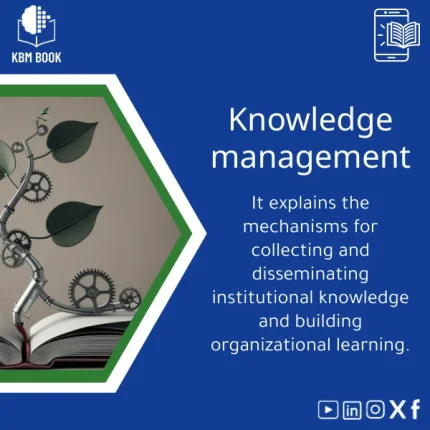
A structured, searchable Knowledge Management (KM) module that captures institutional know-how, standardizes learning paths, and turns fragmented information into a practical organizational learning database — ready to download, integrate, and use.
Key benefits & value for the buyer
This Knowledge Management guide is built as a Knowledge Base Module (KBM) to convert tacit and explicit knowledge into a usable database. Each feature maps to a direct benefit:
From features to outcomes
- Hierarchical structure: Faster onboarding — users find validated answers in minutes instead of sifting through documents.
- Templates and workflows: Immediate application — run a post-project review or set up an institutional knowledge capture process the same day.
- Export-ready formats: Seamless integration — move content into LMS, intranet, or document repositories without rework.
- Evidence and references: Trusted decisions — managers and researchers can cite structured sources rather than relying on memory.
Use cases & real-life scenarios
Practical examples showing how the module adds value in everyday professional and academic work:
Scenario 1 — University research group
A research team uses the KM module as a living lab notebook: onboarding guides for new researchers, standardized data-capture templates, and a literature-summary index — reducing duplicated experiments and accelerating literature reviews.
Scenario 2 — SME implementing continuous improvement
Operations builds a lessons-learned KB to capture process deviations and corrective actions. Within weeks, recurring issues drop because front-line staff can search past incidents and solutions.
Scenario 3 — Training departments & instructors
Training converts KBM chapters into short microlearning units and assessment items, shortening course development time and increasing consistency across trainers.
Who is this product for?
The Knowledge Management Guide is designed for:
- Students and postgraduate researchers who need a reliable reference to build literature maps and knowledge capture protocols.
- Knowledge managers, L&D professionals, and librarians who must create searchable institutional memory.
- Managers and consultants who want repeatable knowledge capture workflows to reduce time-to-productivity.
If you need practical KM tools rather than long theoretical texts — this is tailored for actionable learning and implementation.
How to choose the right format and depth
The product is offered in multiple formats and depths to match different needs:
- Compact (PDF summary): Best for students or quick reference — concise frameworks, 30–50 pages.
- Full KBM (structured database): Best for practitioners — complete taxonomy, templates, export files for knowledge platforms.
- Trainer pack: Best for instructors — slide decks, exercises, and assessment rubrics derived from the KBM.
Choose Compact for learning and quick reference; Full KBM for implementation and integration; Trainer pack for teaching and workshops.
Quick comparison with typical alternatives
How this KBM differs from textbooks, articles, and ad-hoc notes:
- Versus textbooks: Textbooks provide theory; the KBM provides modular, actionable artifacts (templates, capture forms, maps).
- Versus articles: Articles solve a niche question; the KBM stitches multiple articles into a discoverable, connected structure.
- Versus internal spreadsheets/notes: The KBM standardizes taxonomy and searchability to prevent knowledge loss when staff change roles.
Best practices & tips to get maximum value
- Start small: deploy one module (e.g., onboarding or lessons-learned) and measure time saved and error reduction.
- Make capture routine: set a 15-minute post-task update using the KBM capture template.
- Assign a steward: one person keeps taxonomy consistent and tags entries for searchability.
- Use exports: import KBM CSV into your LMS or knowledge platform to keep content synchronized.
Common mistakes when buying/using KM products and how to avoid them
- Mistake — Buying too large a package: Avoid by piloting a compact module first.
- Mistake — No governance: Assign stewardship and simple version control to prevent outdated information.
- Mistake — Over-customizing before use: Use the standard KBM for 4–8 weeks to validate processes before heavy customization.
Product specifications
- Product: Knowledge Management Guide for Organizational Learning (Knowledge Base Module)
- Formats included: PDF (readable), CSV/JSON exports (for import), Trainer PPTX (optional), plain text templates
- Structure: Hierarchical taxonomy with categories, subcategories, templates, checklists, and reference list
- Compatibility: Works with common LMS, Confluence, SharePoint and most knowledge platforms via CSV/JSON import
- Delivery: Digital download immediately after purchase; includes a short user guide
- Updates: Minor updates provided for 12 months; major update options available
- Language: English (structured for translation if needed)
FAQ
Is this a “knowledge management book PDF” or an interactive database?
The product is both: a concise PDF guide for quick reference and a structured KBM (exportable CSV/JSON) for integration into knowledge systems. You get the PDF plus the data files to make the content interactive in your environment.
Will this replace our current documentation or require a consultant?
The KBM is designed to integrate with existing documentation. It includes templates and step-by-step implementation guidance so most teams can deploy without outside consultants. For deep customization or system integration you may choose to engage specialists.
How often is the content updated and what about quality?
Minor content updates are provided for 12 months after purchase. The KBM follows professional KM frameworks and includes references so you can verify quality. We minimize fluff and provide practical, field-tested templates.
What if I’m not sure whether I need a full KBM?
Start with the Compact PDF summary to assess value. If you see immediate benefits, upgrade to the Full KBM. Our modular approach reduces upfront cost and risk.
Ready to capture and scale knowledge in your organization?
The Knowledge Management Guide for Organizational Learning is optimized for learners and practitioners who need fast access to reliable, actionable knowledge. Purchase includes immediate download and setup notes for deployment.
Still hesitating? Remember: pilot the Compact version to test fit, or contact support for guidance on the right package for your team’s size and goals.
Related products
Astrophysics Book: Understanding Stars, Galaxies, and Dark Energy
A searchable, hierarchical Knowledge Base Module (KBM) that converts astrophysics and cosmology into a practical, exam-ready and research-ready reference. Designed for students, researchers, and professionals who need immediate access to reliable explanations, equations, and data models for stars, galaxies, and dark energy.
Biochemistry Book: Understanding Chemical Processes in Living Systems
Biological Anthropology Study Guide on Human Evolution
General and Special Relativity Book on Einstein’s Theory
A structured, searchable Knowledge Base Module (KBM) that converts Einstein's General and Special Relativity into a clear, hierarchical reference: formulas, derivations, worked examples, practical applications (GPS, astrophysics), and a compact research bibliography — ready to download and integrate into study, teaching, or research workflows.
General Physics Book: Fundamentals of Force, Motion, Energy

Inorganic Chemistry Guide: Bonding and Crystal Solids
A structured, searchable Knowledge Base Module (KBM) that converts inorganic chemistry fundamentals and advanced topics—bonding models, lattice structures, defects, and solid-state properties—into a practical digital reference for students, researchers, and professionals who need fast, reliable answers without wading through textbooks.
Materials Physics Guide: Understanding Solid-State Properties
Modern Physics Book: Quantum, Relativity, and Tech Applications Guide
A structured, searchable Knowledge Base Module (KBM) that turns modern physics — quantum mechanics, special & general relativity, and contemporary technological applications — into a hierarchical, practical reference for students, researchers, and professionals who need quick, reliable access to advanced concepts and formulas.
Reviews
Clear filtersThere are no reviews yet.