


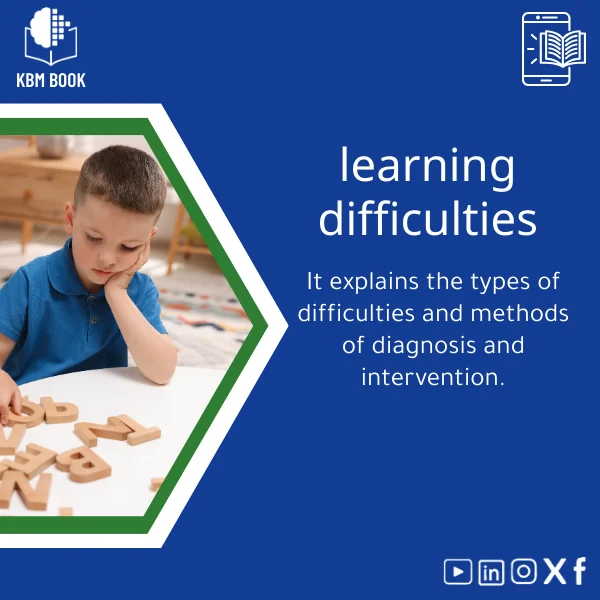
Guide to Understanding Learning Disabilities: Diagnosis and Intervention
Original price was: 299.00 $.249.00 $Current price is: 249.00 $.
A structured, searchable knowledge base module that explains learning disabilities — types, assessment protocols, diagnostic criteria, and evidence-based intervention strategies — designed for students, researchers, clinicians, and education professionals who need fast access to reliable, organized information.
Key benefits & value for the buyer
This KBM converts the complex field of learning disabilities into a structured, actionable resource. Each feature below explains practical value you can use immediately.
Structured knowledge reduces search time
Instead of scanning multiple papers or textbooks, the KBM organizes concepts hierarchically — definitions, prevalence data, diagnostic flowcharts, and intervention modules — so you find the right protocol in seconds.
Clinical and academic rigour
Diagnostic criteria and assessment procedures align with current standards and primary literature, making this KBM suitable for case reports, classroom adaptations, or literature reviews.
Practical outputs
Ready-to-use templates for assessment summaries, individualized education plan (IEP) goals, behavior intervention plans, and signposting to measurement tools speed documentation and improve reproducibility.
Use cases & real-life scenarios
Undergraduate and graduate students
Use the KBM as a study map: module-by-module reading supports coursework, essay sourcing, and systematic reviews. Export bibliographies directly to your reference manager.
Researchers
Extract diagnostic algorithms and intervention effect sizes to design studies or meta-analyses. The KBM’s structured entries reduce time spent assembling background material.
School-based professionals & clinicians
In daily practice, use the quick-assessment checklists, triage flowcharts, and intervention decision trees to standardize referrals and measure outcomes across students.
Who is this product for?
- Students learning assessment and intervention methods for learning disabilities.
- Researchers conducting studies on learning difficulties diagnosis and outcomes.
- Educational psychologists and special educators implementing evidence-based interventions.
- Policy makers and curriculum designers needing concise references.
How to choose the right KBM format
This Guide to Understanding Learning Disabilities is offered in multiple file formats to match workflows. Choose by how you use the KBM:
- CSV / Excel — preferred for data extraction, bulk editing, and integration with analysis tools.
- JSON — best if you plan to import structured entries into software or LMS platforms.
- PDF — quick reference and printable checklists for meetings and workshops.
- XML — compatible with many institutional repositories and digital libraries.
If you need a recommendation: choose CSV/Excel for research and JSON for technical integrations; keep a PDF copy for field use.
Quick comparison with typical alternatives
Typical alternatives include textbooks, journal articles, and scattered online resources. Compared to those, this KBM:
- Is faster to navigate than textbooks and review articles.
- Is more actionable than single research papers because it includes templates and protocols.
- Consolidates references and extracts measurement details other sources leave implicit.
If your goal is immediate application (assessment, planning, documentation), the KBM provides a better ROI than reading multiple separate sources.
Best practices & tips to get maximum value
- Integrate relevant modules into your case management system — map KBM fields to your records for consistency.
- Use the intervention monitoring templates weekly for the first two months to detect response patterns early.
- Export the bibliographic list into your reference manager before drafting reports to ensure citation accuracy.
- Keep a PDF summary on hand for team meetings and parent conferences.
Common mistakes when buying or using similar products and how to avoid them
- Mistake: Buying a generic handbook with no exportable data.
Fix: Choose a KBM that provides CSV/JSON exports. - Mistake: Relying on outdated diagnostic criteria.
Fix: Check update notes and referenced standards within the KBM. - Mistake: Using an unstructured source for case documentation.
Fix: Adopt the KBM templates to standardize reporting across students or participants.
Product specifications
- Title: Guide to Understanding Learning Disabilities: Diagnosis and Intervention
- Format options: CSV, XLSX, JSON, PDF, XML
- Language: English (structured glossary included)
- Content modules: 12 core modules + 30+ submodules (definitions, assessment tools, interventions, measurement templates)
- References: Primary literature and guideline links embedded per module
- Compatibility: Import-ready for LMS and research software; printable templates
- License: Single-user digital license with optional institutional upgrade (details at checkout)
- Delivery: Instant download after purchase
Frequently asked questions
What exactly is included in the KBM — is it a book or a database?
The product is a knowledge base module (KBM): a structured database of modular entries. It includes narrative summaries, diagnostic flowcharts, assessment templates, intervention protocols, and bibliographic references — available in multiple export formats (CSV, JSON, PDF) rather than a conventional single-format book.
How current are the diagnostic criteria and references?
Entries reference contemporary diagnostic frameworks and peer-reviewed studies. Each module lists sources and version notes. We update core clinical modules periodically; update history is included in your download package.
Can I use this KBM for research publication or in a school setting?
Yes. The KBM is designed for academic and clinical use. Templates can be adapted for reports and institutional documentation. Check the license terms for multi-user or institutional deployment.
What if I need a different file format or a team license?
Contact KBMBook support for custom export requests or institutional licensing. We offer service options for format conversion and volume licensing.
Ready to make evidence-based assessment and intervention faster?
Download a structured, research-aligned learning disabilities knowledge base that fits your workflow — immediate access, exportable formats, and practical templates.
Not sure yet? Review the product specifications above and consult the FAQ. If quality or format is a concern, contact support for a sample module before purchase.
Related products

Biochemistry Book: Understanding Chemical Processes in Living Systems
Biological Anthropology Study Guide on Human Evolution

Cell Biology Guide: Structure, Division, and Transport Insights

Comprehensive Botany Book on Plant Taxonomy and Photosynthesis
A structured, searchable botany book designed as a Knowledge Base Module (KBM) — an end-to-end reference on plant taxonomy, organ structure, and the biochemistry of photosynthesis. Built for students, researchers, and professionals who need reliable, hierarchical knowledge they can search, cite, and apply immediately.




Reviews
Clear filtersThere are no reviews yet.