


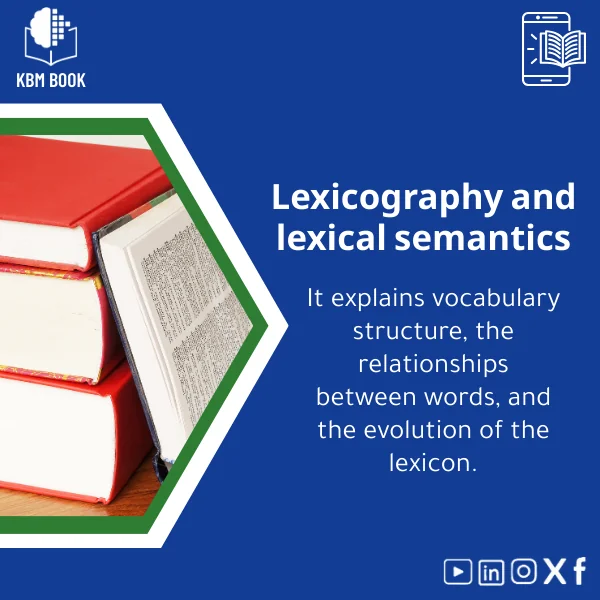
Lexicography Book on Lexical Semantics and Word Relations
Original price was: 179.00 $.139.00 $Current price is: 139.00 $.
A hierarchical, downloadable knowledge base module (KBM) that converts lexical semantics into a searchable database: lexicon structure, word relations, and documented lexical change — ready for study, research citation, or integration into teaching and NLP workflows.
Key benefits & value for the buyer
This lexicography book is packaged as a Knowledge Base Module (KBM): not a conventional textbook but a structured, reusable database that reduces search time and increases reproducibility in research and teaching.
Feature → Practical benefit
- Structured sense taxonomy: Find senses reliably and compare across entries — saves hours in literature review and annotation work.
- Explicit word relations: Synonymy, antonymy, hypernymy, meronymy, collocation notes — supports lexical analysis and feature engineering for NLP.
- Historical & change logs: Documented lexical change and variant forms — essential for diachronic studies and historical linguistics modules.
- Multi-format export: Use directly in spreadsheets, analysis scripts, or LMS systems — no manual reformatting required.
- Arabic linguistics support: Arabic script fields and targeted notes help students and professionals working on Arabic-language projects.
Use cases & real-life scenarios
Where this lexicography book adds immediate, measurable value:
- Graduate thesis: Use the KBM as a primary structured dataset for lexical semantics chapters, export examples and citations quickly.
- Corpus annotation: Load the SQLite file into annotation tools to pre-populate sense inventories and relation labels, reducing annotation time.
- Course design: Professors assemble lectures and problem sets from the hierarchy (entry → sense → examples) without rewriting content.
- Terminology management: Language professionals build glossaries and alignment tables for translation and localization projects.
- Prototype NLP models: Extract features such as semantic classes and relation graphs to bootstrap experiments.
Example: A research student preparing a chapter on semantic shift can filter entries by documented historical changes, export matching lemmas to CSV, and include original citations in the appendix — all within minutes.
Who is this product for?
Targeted for students, researchers, and professionals who need structured, reliable lexical information with minimal setup:
- Undergraduate and graduate linguistics students using a lexicography book for coursework and assignments.
- Researchers in lexical semantics and historical linguistics who need machine-readable corpora.
- Language technologists and computational linguists requiring curated relation graphs for model features.
- Translators and terminologists building field-specific glossaries, especially for Arabic-English projects.
How to choose the right version
The KBM is available in three editions — choose by scope and use:
- Compact (student): Core entries, essentials of lexical semantics, PDF + CSV. Best for coursework and quick study.
- Standard (research): Full entry sets, relations, historical notes, JSON + SQLite + PDF. Ideal for theses and lab work.
- Complete (professional): Extended coverage, parallel Arabic/English fields, additional metadata, and a license for commercial use. Suited to NLP prototypes and institutional use.
Choosing tip: If you plan to run experiments or integrate into tools, pick Standard or Complete for machine-readable formats and richer metadata.
Quick comparison with typical alternatives
How this KBM differs from a traditional linguistics textbook or scattered articles:
- Traditional textbooks: Rich in narrative but not machine-readable. KBM gives the same structured content but exportable to analysis tools.
- Journal articles: Deep but narrow. KBM covers a broad, linked set of concepts and relations ready for cross-reference.
- Raw corpora: Large but unstructured. KBM adds curated sense distinctions and explicit relation labels that improve reproducibility.
Best practices & tips to get maximum value
- Start with the CSV to explore columns; then load the SQLite into your tool of choice for complex queries.
- Use the relation graph to seed annotation guidelines — consistent labels increase inter-annotator agreement.
- For teaching, export filtered subsets (e.g., all entries with semantic change) to build targeted problem sets.
- Keep the KBM alongside a citation list from the module for reproducible references in publications.
Common mistakes when buying/using lexicography or lexical semantics resources — and how to avoid them
- Buying a narrative-only book when you need data: If you plan to analyze or import, ensure the resource is machine-readable — this KBM provides CSV/JSON/SQLite.
- Assuming coverage equals quality: Check metadata fields (sources, sense provenance). Our KBM includes source references and change logs.
- Using the wrong license: Confirm commercial vs. personal use; choose the Complete edition for commercial deployment.
Product specifications
- Product type: Knowledge Base Module (KBM) — lexicography book on lexical semantics and word relations
- Formats included: PDF (readable narrative), CSV (tabular export), JSON (nested entries), SQLite (query-ready)
- Coverage: ~8,000 lemmas with multi-sense annotation, relation types (synonym, antonym, hypernym, meronym, collocation)
- Languages: English primary; Arabic-script fields and targeted notes for Arabic examples
- License options: Personal (study), Academic (research), Commercial (deployment)
- Delivery: Instant digital download after purchase; lifetime minor updates included for 12 months
- Support: Email support for import questions and compatibility guidance
FAQ
Can I use this lexicography book dataset for a commercial project?
Yes. The Complete edition is licensed for commercial use. Academic and personal editions restrict redistribution. The product page and license text specify permitted uses — contact support for institutional licenses.
Which formats are best for NLP experiments?
Use the JSON or SQLite builds. JSON preserves nested sense objects and relations; SQLite enables complex joins and fast queries when combined with analysis pipelines.
How reliable are the sense distinctions and relation labels?
Entries were curated from peer-reviewed sources and standard lexicographic references and include provenance fields. Use the relation confidence and source fields to filter higher-precision subsets for experiments.
What if I need more entries or a custom export?
Customization and dataset extensions are available as a paid service. Contact KBMBook support to request additional lemmas, parallel alignment, or custom CSV/JSON layouts.
Ready to turn lexical knowledge into a usable database?
Choose the edition that fits your workflow and get an instantly downloadable, structured lexicography book that saves time and improves reproducibility.
Need advice on which edition fits your project? Contact our support team — we help researchers and instructors pick the most efficient setup.
Related products
Astrophysics Book: Understanding Stars, Galaxies, and Dark Energy
A searchable, hierarchical Knowledge Base Module (KBM) that converts astrophysics and cosmology into a practical, exam-ready and research-ready reference. Designed for students, researchers, and professionals who need immediate access to reliable explanations, equations, and data models for stars, galaxies, and dark energy.
Biochemistry Book: Understanding Chemical Processes in Living Systems
Classical Mechanics Guide: Newton’s Laws and Dynamics
A searchable, hierarchical Knowledge Base Module (KBM) that turns classical mechanics into a practical, ready-to-use reference for fast problem solving, lecture preparation, and applied engineering. Designed for students, researchers, and professionals who need precise access to Newton’s laws, rotational motion, and applied dynamics without the noise of textbooks.
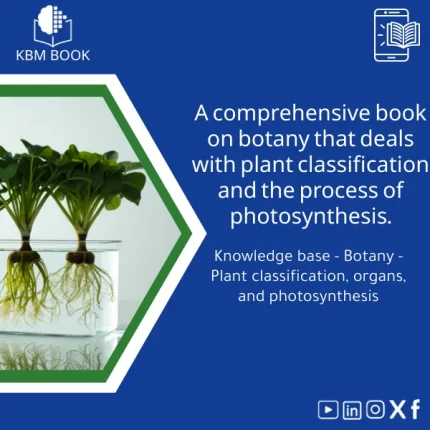
Comprehensive Botany Book on Plant Taxonomy and Photosynthesis
A structured, searchable botany book designed as a Knowledge Base Module (KBM) — an end-to-end reference on plant taxonomy, organ structure, and the biochemistry of photosynthesis. Built for students, researchers, and professionals who need reliable, hierarchical knowledge they can search, cite, and apply immediately.
Comprehensive Nuclear Physics Book on Structure and Radioactivity
Electromagnetism Book: A Comprehensive Guide to Fields and Circuits
General and Special Relativity Book on Einstein’s Theory
A structured, searchable Knowledge Base Module (KBM) that converts Einstein's General and Special Relativity into a clear, hierarchical reference: formulas, derivations, worked examples, practical applications (GPS, astrophysics), and a compact research bibliography — ready to download and integrate into study, teaching, or research workflows.
Reviews
Clear filtersThere are no reviews yet.