


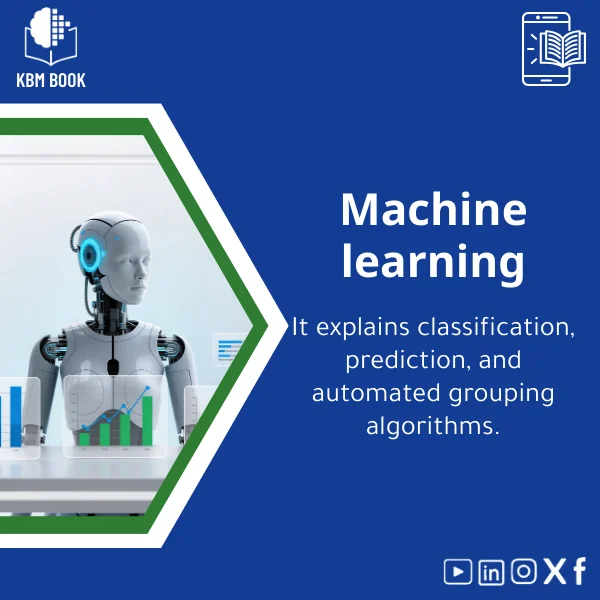
Machine Learning Algorithms Guide for Classification and Prediction
Original price was: 179.00 $.139.00 $Current price is: 139.00 $.
A hierarchical, searchable Knowledge Base Module (KBM) that converts Machine Learning theory into an instantly usable, structured database for classification, prediction, and clustering — optimized for students, researchers, and professionals who need fast, reliable access to algorithms, formulas, and implementation patterns.
Key benefits & value for the buyer
This KBM is designed to move you from searching piles of articles to having a dependable, compact knowledge database. Each feature below is mapped to a clear benefit:
Feature → Benefit
- Hierarchical modules — Benefit: Find the exact algorithm or subtopic in seconds (e.g., “SVM kernels” under classification → SVM).
- Algorithm cards (definition, math, complexity, pros/cons, pseudocode) — Benefit: Rapid comparison and implementation-ready guidance.
- Practical examples & notebooks — Benefit: Copy-ready code snippets for Python/R that reduce proof-of-concept time.
- Exportable tables (parameters, hyperparameters, performance tips) — Benefit: Integrate into reports, slides, or lab notebooks without rework.
- Curated references — Benefit: Trusted sources tied to each entry so you can cite or drill down when needed.
Use cases & real-life scenarios
Below are concrete ways students, researchers, and professionals use this Machine Learning KBM to save time and increase accuracy.
Student — coursework and revision
Quickly locate the derivation of logistic regression, review decision boundary visuals, and export a one-page cheat sheet for an exam. The KBM’s progressive structure helps move from “introduction to machine learning” topics to applied classification tasks.
Researcher — reproducible experiments
Use algorithm cards to standardize hyperparameter ranges, reproduce baseline results, and grab recommended evaluation metrics for imbalanced classification or time-series prediction experiments.
Practitioner — production-ready decisions
Compare classifiers with complexity and interpretability notes, choose between tree ensembles and linear models for deployment constraints, and export model-selection checklists for engineering teams.
Who is this product for?
The KBM is expressly targeted to:
- Students learning core Machine Learning algorithms and needing an organized reference beyond textbooks.
- Researchers who require a concise, citable algorithm library for reproducibility and literature links.
- Data scientists and analysts who need an actionable classification and prediction playbook for real-world projects.
- Instructors and trainers building curricula or workshop materials who want ready-made modules and examples.
How to choose the right KBM edition
Editions vary by depth and files included. Choose based on your immediate needs:
- Intro edition: Focuses on “introduction to machine learning”, core classifiers (logistic regression, k-NN), and basic exercises — best for coursework.
- Applied edition: Includes full implementation snippets, preprocessing recipes, and model selection flows — best for practitioners.
- Research edition: Adds advanced topics (SVM kernels, ensemble theory, bias-variance proofs), curated references, and experiment reproducibility templates.
If you need both teaching materials and reproducible experiments, choose the Applied or Research edition. All editions are downloadable and include sample notebooks to preview content before committing.
Quick comparison with typical alternatives
Typical alternatives: textbooks, scattered articles, and code repos. How this KBM differs:
- Textbooks: Deep but linear — KBM is modular and search-first, enabling targeted access without reading entire chapters.
- Articles & blogs: Up-to-date but unstructured — KBM curates and connects content, removing redundancy and contradictions.
- Code repositories: Practical but often undocumented — KBM pairs code with theory, complexity notes, and usage guidelines.
Best practices & tips to get maximum value
- Start with the decision flowcharts to select candidate models quickly for your problem (classification vs. regression, balanced vs. imbalanced classes).
- Use the exported parameter tables as a baseline for hyperparameter search — they save hours of trial and error.
- Integrate the KBM’s pseudocode into teaching slides or lab exercises to speed preparation.
- Keep a personal “project notes” export to track choices and results; the KBM’s structure makes audit trails simple.
Common mistakes when buying/using similar products and how to avoid them
- Mistake: Buying a long textbook expecting instant answers. Fix: Use a KBM designed for lookup and application-first access.
- Mistake: Choosing a KBM without export formats. Fix: Verify you can export tables/notebooks for reproducibility — this KBM includes CSV/JSON/PDF/Notebook exports.
- Mistake: Ignoring update frequency. Fix: Select editions that note revision history and include curated references for further reading.
Product specifications
- Format: Downloadable KBM package (searchable database) + PDF companion + Jupyter/Python notebook examples
- Coverage: Classification, prediction (regression & time-series), and clustering algorithms
- Modules: Hierarchical modules including Fundamentals → Supervised → Unsupervised → Model Selection → Deployment Notes
- Exports: CSV, JSON, PDF, Jupyter Notebook (ipynb)
- Size: Varies by edition (Intro ≈ 20MB, Applied ≈ 120MB, Research ≈ 220MB)
- Language: English (documentation); KBMBook is an Arabic-rooted provider adapting professional knowledge into structured English modules
- Last updated: 2025-12-02
- Compatibility: Desktop and cloud environments that support standard file formats and notebooks
- Usage notes: Single-user digital license; commercial team licenses available on request
FAQ
What file formats are included and can I access code examples?
Yes. The KBM includes a PDF companion, full-text searchable database files, exportable tables (CSV/JSON), and runnable Jupyter notebooks with Python examples for classification, regression, and clustering.
Is this a “machine learning book pdf” or something different?
It contains a downloadable PDF companion, but the primary product is a structured Knowledge Base Module (KBM): a searchable, hierarchical dataset of algorithm entries, examples, and references designed for practical use beyond a static book PDF.
How often is the KBM updated and are updates free?
Edition updates and errata are published periodically. Small updates (typos, clarifications) are provided free for registered buyers; major edition upgrades may be offered at a discounted rate. Specific update policy is noted on the product page.
Can I use the KBM for commercial projects?
Single-user digital license permits individual commercial use. For team or enterprise use, request a multi-user license via KBMBook support.
What if I’m unsure whether this KBM fits my course or project?
Download the sample preview notebooks and PDF pages included on the product page to verify coverage. The previews show table of contents, example algorithm card, and a runnable notebook snippet.
Ready to stop searching and start building?
Purchase the Machine Learning KBM now and gain a searchable, exportable knowledge database that accelerates study, research, and development. Includes examples, pseudocode, comparison charts, and practical export options.
If you have questions about editions, licensing, or previews before purchasing, contact KBMBook support; preview files are available on the product page to ensure fit.
Related products
Analytical Chemistry Book: Qualitative and Quantitative Methods Guide
Atomic Physics Guide: Understanding Atomic and Electron Properties
Knowledge Base — Atomic/Electron Properties & Electromagnetic Interactions. A structured, searchable KBM for students, researchers, and professionals who need an authoritative atomic physics reference that organizes concepts, formulas, experiments, and practical applications from basics of atomic physics to advanced electron properties.
Cell Biology Guide: Structure, Division, and Transport Insights
Classical Mechanics Guide: Newton’s Laws and Dynamics
A searchable, hierarchical Knowledge Base Module (KBM) that turns classical mechanics into a practical, ready-to-use reference for fast problem solving, lecture preparation, and applied engineering. Designed for students, researchers, and professionals who need precise access to Newton’s laws, rotational motion, and applied dynamics without the noise of textbooks.
Comprehensive Microbiology Book on Bacteria, Viruses, and Fungi
General Physics Book: Fundamentals of Force, Motion, Energy
Modern Physics Book: Quantum, Relativity, and Tech Applications Guide
A structured, searchable Knowledge Base Module (KBM) that turns modern physics — quantum mechanics, special & general relativity, and contemporary technological applications — into a hierarchical, practical reference for students, researchers, and professionals who need quick, reliable access to advanced concepts and formulas.
Thermal Physics Guide: Understanding Heat, Energy, and Entropy
A downloadable, hierarchically structured Knowledge Base Module (KBM) that converts university-level thermodynamics into a searchable, practical digital database. Ideal for students, researchers, and professionals who need fast, reliable access to fundamentals and advanced topics in thermal physics.
Reviews
Clear filtersThere are no reviews yet.