


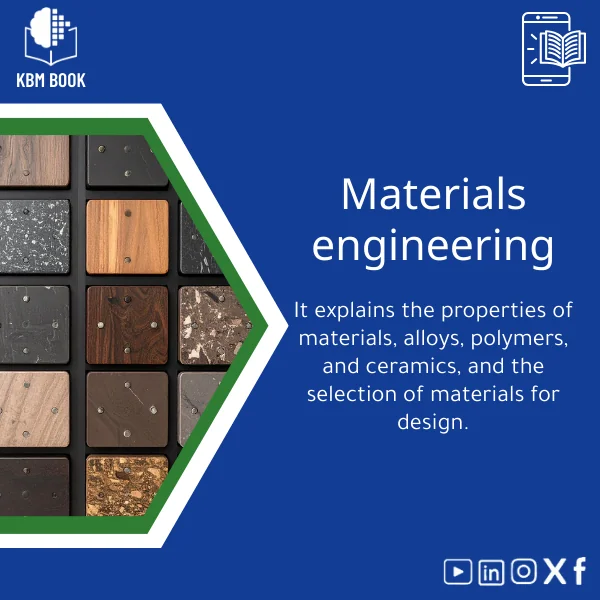
Materials Engineering Guide: Alloys, Polymers, and Ceramics
Original price was: 179.00 $.139.00 $Current price is: 139.00 $.
A searchable, hierarchical Knowledge Base Module (KBM) that converts materials engineering theory into a practical, ready-to-use database for fast material selection, property lookup, testing guidance, and design decision support—ideal for students, researchers, and professionals.
Key benefits & value for the buyer
This KBM transforms dispersed materials engineering knowledge into an organized, searchable resource so you spend less time hunting data and more time making design decisions. Each module converts technical content into practical artifacts: tables, selection matrices, annotated property charts, and compact decision trees.
What you get in day-to-day work
- Instant access to engineering materials properties for preliminary design calculations and comparison (tensile strength, Young’s modulus, thermal conductivity, density, corrosion resistance indices).
- Clear selection workflow: requirements → constraints → candidate materials → testing/verification checklist.
- Sample calculations and worked examples you can adapt for homework, lab reports, or project specs.
- Exportable data sets (CSV/Excel/JSON) for direct use in analysis, simulation, or BOM tools.
Use cases & real-life scenarios
Student — course projects and exams
Quickly assemble a materials selection justification for a design project: pick candidate alloys, show property trade-offs, and attach referenced data tables to lab reports. Example: selecting an aluminum alloy for a lightweight bracket using stiffness-to-weight and fatigue criteria.
Researcher — experiments and literature integration
Use the KBM to cross-reference published material properties with your test results, generate plots comparing expected vs. measured values, and export JSON for reproducible research workflows.
Professional — product development and procurement
Integrate property tables into your design review package, prepare supplier queries with precise property thresholds, or screen materials by cost, availability, and manufacturability constraints using the included decision matrix.
Who is this product for?
The Materials Engineering Guide is designed for students, researchers, and professionals who need structured, reliable access to engineering materials properties and selection guidance:
- Undergraduate and graduate engineering students (materials, mechanical, aerospace, civil).
- Laboratory engineers and researchers validating material behavior.
- Design engineers and product managers who must choose and justify materials quickly.
- Educators and trainers building course modules or lab exercises.
How to choose the right format & edition
KBMs are offered in multiple formats—pick based on your workflow:
- PDF (readable): Best for study and reference. Print-friendly, annotated charts and diagrams.
- Excel/CSV (editable): Use for calculations, filtering, and adding lab measurements.
- JSON (integrable): For researchers and developers who import data into scripts, databases, or simulation tools.
- Full KBM bundle: Includes all formats plus a short guide and sample workflows—recommended for teams and instructors.
If you’re unsure: choose the Full KBM bundle for maximum flexibility. It reduces integration time and supports both learning and production use.
Quick comparison with typical alternatives
Compared to scattered PDFs, textbooks, or raw spreadsheets, this KBM combines hierarchy, searchability, and exportable datasets:
- Textbook: deep theory but slow to extract practical tables; KBM gives concise, actionable data extracts.
- Single PDF table: quick but static; KBM offers editable CSV/JSON for calculations and automation.
- Raw spreadsheet from web: inconsistent formatting and missing context; KBM includes standardized units, references, and selection guidance.
Best practices & tips to get maximum value
- Start with the selection workflow inside the KBM: define functional requirements, constraints, and ranking criteria before filtering materials.
- Use the provided sample calculations to verify unit consistency and adapt them to your boundary conditions.
- Integrate JSON exports into your analysis scripts to avoid manual copy/paste errors and keep results reproducible.
- Cross-check critical properties with referenced standards (ASTM/ISO notes included) when moving to procurement or certification stages.
Common mistakes when buying/using materials data — and how to avoid them
- Mistake: Using a single property to decide (e.g., tensile strength only). Fix: Use multi-criteria selection matrices included in the KBM.
- Mistake: Ignoring manufacturing constraints. Fix: Consult the manufacturability notes and process-specific property variations in the KBM.
- Mistake: Relying on outdated or unreferenced numbers. Fix: Each data table includes references and typical variation ranges; check update logs.
- Mistake: Assuming PDF is enough for analysis. Fix: Use the Excel/CSV files for calculations and the JSON for integrations.
Product specifications
- Title: Materials Engineering Guide: Alloys, Polymers, and Ceramics
- Format: PDF (readable), Excel/CSV (editable), JSON (integrable)
- Content scope: Alloys (ferrous & non-ferrous), polymers (thermoplastics & thermosets), ceramics, composites, material selection matrices, testing & standards notes, worked examples
- Data: >1,000 material entries with mechanical, thermal, electrical, and chemical properties (typical values & ranges)
- Delivery: Instant download after purchase; includes usage guide and sample workflows
- Language: English
- Updates: Periodic content updates and errata included for purchasers
- License: Single-user commercial and educational license (team and site licenses available)
Frequently asked questions
What formats are included and which should I choose?
The KBM bundle includes PDF for reading, Excel/CSV for calculations, and JSON for integration. Choose PDF if you need a study/reference copy; choose Excel/CSV if you plan calculations or lab entries; choose the Full KBM bundle for all workflows.
How current and reliable is the data?
Data is compiled from standard references and industry sources and presented with typical ranges and citation notes. Purchasers receive periodic updates and access to an errata log. For final certification or procurement, always verify against supplier data sheets and applicable standards.
Can I integrate the data with simulation tools?
Yes. JSON exports are structured for easy parsing and integration. CSV and Excel are also provided for import into most simulation and FEA pre-processing workflows.
What if I need a team or site license?
Team and site licenses are available. Contact KBMBook for a license quote tailored to your organization and deployment needs.
Refunds and previews — can I view a sample before buying?
KBMBook provides a free sample extract with a preview of the table structure and one example module. Refund policy details are available on the purchase page; we aim to ensure you can evaluate the KBM before committing.
Ready to speed up material selection and analysis?
Get instant access to a structured materials engineering database that moves from classroom theory to practical design decisions. Includes searchable tables, decision tools, and exportable datasets—ready for coursework, research, or product development.
Related products
Atomic Physics Guide: Understanding Atomic and Electron Properties
Knowledge Base — Atomic/Electron Properties & Electromagnetic Interactions. A structured, searchable KBM for students, researchers, and professionals who need an authoritative atomic physics reference that organizes concepts, formulas, experiments, and practical applications from basics of atomic physics to advanced electron properties.
Comprehensive Microbiology Book on Bacteria, Viruses, and Fungi
General and Special Relativity Book on Einstein’s Theory
A structured, searchable Knowledge Base Module (KBM) that converts Einstein's General and Special Relativity into a clear, hierarchical reference: formulas, derivations, worked examples, practical applications (GPS, astrophysics), and a compact research bibliography — ready to download and integrate into study, teaching, or research workflows.
General Physics Book: Fundamentals of Force, Motion, Energy
Introductory General Chemistry Book on Matter and Reactions
A structured, searchable Knowledge Base Module (KBM) that converts core general chemistry concepts — matter, elements, reactions, stoichiometry and molarity — into a hierarchical reference you can query, teach from, or integrate into study workflows. Ideal as a concise General Chemistry book alternative for students, researchers, and professionals who need accurate, practical chemistry knowledge fast.
Reviews
Clear filtersThere are no reviews yet.