


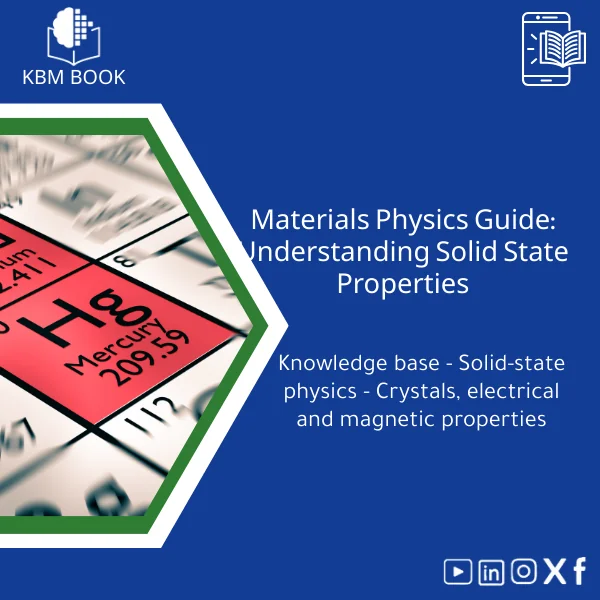
Materials Physics Guide: Understanding Solid-State Properties
Original price was: 179.00 $.139.00 $Current price is: 139.00 $.
A hierarchical, searchable knowledge base for materials physics — from crystal lattices to electrical and magnetic properties — organized to give students, researchers, and professionals instant access to reliable, practical reference content.
Key benefits & value for the buyer
This materials physics KBM translates complex theory into a compact, searchable reference suited to rapid decision-making and learning. Each feature is designed to deliver concrete outcomes:
- Faster problem-solving: Indexed derivations and formula sheets reduce time spent hunting through textbooks or articles.
- Consistent teaching & reporting: Reusable modules (crystal symmetry tables, measurement protocols) ensure standardization across labs and coursework.
- Applied focus: Examples tied to real materials (semiconductors, ferromagnets, ceramics) show how crystal structure of materials affects electrical and magnetic properties.
- Interoperable data: Exportable datasets and templates speed up experiments, simulations, and literature synthesis.
Use cases & real-life scenarios
1. Laboratory prep and execution
Before an experiment on resistivity or Hall effect, open the KBM to the step-by-step measurement checklist, calibration notes, and a template for capturing raw data — all tailored to the material class (metals, semiconductors, insulators).
2. Coursework and exam revision
Students use the modular summaries for quick review: crystal lattice systems, Brillouin zones, and an annotated list of typical approximations used in solid state physics basics.
3. R&D & materials selection
Engineers filter the KBM by property (thermal conductivity, band gap, magnetoresistance) and retrieve decision trees for selecting candidate materials, supported by sample cost/availability notes and fabrication constraints.
4. Literature review & proposal writing
Researchers extract concise background sections and citation-ready definitions to accelerate writing grant proposals or introduction sections for papers.
Who is this product for?
Designed for anyone who needs a reliable, fast-reference materials physics book in a database format:
- Undergraduate and graduate students preparing labs, assignments, or qualifying exams.
- Academic and industry researchers conducting materials characterization, simulations, or cross-disciplinary studies.
- R&D engineers and product developers who must select materials based on structure–property relationships.
- Instructors and trainers building structured lesson plans or practical exercises.
How to choose the right KBM variant
KBMBook offers the Materials Physics Guide in several delivery options. Choose based on your workflow:
- Student Pack: Condensed modules, printable cheat-sheets, and exam-focused examples — best for coursework.
- Research Pack: Full dataset exports, extended derivations, and literature links — best for thesis work and papers.
- Lab Pack: Measurement protocols, template logs, and troubleshooting guides — best for experimental teams.
All variants include the same hierarchical structure; they differ only in depth and included export formats.
Quick comparison with typical alternatives
Compared to a traditional textbook or scattered articles, this KBM offers:
- Faster lookup vs. books (indexed, modular entries vs. linear chapters).
- Practical templates vs. conceptual-only texts (ready-to-use lab and reporting formats).
- Exportable data vs. static PDF pages (integrates with your notes and tools).
If you value time-to-answer and reusability over narrative depth, a KBM is a more efficient purchase than a single monograph.
Best practices & tips to get maximum value
- Integrate the KBM into your reference manager: import metadata and use it as canonical definitions for reports and slides.
- Start with the “Fundamentals” module and then switch to targeted modules (band theory, defects) when working on a specific task.
- Use the export templates for lab notebooks to maintain reproducible records and speed peer review.
- Keep one copy as the canonical source for group projects to ensure terminology and formatting consistency.
Common mistakes when buying or using similar resources — and how to avoid them
- Mistake: Buying an overly broad atlas of physics. Fix: Choose a focused KBM on solid-state topics to avoid irrelevant content.
- Mistake: Assuming print-style structure will suit fast lookup. Fix: Verify the KBM offers hierarchical indexing and exportable snippets.
- Mistake: Overlooking licensing limits. Fix: Check the usage terms for classroom sharing or institutional deployment before purchase.
Product specifications
- Title: Materials Physics Guide: Understanding Solid-State Properties
- Category: KBM Book – Natural Sciences Section
- Core topics: crystal lattice systems, electronic band structure, transport phenomena, magnetic ordering, defects & interfaces
- Formats included: searchable HTML, printable PDF, JSON, CSV, and Markdown snippets
- Depth options: Student Pack (concise), Research Pack (extended), Lab Pack (protocols)
- Compatibility: works with standard reference managers and text editors; CSV/JSON ready for analysis tools
- Language: English
- Delivery: Instant digital download after purchase
FAQ
What exactly is included in the KBM? (contents & formats)
The KBM includes hierarchical modules covering crystal structure of materials, solid state physics basics, electrical and magnetic properties, worked examples, experimental templates, and bibliographic links. Files are provided as HTML for browsing, PDF for printing, and JSON/CSV/Markdown for integration with tools.
Can I use the content in class or share it with colleagues?
Personal use and classroom presentations are allowed. Institutional redistribution or resale requires a site license. Check the licensing options during checkout to add team or institutional access.
How often is the KBM updated?
Content is reviewed and updated periodically to reflect important advances and corrections. Purchasers receive update notifications and can download the latest version from their account for a defined update window stated at purchase.
Will this replace a textbook?
The KBM is designed as a practical reference and database rather than a replacement for narrative textbooks. It complements textbooks by providing structured, searchable modules and practical templates that speed applied work and revision.
Ready to speed up your work in materials physics?
Purchase the KBM now and gain instant access to a well-structured, exportable knowledge base that makes the crystal structure of materials and their physical properties immediately usable in class, lab, and research.
Related products
Analytical Chemistry Book: Qualitative and Quantitative Methods Guide
Biochemistry Book: Understanding Chemical Processes in Living Systems
Comprehensive Microbiology Book on Bacteria, Viruses, and Fungi
Electromagnetism Book: A Comprehensive Guide to Fields and Circuits
Molecular Biology Guide: Transcription, Translation & Repair
Physical Chemistry Guide: Energy, Thermodynamics & Interactions
A structured Knowledge Base Module (KBM) for Physical Chemistry that converts core theory, worked examples, and applied datasets into a searchable, hierarchical database — ideal for students, researchers, and professionals who need fast, reliable access to chemical thermodynamics basics and molecular interaction models.
Thermal Physics Guide: Understanding Heat, Energy, and Entropy
A downloadable, hierarchically structured Knowledge Base Module (KBM) that converts university-level thermodynamics into a searchable, practical digital database. Ideal for students, researchers, and professionals who need fast, reliable access to fundamentals and advanced topics in thermal physics.
Reviews
Clear filtersThere are no reviews yet.