


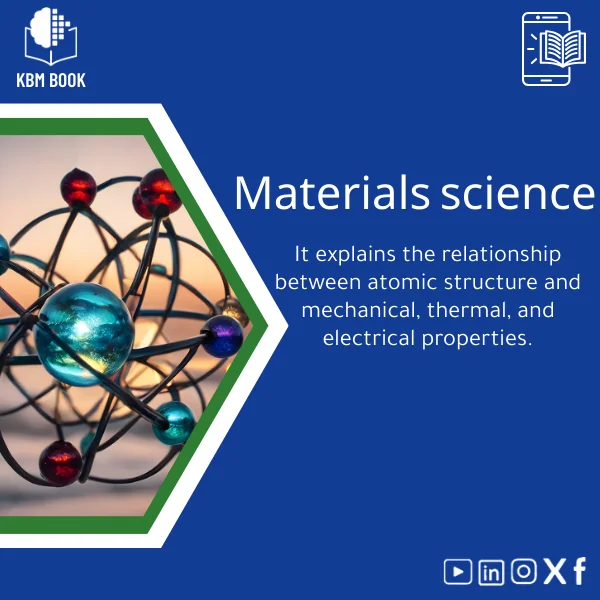
Materials Science Guide: Understanding Structure-Property Relations
Original price was: 179.00 $.139.00 $Current price is: 139.00 $.
A hierarchical, searchable Knowledge Base Module (KBM) that explains how atomic structure, microstructure, and processing control mechanical, thermal and electrical behavior — built for students, researchers, and practicing engineers who need fast, reliable reference and practical decision-making tools.
Key benefits & value for the buyer
This KBM transforms core materials science knowledge into an actionable reference. Instead of wading through long chapters or scattered notes, you get:
- Immediate answers: Single-topic modules (e.g., crystal defects, diffusion, thermal conductivity) reduce search time; ideal when you need a fact, equation, or diagram during lab work or design reviews.
- Structured reasoning: Hierarchical sequences guide you from fundamentals (atomic bonding) to applied topics (composite design, fatigue life estimation), supporting both learning and decision-making.
- Practical outputs: Ready tables, sizing formulas, experimental checks, and example calculations you can copy into reports or slide decks.
- Integration-ready: Download PDF for offline study plus CSV/JSON tables that integrate with spreadsheets and simulation workflows.
Use cases & real-life scenarios
For students
Prepare for exams faster: follow the “structure → property → evidence” path for each topic. Use the KBM’s concise formula blocks for stress-strain problems and the worked examples for lab reports.
For researchers
Rapidly locate experimental relations (e.g., thermal conductivity vs. porosity), standard equations, and cross-referenced literature nodes to check assumptions before simulations or experiments.
For professionals & engineers
Make material selection decisions with confidence: compare mechanical, thermal and electrical behavior entries; use decision flowcharts for selecting alloys, ceramics, polymers, or composites in a product design review.
Practical example
Designing a heat sink: use the KBM to compare copper and aluminum alloys by thermal conductivity, weight penalty, manufacturability notes and temperature-dependent strength — then export the relevant property table to your spreadsheet and run a trade-off analysis in minutes.
Who is this product for?
Targeted to:
- Undergraduate and graduate students studying mechanics, thermodynamics, and materials courses.
- Laboratory researchers needing quick-reference data and experimental checklists.
- Design and R&D engineers who require a compact materials reference for engineering decisions.
- Trainers and educators building curriculum modules from fundamentals to advanced topics.
How to choose the right KBM scope
KBMs are offered in scope tiers. Choose by your immediate need:
- Fundamentals pack: If you need a materials science book PDF covering engineering materials fundamentals and classroom essentials.
- Applied pack: If your work requires selection criteria, failure analysis and case studies for industry applications.
- Complete pack: Full hierarchy with CSV/JSON tables, example datasets and extended reference lists for researchers.
If unsure, start with the Fundamentals pack and upgrade — modules are designed to stack without duplication.
Quick comparison with typical alternatives
Alternatives include traditional textbooks, scattered PDFs, and online articles. Compared to those, this KBM offers:
- More targeted structure — no repeated background material; each module is atomic and cross-linked.
- Faster retrieval — searchable fields and exportable tables vs. static book pages.
- Better integration — machine-readable tables for engineers vs. prose-only resources.
Best practices & tips to get maximum value
- Use the search index when you need a single formula or property value; don’t read linearly unless you’re studying a new topic.
- Export property tables to CSV before simulation runs to avoid transcription errors.
- Reference module citation blocks directly in reports — each KBM includes recommended citation text and primary sources.
- Combine modules: link the “phase diagrams” module with “heat treatment” and “mechanical properties” for alloy design tasks.
Common mistakes when buying/using similar products — and how to avoid them
- Mistake: Choosing a general textbook expecting quick lookup. Fix: Choose a KBM for concise, modular access.
- Mistake: Copying property values without checking units or test conditions. Fix: Use the KBM’s condition notes and conversion helpers included with each table.
- Mistake: Ignoring integration options. Fix: Download the CSV/JSON exports to validate data in your tools.
Product specifications
- Format: Hierarchical KBM package — downloadable PDF + CSV and JSON tables
- Size: ~250–400 pages equivalent; 40+ atomic modules and 60+ reference tables
- Coverage: Atomic bonding, crystal structures, defects, diffusion, phase diagrams, mechanical behavior (elasticity, plasticity, fracture, fatigue), thermal and electrical transport, composites and coatings
- Includes: Worked examples, decision flowcharts, lab checklists, citation-ready references
- Language: English; Arabic metadata and support notes available
- License: Single user download; team and institutional licenses available
- Compatibility: PDF reader; CSV/JSON compatible with Excel, MATLAB, Python, and simulation software
FAQ
Is this a materials science book PDF or an interactive database?
The package includes a readable materials science book PDF for study plus machine-readable tables (CSV/JSON) and a structured module map designed for quick lookup and integration with engineering workflows.
Will the data fit professional engineering needs (units, test conditions, accuracy)?
Yes. Each property table includes units, standard test conditions, measurement methods, and confidence notes. For critical design work, cross-check with primary standards cited in the module.
Can I use sections in my reports or slides?
Yes. The KBM includes citation-ready text blocks and figures for non-commercial academic and professional reports. Commercial redistribution requires a business license.
What if I need more detailed datasets or labs?
Upgrades are available: extended datasets, raw experimental tables, and lab protocols for faculty or research teams. Contact support through KBMBook for custom packages.
Ready to get reliable materials insight?
Download a focused, professionally organized Materials Science KBM that saves time, reduces errors and accelerates decisions. Whether you want a materials science book PDF for study or engineering materials fundamentals for design, this KBM is structured to fit into your workflow.
Related products
Atomic Physics Guide: Understanding Atomic and Electron Properties
Knowledge Base — Atomic/Electron Properties & Electromagnetic Interactions. A structured, searchable KBM for students, researchers, and professionals who need an authoritative atomic physics reference that organizes concepts, formulas, experiments, and practical applications from basics of atomic physics to advanced electron properties.
Comprehensive Genetics Book: DNA, Mendelian Genetics & Engineering
A structured, searchable knowledge base module (KBM) that turns genetics theory and practice into an immediately usable digital reference — from DNA structure to Mendelian genetics and contemporary genetic engineering techniques — optimized for students, researchers, and professionals who need reliable answers fast.
Electromagnetism Book: A Comprehensive Guide to Fields and Circuits
General and Special Relativity Book on Einstein’s Theory
A structured, searchable Knowledge Base Module (KBM) that converts Einstein's General and Special Relativity into a clear, hierarchical reference: formulas, derivations, worked examples, practical applications (GPS, astrophysics), and a compact research bibliography — ready to download and integrate into study, teaching, or research workflows.
Materials Physics Guide: Understanding Solid-State Properties
Modern Physics Book: Quantum, Relativity, and Tech Applications Guide
A structured, searchable Knowledge Base Module (KBM) that turns modern physics — quantum mechanics, special & general relativity, and contemporary technological applications — into a hierarchical, practical reference for students, researchers, and professionals who need quick, reliable access to advanced concepts and formulas.
Organic Chemistry Guide: Carbon Chains and Reactions
Thermal Physics Guide: Understanding Heat, Energy, and Entropy
A downloadable, hierarchically structured Knowledge Base Module (KBM) that converts university-level thermodynamics into a searchable, practical digital database. Ideal for students, researchers, and professionals who need fast, reliable access to fundamentals and advanced topics in thermal physics.
Reviews
Clear filtersThere are no reviews yet.