


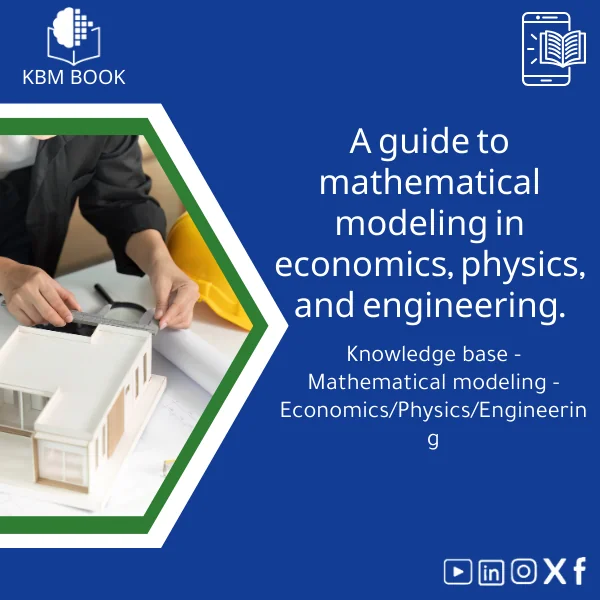
Mathematical Modeling Guide for Economics, Physics, and Engineering
Original price was: 349.00 $.279.00 $Current price is: 279.00 $.
A hierarchical, searchable Knowledge Base Module (KBM) that converts mathematical modeling theory into ready-to-use model libraries, worked examples, and code templates for economics, physics, and engineering — designed for students, researchers, and professionals who need accurate answers fast.
Key benefits & value for the buyer
This Mathematical Modeling KBM translates theory into practical tools. Each feature is designed to save time and reduce uncertainty when building or evaluating models:
From feature to benefit
- Hierarchical structure: Learn concepts in the correct sequence, avoiding gaps and repetition — ideal for course planning or self-study.
- Worked examples: Step-by-step solutions (economic equilibrium, heat equation, beam bending) that you can adapt directly to assignments and projects.
- Code-ready templates: Python/MATLAB/R snippets for solving ODEs/PDEs, regression systems, and optimization problems — reduces setup time dramatically.
- Data & test cases: Small, curated datasets and validation cases so you can verify results quickly and reproduce experiments.
- Exportable modules: Easy to import into Jupyter, MATLAB Live Scripts, or spreadsheet tools — integrates with existing workflows.
Use cases & real-life scenarios
How buyers actually use this KBM in day-to-day work and study:
For students
Prepare assignments and lab reports faster: use stepwise templates to set up differential equation models, run simulations, and document results in a reproducible way.
For researchers
Prototype models for manuscripts: borrow validated model structures, calibration routines, and example datasets to shorten the research cycle and improve reproducibility.
For professionals & engineers
Deploy deterministic and stochastic models for forecasting, control, and optimization: adapt ready-made finite-element or control-system templates to engineering problems with minimal customization.
Teaching & training
Build lesson plans and workshops using topic modules and graded exercises; the KBM’s hierarchical flow makes it easy to sequence learning outcomes.
Who is this product for?
The Mathematical Modeling KBM is aimed at:
- Undergraduate and graduate students needing clear, structured material for coursework and projects.
- Researchers who want reproducible model templates and example-driven validation.
- Engineers and data scientists requiring transfer-ready model components for prototypes and reports.
- Instructors and trainers building curriculum or practical labs across economics, physics, and engineering.
How to choose the right KBM level
Choose based on your starting point and intended depth:
- Basics of mathematical modeling: Pick this if you need fundamentals, simple ODE/linear regression examples, and guided exercises.
- Intermediate (applied): Includes multi-variable systems, optimization, numerical methods, and economic modeling applications.
- Advanced (professional): Contains PDE discretization, finite element examples, stochastic simulations, and full reproducible case studies.
Each level includes the same structured hierarchy; advanced modules add depth, code complexity, and additional datasets.
Quick comparison with typical alternatives
Compared with textbooks, papers, or scattered code repositories, this KBM offers:
- Less fluff: No long non-technical chapters — focused entries and direct model artifacts.
- Better searchability: Indexed topics make it faster to find the exact formula, boundary condition, or script you need.
- Higher reusability: Modules are designed to be mixed and adapted; they are not single-run notebooks with hidden dependencies.
Best practices & tips to get maximum value
- Start with the “Modeling workflow” module to align notation and assumptions across examples.
- Use provided test datasets to confirm the code runs in your environment before modifying large models.
- Keep a reproducibility log: the KBM includes a README template for documenting parameter choices and solver settings.
- Integrate snippets into version control (Git) and literate notebooks for reproducible reporting.
Common mistakes when buying or using modeling resources — and how we prevent them
- Mistake: Buying a “book” that lacks runnable code. KBM solution: Every concept includes executable templates and data.
- Mistake: Incomplete examples that don’t scale. KBM solution: Each example has a minimal working case and an extended case for real-world scaling.
- Mistake: Ambiguous notation across topics. KBM solution: Global notation guide and cross-references unify symbols and units.
Product specifications
- Product type: Knowledge Base Module (KBM) — Mathematical Modeling
- Coverage: Economics, Physics, Engineering (multi-domain)
- Structure: ~60 modules; each module contains definitions, worked examples, code snippets, and datasets
- Formats included: JSON, CSV, Markdown, PDF summaries, and code files (.py, .m, .R)
- Compatibility: Jupyter, MATLAB, RStudio, Excel (CSV import)
- Language: English (technical glossary with Arabic key-term index available)
- Delivery: Instant digital download with README and license
- Support: 30-day support for setup and basic usage questions
- Updates: Minor updates included; major updates available as paid upgrades
Frequently asked questions
Is this a textbook or a runnable database?
It is a Knowledge Base Module: a hybrid of concise, textbook-style explanations and runnable artifacts (code, datasets, templates). The emphasis is on practical reuse rather than long-form exposition.
Can I use the models in published research or commercial projects?
Yes — the KBM includes a clear license for research and commercial use with attribution. See the included license file for specifics; contact support for multi-user or site-license questions.
Which tools do I need to run the code examples?
Most examples run in Python (SciPy/NumPy), MATLAB, or R. A spreadsheet-compatible CSV is provided for simple tests. The README lists required packages and quick installation commands.
What if the KBM doesn’t fit my exact course or project?
Modules are designed to be mixed and adapted. If a module is too basic, the intermediate and advanced modules can be combined. Support can advise on how to adapt content to your syllabus or project constraints.
Ready to build reliable models faster?
The Mathematical Modeling KBM puts structured knowledge, verified examples, and runnable templates into your hands so you can focus on analysis and decisions — not setup and guesswork.
Instant download. Includes README, license, and 30-day support for setup questions. If you have concerns about fit or integration, contact support before purchase for guidance.
Related products
Analytical Chemistry Book: Qualitative and Quantitative Methods Guide
Astronomy Observational Techniques Guide for Celestial Motion
Comprehensive Genetics Book: DNA, Mendelian Genetics & Engineering
A structured, searchable knowledge base module (KBM) that turns genetics theory and practice into an immediately usable digital reference — from DNA structure to Mendelian genetics and contemporary genetic engineering techniques — optimized for students, researchers, and professionals who need reliable answers fast.

Comprehensive Nuclear Physics Book on Structure and Radioactivity
Introductory General Chemistry Book on Matter and Reactions
A structured, searchable Knowledge Base Module (KBM) that converts core general chemistry concepts — matter, elements, reactions, stoichiometry and molarity — into a hierarchical reference you can query, teach from, or integrate into study workflows. Ideal as a concise General Chemistry book alternative for students, researchers, and professionals who need accurate, practical chemistry knowledge fast.



Reviews
Clear filtersThere are no reviews yet.