


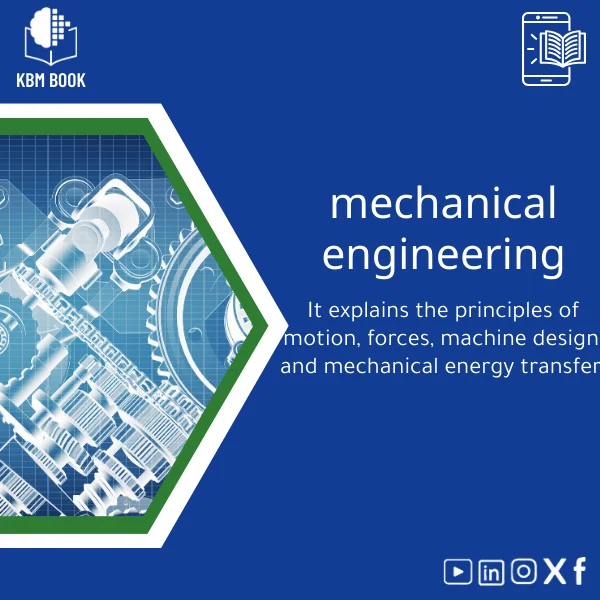
Mechanical Engineering Guide to Motion, Forces, and Design
Original price was: 179.00 $.139.00 $Current price is: 139.00 $.
A structured, searchable knowledge base covering mechanics, motion, forces, machine design, and power transmission — designed for students, researchers, and professionals who need reliable, fast access to applied mechanical engineering knowledge.
Key benefits & value for buyers
This Mechanical Engineering KBM translates core subjects — motion, forces, machine design, and power transmission — into an actionable reference you can use during study, research, or fieldwork. The content is organized to reduce search time and cognitive load:
From features to outcomes
- Hierarchical organization: Find foundational definitions, step-by-step derivations, and advanced notes in seconds — saves hours compared with linear textbooks.
- Design-ready templates: Pre-filled calculation sheets and decision flowcharts speed up component sizing and failure analysis.
- Cross-referenced modules: Link motion kinematics to stress analysis and bearing selection without duplicating content.
- Downloadable & integrable formats: Use the PDF for reading, CSV for spreadsheet work, or JSON for integration with research tools and LMS.
Use cases & real-life scenarios
How this KBM fits into real workflows:
- University labs: Students use the modules to validate lab results, compare expected kinematic profiles, and check force equilibrium before experiments.
- Research projects: Researchers extract exact derivations, unit-consistent formulas, and recommended references for papers or simulation setups.
- Design offices: Junior engineers run quick bearing, shaft, and gear checks using the included calculation templates and failure-mode guidelines.
- Self-study: Professionals brushing up on “basics of mechanical engineering” and “introduction to mechanical engineering” follow a progressive path from fundamentals to applied design.
Example: A mechanical design intern uses the “power transmission” module to size a gearbox, applying the KBM’s torque diagrams and safety factors—cutting design review time by half.
Who is this product for?
This KBM is tailored for:
- Undergraduate and graduate students preparing for exams or lab reports.
- Researchers needing quick access to validated derivations and parameter tables.
- Junior and mid-level mechanical engineers performing routine design and verification.
- Instructors creating structured modules or assignments with clear learning progressions.
How to choose the right KBM version
Pick the version that matches your workflow:
- Starter (PDF): Best if you want “mechanical engineering book pdf” style reading and printable worksheets.
- Professional (PDF + CSV): Includes calculation spreadsheets and component tables—ideal for engineers who use spreadsheets every day.
- Research pack (JSON + CSV + PDF): For researchers and teams that need to import modules into tools or conduct meta-analysis across topics.
If unsure, select the Professional pack—balanced for study and applied work. All versions include a sample chapter preview before purchase.
Quick comparison with typical alternatives
Why a KBM beats single textbooks, scattered articles, or video tutorials for many tasks:
- Textbooks: Deep but linear; KBMs are modular and searchable for targeted problems.
- Online articles: Fragmented and inconsistent; KBMs provide vetted, cross-referenced knowledge with uniform notation.
- Video courses: Great for concepts, but slow for lookup. KBMs offer immediate answers, formulas, and calculation templates.
Best practices & tips to get maximum value
- Start with the module map to identify the minimum required chapters for your task (lab report, design check, or literature review).
- Use CSV templates to keep calculation provenance — store inputs, versions, and notes alongside your work.
- Cross-reference the KBM citation list when writing reports or publications to ensure consistent sourcing.
- Periodically check for updates — KBMBook issues patch notes when formulas, units, or recommendations change.
Common mistakes when buying or using similar resources — and how to avoid them
- Mistake: Buying a single-format PDF when you need data tables. Fix: Choose the Professional or Research pack.
- Mistake: Assuming textbook notation matches your project’s units. Fix: Use the KBM’s unit-consistency checklist before calculations.
- Mistake: Overlooking update and citation details. Fix: Track KBM version numbers and include them in your project documentation.
Product specifications
- Title: Mechanical Engineering Guide to Motion, Forces, and Design
- Formats: Interactive PDF, CSV calculation templates, JSON module export
- Size: PDF ~18–40 MB depending on pack; CSV and JSON ~2–10 MB combined
- Structure: 6 major modules (Kinematics, Dynamics, Statics, Strength of Materials, Machine Design, Power Transmission) with 48 submodules and 120+ worked examples
- Language: English (technical terminology aligned with international standards)
- License: Single-user commercial & educational license; team licenses available
- Updates: Minor corrections & errata free for 12 months; major version upgrades offered at a discount
- Compatibility: PDF readers, spreadsheet software (Excel/LibreOffice), JSON-compatible research tools
Frequently asked questions
Is this a “mechanical engineering book pdf” I can print?
Yes. The Starter and Professional packs include a well-formatted PDF optimized for screen reading and printing. Pages include numbered sections and a hyperlinked index for quick navigation.
Will this cover the basics of mechanical engineering for beginners?
Yes. The KBM begins with introductory modules that explain core concepts and build up to applied design topics. The progressive structure makes it suitable for those seeking an “introduction to mechanical engineering.”
How do I trust the quality of formulas and design recommendations?
KBMBook sources content from peer-reviewed references, standard engineering handbooks, and industry practice. Each module includes references, derivation steps, and notes on assumptions and safety factors.
Can I use the content commercially (e.g., in client reports)?
The single-user license allows use in professional work; attribution is requested for published reports. Team and extended licenses are available for multi-user commercial deployment.
Ready to streamline mechanical engineering work?
Choose the version that fits your workflow and get immediate access to a structured, reliable knowledge base that reduces lookup time and improves design confidence.
Need a team license or preview sample? Contact KBMBook support before purchase for trials and volume pricing.
Related products
Analytical Chemistry Book: Qualitative and Quantitative Methods Guide

Astrophysics Book: Understanding Stars, Galaxies, and Dark Energy
A searchable, hierarchical Knowledge Base Module (KBM) that converts astrophysics and cosmology into a practical, exam-ready and research-ready reference. Designed for students, researchers, and professionals who need immediate access to reliable explanations, equations, and data models for stars, galaxies, and dark energy.
Biochemistry Book: Understanding Chemical Processes in Living Systems
Classical Mechanics Guide: Newton’s Laws and Dynamics
A searchable, hierarchical Knowledge Base Module (KBM) that turns classical mechanics into a practical, ready-to-use reference for fast problem solving, lecture preparation, and applied engineering. Designed for students, researchers, and professionals who need precise access to Newton’s laws, rotational motion, and applied dynamics without the noise of textbooks.

Comprehensive Evolutionary Biology Book on Natural Selection

Cosmology Book: Guide to Big Bang and Galaxy Evolution

Introductory General Chemistry Book on Matter and Reactions
A structured, searchable Knowledge Base Module (KBM) that converts core general chemistry concepts — matter, elements, reactions, stoichiometry and molarity — into a hierarchical reference you can query, teach from, or integrate into study workflows. Ideal as a concise General Chemistry book alternative for students, researchers, and professionals who need accurate, practical chemistry knowledge fast.
Thermal Physics Guide: Understanding Heat, Energy, and Entropy
A downloadable, hierarchically structured Knowledge Base Module (KBM) that converts university-level thermodynamics into a searchable, practical digital database. Ideal for students, researchers, and professionals who need fast, reliable access to fundamentals and advanced topics in thermal physics.

Reviews
Clear filtersThere are no reviews yet.