


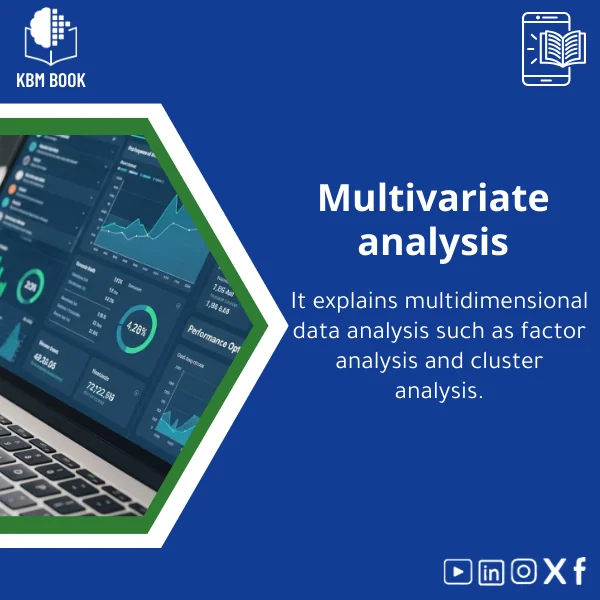
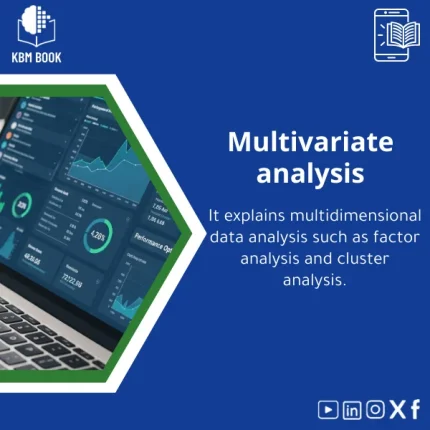
Multivariate Analysis Guide: Factor and Cluster Methods
Original price was: 199.00 $.159.00 $Current price is: 159.00 $.
A structured, searchable Knowledge Base Module (KBM) that turns multivariate analysis theory into ready-to-use workflows: clear explanations of factor and cluster methods, practical examples, annotated code snippets, and decision-checklists for research and professional projects.
Key benefits & value for buyers
This KBM converts multivariate analysis—especially factor analysis and cluster analysis—into structured, actionable knowledge you can reuse. Each module translates methods into outcomes you care about:
- Save time: replace scattered notes and multiple textbooks with a single, indexed resource that contains conceptual summaries, assumptions checks, and code templates.
- Increase reproducibility: annotated scripts and sample datasets let you reproduce results and include exact procedures in methods sections.
- Improve decisions: decision trees and diagnostic matrices help you choose the right extraction method, rotation, clustering algorithm, and validation metrics.
- Cross-disciplinary examples: practical end-to-end analyses tailored to social sciences, marketing, bioinformatics, and product analytics.
Use cases & real-life scenarios
Academia — Thesis & papers
When validating survey constructs, use the factor analysis templates to run EFA, confirmatory factor checks, and report loadings with recommended cutoff rules and reporting tables formatted for publication.
Market research & product teams
Segment customers with cluster analysis workflows that guide feature selection, distance measures, and cluster validation so product teams can prioritize segments by value and behavior.
Data science & analytics
Use the PCA & factor pipelines to reduce dimensionality for predictive modeling, with clear guidance on when and how to use component scores versus rotated factor scores.
Health & bioinformatics
Apply clustering modules for cohort discovery and feature grouping, with notes on preprocessing genomic data and avoiding common pitfalls with high-dimensional inputs.
Who is this product for?
Designed for the target audience—students, researchers, and professionals—who need reliable, organized access to multivariate data analysis knowledge:
- Undergraduate and graduate students learning multivariate analysis or preparing theses.
- Researchers needing repeatable procedures for factor extraction and cluster validation.
- Data analysts and consultants who perform segmentation, dimensionality reduction, or construct validation regularly.
- Trainers and instructors looking for clear teaching modules and classroom-ready examples.
How to choose the right edition
Our KBM comes in tiered editions to match skill and project needs:
- Starter: Concept maps, assumptions checklists, and worked examples — best for students and early learners.
- Professional: Full code templates (R/Python), multiple sample datasets, and report-ready tables — best for researchers and analysts.
- Complete: Everything above plus advanced modules (confirmatory approaches, ensemble clustering), and extended case studies — best for teams and trainers.
Choose based on the complexity of your projects and whether you need reproducible code and extended case studies. If unsure, the Professional edition covers most research and business use-cases.
Quick comparison with typical alternatives
How this KBM differs from common sources:
- Textbooks: Deep theory but scattered examples. KBM provides compact, step-by-step workflows plus code and outputs.
- Blog posts & articles: Often shallow and fragmented. KBM is hierarchical and exhaustive—no need to assemble fragments from multiple posts.
- Library of slides: Good for overview, poor for reproducibility. KBM includes runnable scripts and downloadable datasets.
Best practices & tips to get maximum value
- Start with the assumptions checklist before running analyses—this prevents wasted time on invalid models.
- Use the provided sample datasets to test pipelines end-to-end before applying them to your data.
- Follow the interpretation templates to write clear results sections; copy-ready tables reduce revision time.
- Combine factor and cluster modules: reduce dimensions with factor scores, then cluster for more stable segmentation.
Common mistakes when buying or using multivariate resources—and how to avoid them
- Mistake: Buying a theory-only resource. Fix: Choose the edition with reproducible code and examples.
- Mistake: Skipping preprocessing guidance. Fix: Use the KBM’s preprocessing checklist (missing data, scaling, outliers) before analysis.
- Mistake: Applying clustering without validation. Fix: Follow internal validation and stability checks included in the module.
Product specifications
- Product type: Knowledge Base Module (KBM) — digital download.
- Contents: Concept summaries, decision trees, annotated R & Python scripts, sample datasets (CSV), plots, and report templates (Word/Markdown).
- Editions: Starter, Professional, Complete (choose in checkout).
- File formats: PDF, CSV, .R, .py, .md, .docx.
- Language: English (structured Arabic metadata available on KBMBook platform).
- License: Single-user license by default; team licenses available at checkout.
- Delivery: Instant download after purchase; includes update notifications for major revisions.
- Compatibility: Works with common analysis environments (RStudio, Jupyter, Excel for CSV imports).
FAQ
Can I run the provided code with my data?
Yes. All scripts include inline comments and a preprocessing section. Replace the sample CSV input with your file and follow the variable-mapping checklist. The Professional and Complete editions include extra notes for high-dimensional datasets.
Which edition should I choose for a master’s thesis?
The Professional edition is recommended for most theses: it provides reproducible scripts, interpretation templates, and multiple validation techniques. Choose Complete if you need confirmatory modeling or extended case studies.
Is the KBM updated for new methods?
Yes. KBMBook issues updates for major methodological advances and improved workflows. Purchasers receive update notifications and can download revised modules when available.
What if I need help applying a template to my project?
Each purchase includes a limited support guide and troubleshooting notes. For detailed consulting, KBMBook offers paid support packages—see the help center after purchase.
Ready to standardize your multivariate analysis workflow?
Get a structured, searchable knowledge base that saves time, improves reproducibility, and supports publication-ready reporting. Choose the edition that matches your needs and download instantly.
Need a team license or training bundle? Contact KBMBook support after purchase for custom options.
Related products
Cell Biology Guide: Structure, Division, and Transport Insights
Comprehensive Botany Book on Plant Taxonomy and Photosynthesis
A structured, searchable botany book designed as a Knowledge Base Module (KBM) — an end-to-end reference on plant taxonomy, organ structure, and the biochemistry of photosynthesis. Built for students, researchers, and professionals who need reliable, hierarchical knowledge they can search, cite, and apply immediately.
Comprehensive Microbiology Book on Bacteria, Viruses, and Fungi

General Physics Book: Fundamentals of Force, Motion, Energy

Materials Physics Guide: Understanding Solid-State Properties
Physical Chemistry Guide: Energy, Thermodynamics & Interactions
A structured Knowledge Base Module (KBM) for Physical Chemistry that converts core theory, worked examples, and applied datasets into a searchable, hierarchical database — ideal for students, researchers, and professionals who need fast, reliable access to chemical thermodynamics basics and molecular interaction models.
Thermal Physics Guide: Understanding Heat, Energy, and Entropy
A downloadable, hierarchically structured Knowledge Base Module (KBM) that converts university-level thermodynamics into a searchable, practical digital database. Ideal for students, researchers, and professionals who need fast, reliable access to fundamentals and advanced topics in thermal physics.
Reviews
Clear filtersThere are no reviews yet.