


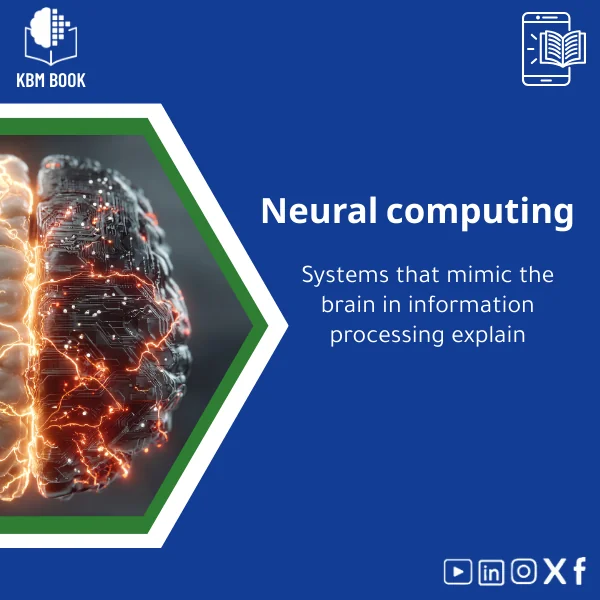
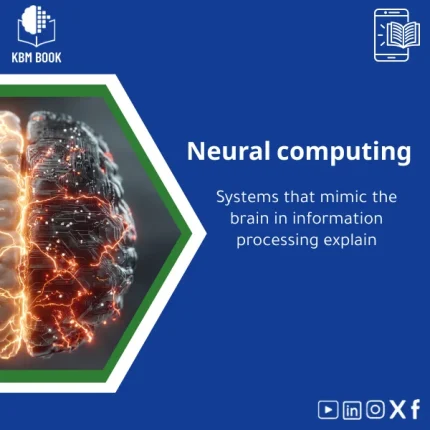
Neural Computing Guide: Understanding Brain-Inspired Systems
Original price was: 199.00 $.159.00 $Current price is: 159.00 $.
A structured, searchable Knowledge Base Module (KBM) that converts advanced concepts in neural computing
into an ordered, practical reference — ideal for students, researchers, and professionals who need fast,
reliable access to brain‑inspired systems, architectures, and implementation patterns.
Key benefits & value for the buyer
Neural Computing Guide turns complex theory into an operational reference. Each entry in the KBM is
intentionally concise and linked: definitions, derivations, comparative notes, implementation templates,
and references are stored in a hierarchical model that minimizes repetition and maximizes reusability.
The result is faster task completion (paper reading, algorithm implementation, course prep) and higher
confidence in technical decisions.
Features translated into buyer value
- Hierarchical modules: Learn progressively — from perceptrons to spiking neural networks — with clear prerequisites.
- Search-first design: Save time when preparing literature reviews or debugging models; find the exact concept and example in seconds.
- Implementation-ready items: Pseudocode, parameter lists, and experiment setups that reduce trial-and-error in labs or projects.
- Interoperable exports: Copy structured sections into reports, slides, or teaching materials without reformatting.
Use cases & real-life scenarios
For a student preparing an exam
Instead of reading scattered articles, a student can use the KBM to drill specific topics (e.g., backpropagation derivation,
regularization methods, or energy-efficient neuromorphic hardware) and pull worked examples to practice on.
For a researcher writing a paper
Use the guide to compare architectures (CNN vs. spiking networks), get authoritative references, and extract reproducible
experiment templates to speed up method sections and ensure consistency across experiments.
For a professional building a prototype
Developers and engineers will use the implementation templates and deployment notes (quantization, pruning, neuromorphic
constraints) to move from concept to prototype faster and with fewer unknowns.
Who is this product for?
The KBM is tailored for three primary groups:
- Students: undergraduate and graduate courses needing a reliable, exam-focused resource for neural computing concepts.
- Researchers: PhD candidates and research teams requiring a compact, linked reference for literature reviews and experiment design.
- Professionals: engineers, data scientists, and product teams integrating brain-inspired systems into real products or demos.
How to choose the right edition & format
The Neural Computing Guide is offered in levels and formats to match your goals:
- Introductory edition: Core concepts, glossary, and foundational exercises. Best if you need an introduction to neural computing book pdf style resources.
- Applied edition: Implementation templates, reproducible experiments, and deployment notes. Best for professionals and lab work.
- Comprehensive edition: Full KBM with research literature links, advanced topics in spiking networks and neuromorphic hardware, and instructor packs.
Formats: downloadable structured files optimized for search (JSON/CSV), printable PDFs, and copy-ready HTML snippets for course materials.
Choose the edition that matches your time horizon: quick learning vs. long-term research reference.
Quick comparison with typical alternatives
Common alternatives are textbooks, scattered articles, and recorded courses. Compared to those, the KBM:
- Is more searchable than a textbook — find specific proofs or parameters quickly.
- Is more up-to-date and modular than a single article — modules are designed to be combined and updated.
- Provides reproducible code patterns unlike many lecture slides — reducing integration time in projects.
If you need a long narrative, a textbook may serve better. If you need actionable, linked knowledge for work or research, this KBM is likely the faster solution.
Best practices & tips to get maximum value
- Start with the module prerequisites list to avoid skipping foundational concepts.
- Use the searchable exports to create a personal cheat sheet for exams or meetings.
- Integrate the pseudocode blocks into your notebooks and tag them with experiment metadata for reproducibility.
- Keep a changelog of which KBM sections you apply in experiments to accelerate future literature reviews.
Common mistakes when buying or using similar products and how to avoid them
- Buying the wrong level: Read the edition descriptions; if you only need fundamentals, avoid the comprehensive pack initially.
- Ignoring format compatibility: Check export formats before purchase to ensure they fit your workflow (PDF vs. structured JSON).
- Assuming completeness: Use the KBM as a primary reference, but cross-check cutting-edge claims with recent papers linked in the modules.
Product specifications
- Product name: Neural Computing Guide: Understanding Brain-Inspired Systems
- Category: Future & Emerging Technologies Section
- Editions: Introductory, Applied, Comprehensive
- Formats available: PDF (print-ready), Structured export (JSON/CSV), HTML snippets
- Primary topics: perceptrons, backpropagation, recurrent networks, spiking neural networks, neuromorphic systems
- Included artifacts: definitions, derivations, pseudocode, experiment templates, reference lists
- Delivery: Instant digital download after purchase — compatible with research and teaching workflows
Frequently asked questions
Is this a “neural computing book pdf” or a searchable database?
It is both. You may download printable PDFs for reading, but the core product is a structured, searchable KBM
designed for quick lookup and reuse (JSON/CSV and HTML snippets). This dual approach supports study and production use.
How current is the content and are references updated?
Each KBM includes a curated reference list with timestamps. The Comprehensive edition receives scheduled updates
to include major new results. Update notes are included with the module so you can assess currency before use.
Can I use sections from the KBM in a published paper or course?
Yes — the KBM is licensed for educational and research use. Attribution and license terms are provided at download;
commercial redistribution requires a separate license. Contact KBMBook support for institutional licensing.
What if I only need a quick introduction to neural computing?
Purchase the Introductory edition. It contains a focused “Introduction to Neural Computing” path that covers core concepts
and essential examples without advanced material.
Get the Neural Computing KBM
Convert theory into practical work. Whether you need a reliable “introduction to neural computing,” a reproducible experiment
pack, or a searchable reference for brain inspired systems and advanced AI technologies, this KBM is structured to accelerate results.
Instant download. Clear licensing for academic and professional use. Contact support for bulk or institutional packages.
Related products
Astrophysics Book: Understanding Stars, Galaxies, and Dark Energy
A searchable, hierarchical Knowledge Base Module (KBM) that converts astrophysics and cosmology into a practical, exam-ready and research-ready reference. Designed for students, researchers, and professionals who need immediate access to reliable explanations, equations, and data models for stars, galaxies, and dark energy.
Cell Biology Guide: Structure, Division, and Transport Insights
General Physics Book: Fundamentals of Force, Motion, Energy

Inorganic Chemistry Guide: Bonding and Crystal Solids
A structured, searchable Knowledge Base Module (KBM) that converts inorganic chemistry fundamentals and advanced topics—bonding models, lattice structures, defects, and solid-state properties—into a practical digital reference for students, researchers, and professionals who need fast, reliable answers without wading through textbooks.

Introductory General Chemistry Book on Matter and Reactions
A structured, searchable Knowledge Base Module (KBM) that converts core general chemistry concepts — matter, elements, reactions, stoichiometry and molarity — into a hierarchical reference you can query, teach from, or integrate into study workflows. Ideal as a concise General Chemistry book alternative for students, researchers, and professionals who need accurate, practical chemistry knowledge fast.

Reviews
Clear filtersThere are no reviews yet.