


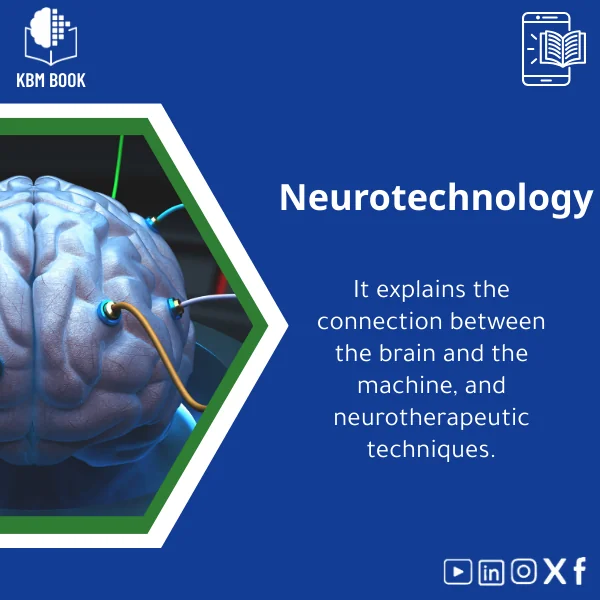
Neurotechnology Guide: Brain-Machine Interfaces & Therapy
Original price was: 179.00 $.139.00 $Current price is: 139.00 $.
A structured, searchable knowledge base for neurotechnology — from fundamentals of brain–machine interfaces to clinical and therapeutic applications. Designed for students, researchers, and professionals who need reliable, hierarchical reference material for study, research, and product development.
Key benefits & value for the buyer
This neurotechnology KBM translates complex, multidisciplinary content into a compact, navigable knowledge database. Each technical feature below is shown with a practical benefit to you.
Feature: Hierarchical modules
Benefit: Learn in a logical progression — from electrophysiology fundamentals, through BCI signal processing, to therapeutic device deployment — without redundant reading.
Feature: Searchable indexes and JSON maps
Benefit: Find answers in seconds; export sections to lab notebooks, presentation slides, or data pipelines.
Feature: Applied examples and SOP-like checklists
Benefit: Apply theory to practice quickly — sample code snippets, experiment checklists, and therapy protocol templates reduce setup time and errors.
Feature: Citations and validated references
Benefit: Confidently use the content in academic work and regulatory submissions; references are curated for reliability and traceability.
Use cases & real-life scenarios
Below are concrete scenarios showing how the neurotechnology KBM fits into daily workflows.
For a graduate student preparing a thesis
Use the chapter on signal preprocessing and artifact removal to design your data pipeline; export the literature list as a formatted reference list for your proposal.
For a research lab developing a BCI prototype
Follow the electrode-selection matrix and safety checklist, adopt the sample firmware architecture, and copy the experimental SOP to shorten design cycles and ensure repeatability.
For clinicians exploring therapeutic neurotechnology
Use the therapy modules to compare stimulation modalities, review clinical trial design examples, and access regulatory guidance summaries for medical device submissions.
For instructors and course designers
Integrate module outlines into syllabi and assign compact KBM sections as reading — students get the structured depth without wading through dozens of papers.
Who is this product for?
The KBM is explicitly built for: students, Master’s and PhD researchers, biomedical engineers, clinicians exploring neurotherapies, and product teams building brain–machine interfaces. If you need dependable, structured knowledge that you can search, cite, and integrate into workflows, this KBM is for you.
How to choose the right format & license
The neurotechnology KBM is offered in multiple digital formats and license tiers. Choose based on how you will use it:
- Student / personal license (PDF + CSV index): Best for study and thesis work.
- Research lab license (PDF + JSON map + Excel workbook): Useable for data integration and SOP sharing across a lab.
- Institutional license (multi-user + export rights): Allows redistribution within a department and integration into LMS platforms.
If you’re unsure, select the trial preview to inspect the table of contents and a sample module before committing.
Quick comparison with typical alternatives
Many buyers consider textbooks, review papers, or scattered online articles. Compared to those:
- Textbooks: More up-to-date and modular; KBM is indexable and exportable for workflows.
- Review articles: Broader but shallow; KBM avoids redundancy and organizes content for action.
- Online posts/forums: Faster to find but unreliable; KBM includes curated citations and validated protocols.
Best practices & tips to get maximum value
- Start with the “Core Concepts” module to align terminology and assumptions across your team.
- Use the CSV index or JSON map to import terms into your lab’s search tools (Obsidian, Notion, or custom DB).
- Copy checklists into your experiment logs to enforce reproducibility and safety.
- Cross-check the KBM references with original papers when preparing regulatory documents — the KBM accelerates discovery but your submission should cite original sources.
Common mistakes when buying/using similar products & how to avoid them
- Mistake: Buying a single long textbook expecting it to be an actionable lab guide.
Fix: Choose a module-based KBM that separates concepts, protocols, and implementation checklists. - Mistake: Assuming a single file format will serve all needs.
Fix: Select a package with both human-readable (PDF) and machine-readable (CSV/JSON) exports. - Mistake: Neglecting license terms for team use.
Fix: Purchase the appropriate license level for institutional sharing if required.
Product specifications
- Title: Neurotechnology Guide: Brain–Machine Interfaces & Therapy
- Format: Searchable PDF, CSV index, JSON module map; Excel workbook available in research tier
- Structure: 8 hierarchical modules (Foundations, Signals, Hardware, Algorithms, Clinical Applications, Regulatory, Protocols, Case Studies)
- Pages / Entries: ~320 pages equivalent; ~1,200 indexed entries and cross-references
- Language: English
- License options: Personal, Research Lab, Institutional
- Delivery: Instant download after purchase; sample preview available
- Updates: Minor content updates free for 12 months; extended update plans available
- Compatibility: Works with standard readers and data tools that accept CSV/JSON imports
FAQ
Is this a textbook or a practical guide?
The KBM combines both: concise theoretical summaries for grounding, plus practical modules — SOPs, checklists, and code snippets — designed for direct application. It is intentionally modular so you can use the parts you need without reading everything sequentially.
Can I integrate the KBM into my lab’s knowledge system (Notion, Obsidian, LMS)?
Yes. The package includes a CSV index and JSON module map to import terms and structure into common knowledge platforms. The research-tier files provide an Excel workbook for quick sharing among team members.
How reliable are the references and clinical sections?
References are curated from peer-reviewed literature, standards, and device guidance. Clinical modules summarize best practices and cite primary sources; for regulatory filings you should cite original papers and device standards directly — the KBM is a curated accelerator, not a substitute for primary citations.
What if the KBM doesn’t meet my needs?
We provide a preview module so you can inspect structure and depth before purchase. Additionally, minor-content update support is included for 12 months. Contact support if a refund or exchange is needed under the purchase terms.
Ready to get structured, usable knowledge on neurotechnology?
Accelerate research, teaching, and development with a knowledge base designed for practical use. Instant download, multiple formats, and tiered licenses to match your project.
Tip: Click to view the preview module before you buy or choose the research tier for team-wide access and data exports.
Related products
Astronomy Observational Techniques Guide for Celestial Motion
Cell Biology Guide: Structure, Division, and Transport Insights
Classical Mechanics Guide: Newton’s Laws and Dynamics
A searchable, hierarchical Knowledge Base Module (KBM) that turns classical mechanics into a practical, ready-to-use reference for fast problem solving, lecture preparation, and applied engineering. Designed for students, researchers, and professionals who need precise access to Newton’s laws, rotational motion, and applied dynamics without the noise of textbooks.
Comprehensive Genetics Book: DNA, Mendelian Genetics & Engineering
A structured, searchable knowledge base module (KBM) that turns genetics theory and practice into an immediately usable digital reference — from DNA structure to Mendelian genetics and contemporary genetic engineering techniques — optimized for students, researchers, and professionals who need reliable answers fast.

Comprehensive Microbiology Book on Bacteria, Viruses, and Fungi

Cosmology Book: Guide to Big Bang and Galaxy Evolution

Introductory General Chemistry Book on Matter and Reactions
A structured, searchable Knowledge Base Module (KBM) that converts core general chemistry concepts — matter, elements, reactions, stoichiometry and molarity — into a hierarchical reference you can query, teach from, or integrate into study workflows. Ideal as a concise General Chemistry book alternative for students, researchers, and professionals who need accurate, practical chemistry knowledge fast.

Reviews
Clear filtersThere are no reviews yet.