


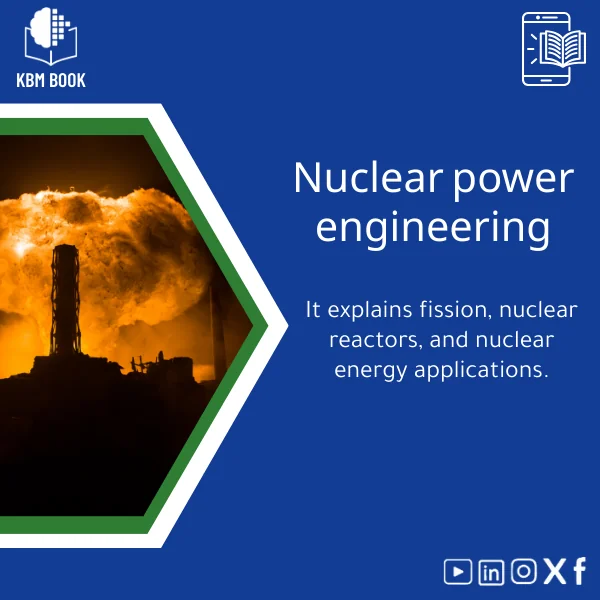
Nuclear Engineering Guide: Fission, Reactors, and Applications
Original price was: 349.00 $.279.00 $Current price is: 279.00 $.
A structured, searchable Knowledge Base Module (KBM) covering nuclear fission, reactor theory, design principles, safety, and real‑world applications — organized for students, researchers, and professionals who need fast, reliable access to technical knowledge.
Key benefits & value for students, researchers, and professionals
This Nuclear Engineering KBM converts dispersed technical material into a single, connected reference designed for quick retrieval and practical use. Each feature of the KBM maps to an immediate benefit:
- Structured learning path: follow a stepwise module progression from basics of nuclear engineering to reactor design guidance — reduces ramp-up time for new learners.
- Time savings: search-ready indexes, annotated equations, and one-page summaries save hours compared to assembling notes from multiple textbooks.
- Operational readiness: checklists and failure-mode summaries help engineers prepare technical reports and design reviews faster and with fewer omissions.
- Reusable data: tabulated cross-sections, decay chains, and thermophysical properties available as CSV/JSON for simulation inputs or lab spreadsheets.
- Academic reliability: references and citation-ready entries support research literature reviews and assignments.
Use cases & real-life scenarios
For students
Use the KBM to prepare for exams or lab assignments: fundamentals chapters, worked problems, and compact formula sheets let you revise quickly. Example: solve reactor kinetics problems by following step‑by‑step worked examples and then exporting relevant tables into your simulation tool.
For researchers
Rapidly assemble literature reviews with an annotated bibliography, compare cross-section datasets, and extract curated data tables for modelling. Scenario: evaluate fuel cycle options by pulling material property tables and procedural checklists into your analysis pipeline.
For professionals & trainers
Integrate the KBM into onboarding material, design reviews, and safety briefings. Example: run a pre‑review checklist for a small modular reactor concept using the KBM’s design and regulatory summary pages.
Who is this product for?
This KBM is crafted for:
- Undergraduate and graduate students studying Nuclear Engineering or related disciplines.
- Researchers needing a consolidated data source for reactor physics, fuel behaviour, and radiation shielding.
- Junior and mid-career engineers responsible for conceptual design, safety assessment, or operational procedures.
- Instructors and trainers seeking concise, reliable modules to include in course materials.
How to choose the right KBM version
The Nuclear Engineering KBM is offered in multiple delivery options. Choose based on your workflow:
- Student Pack (PDF + summary sheets): compact, low file size, ideal for study and exams.
- Research Pack (PDF + CSV/JSON exports): includes raw tables and data extracts for simulation and analysis.
- Professional Pack (full KBM): complete modules, checklists, editable tables, and design templates for engineering teams.
Pick the pack that matches your need for data integration vs. quick reading. If you plan to feed data into tools, choose the Research or Professional Pack.
Quick comparison with typical alternatives
Typical alternatives are single textbooks, scattered articles, or full courses. Compared to those:
- Textbooks: deep but unsearchable and often redundant; the KBM offers modular access and data exports.
- Articles and lecture notes: up-to-date but fragmented; the KBM consolidates and cites the best sources in one place.
- Online courses: interactive learning but not always exportable; the KBM is a practical reference you own and can integrate with tools.
Best practices & tips to get maximum value
- Start with the “Core Concepts” module to align terminology and notation before diving into reactor design sections.
- Use the CSV/JSON exports for simulation inputs rather than retyping numerical tables — this reduces transcription errors.
- Customize the checklists and templates to reflect local regulations or project constraints, then save them as your team’s standard operating templates.
- Keep the annotated bibliography page open when preparing reports — it accelerates accurate citation and literature cross-checks.
Common mistakes when buying or using similar products — and how to avoid them
- Buying a single-format resource: choose a KBM with data exports if you need to run simulations or integrate tables. Avoid PDF-only packs for heavy data work.
- Assuming completeness: check the module list before purchase to confirm coverage of topics you need (e.g., thermal hydraulics, fuel behaviour, shielding).
- Ignoring citation sources: rely on KBMs that include references and version notes so you can validate key figures.
Product specifications
- Title: Nuclear Engineering Guide: Fission, Reactors, and Applications
- Formats: Downloadable PDF (searchable), CSV and JSON data exports, editable checklist templates (DOCX)
- Coverage: Fundamentals of nuclear fission, reactor theory, thermal hydraulics, fuel cycle, control and instrumentation, safety & licensing summaries, design checklists, worked examples
- Language: English (technical notation standard)
- Delivery: Instant digital download after purchase — ZIP package with files
- Compatibility: Works with standard PDF readers and data tools (Excel, Python, MATLAB)
- Usage notes: Single‑user license; team and classroom licenses available on request
Frequently asked questions
Is this a textbook or a practical reference?
It is a structured knowledge database combining both: conceptual chapters for learning and practical modules (checklists, templates, and data exports) for real-world engineering and research use. The format is optimized for quick lookup and integration with tools rather than continuous narrative reading only.
Can I use the included data in simulations?
Yes — the Research and Professional Packs include CSV/JSON extracts of tables (cross-sections, decay data, thermophysical properties) intended for simulation input. Always verify units and version notes before use in safety‑critical analyses.
How current and accurate is the technical content?
The KBM is compiled from established sources and includes inline references and versioning notes. It is curated to be academically reliable; however, for regulatory submissions or safety decisions, cross-check original standards and recent publications cited in the bibliography.
What if the KBM doesn’t cover a specific topic I need?
Before purchase, review the module list (available on the product page). If a topic is missing, contact KBMBook support — extended or custom modules can be commissioned for team licenses.
Ready to get structured, usable Nuclear Engineering knowledge?
Purchase the KBM that matches your workflow and start saving time on study, research, or engineering tasks. Instant download, searchable content, and data exports mean you can go from reading to modelling in minutes.
Related products
Analytical Chemistry Book: Qualitative and Quantitative Methods Guide
Astrophysics Book: Understanding Stars, Galaxies, and Dark Energy
A searchable, hierarchical Knowledge Base Module (KBM) that converts astrophysics and cosmology into a practical, exam-ready and research-ready reference. Designed for students, researchers, and professionals who need immediate access to reliable explanations, equations, and data models for stars, galaxies, and dark energy.
Biological Anthropology Study Guide on Human Evolution
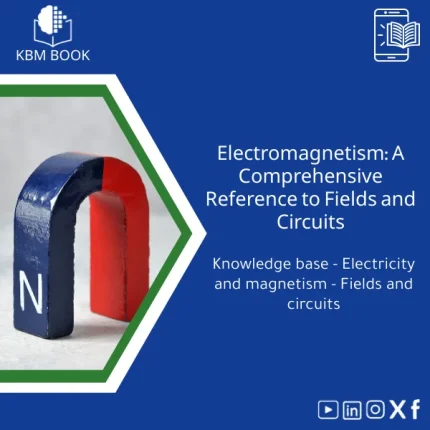
Electromagnetism Book: A Comprehensive Guide to Fields and Circuits
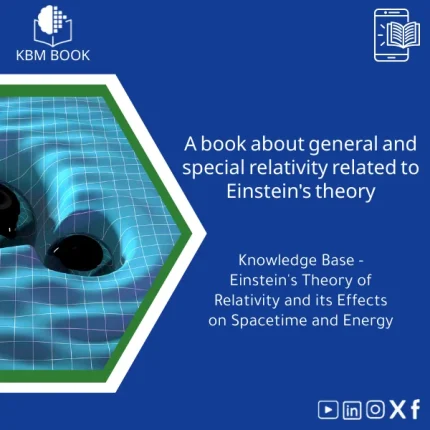
General and Special Relativity Book on Einstein’s Theory
A structured, searchable Knowledge Base Module (KBM) that converts Einstein's General and Special Relativity into a clear, hierarchical reference: formulas, derivations, worked examples, practical applications (GPS, astrophysics), and a compact research bibliography — ready to download and integrate into study, teaching, or research workflows.
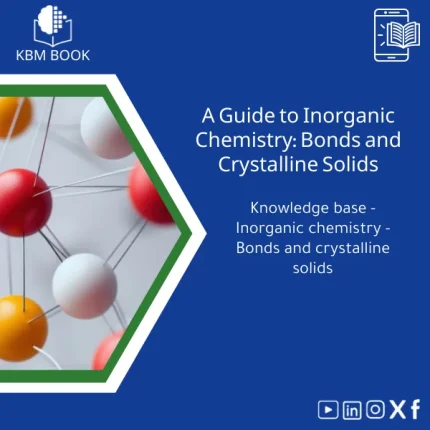
Inorganic Chemistry Guide: Bonding and Crystal Solids
A structured, searchable Knowledge Base Module (KBM) that converts inorganic chemistry fundamentals and advanced topics—bonding models, lattice structures, defects, and solid-state properties—into a practical digital reference for students, researchers, and professionals who need fast, reliable answers without wading through textbooks.
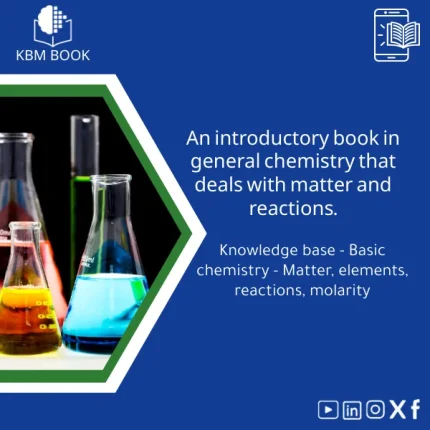
Introductory General Chemistry Book on Matter and Reactions
A structured, searchable Knowledge Base Module (KBM) that converts core general chemistry concepts — matter, elements, reactions, stoichiometry and molarity — into a hierarchical reference you can query, teach from, or integrate into study workflows. Ideal as a concise General Chemistry book alternative for students, researchers, and professionals who need accurate, practical chemistry knowledge fast.
Reviews
Clear filtersThere are no reviews yet.