


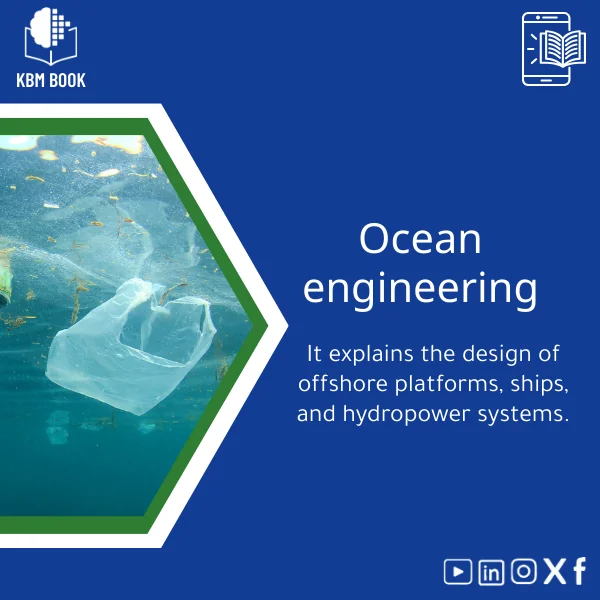
Ocean Engineering Guide for Offshore Platforms and Ships
Original price was: 199.00 $.159.00 $Current price is: 159.00 $.
A structured, searchable Knowledge Base Module (KBM) that converts ocean engineering theory into practical, step-by-step decision tools for offshore platform design, ship structures, and hydropower systems — optimized for students, researchers, and professionals who need fast, reliable access to technical knowledge.
Key benefits & value for the buyer
Turn complex theory into actionable checks
This Ocean Engineering KBM is organized as a learning and working database: every topic is broken into concise entries with direct references to formulas, units, and example calculations. Instead of flipping through a dense textbook, you get targeted modules — e.g., wave loading on offshore platforms, fatigue assessment of hull members, and mooring line analysis — ready for immediate application.
Save time during design and research
Save hours on literature search: pre-curated design standards, typical parameter ranges, and annotated references are included so you can move directly to modeling, verification, or report writing. For supervisors and instructors, the KBM is a repeatable source for assignments and grading rubrics.
Reliable, structured, and updateable
Each KBM entry cites core standards and key papers where applicable and is structured to be updated without losing the hierarchical context — ideal for teams that need a living reference rather than a one-off PDF.
Use cases & real-life scenarios
Student — coursework and exam prep
Use the KBM to review wave mechanics, learn typical load combinations, and practice sample calculations. The “worked example” nodes mirror exam-style questions and show step-by-step solutions.
Researcher — literature synthesis and modeling
Quickly gather governing equations, boundary condition templates, and a catalog of validation datasets. Export tables to CSV for parametrized simulations and sensitivity studies.
Engineer — design & verification
Use the offshore platform design modules for initial sizing, global strength checks, and serviceability limits. The marine structures design section contains checklists for fabrication and inspection to shorten review cycles.
Who is this product for?
- Undergraduate and graduate students in naval, ocean, or civil engineering studying marine structures.
- Researchers building or validating computational models related to hydrodynamics and structural response.
- Design engineers and consultants working on offshore platforms, ships, floating wind foundations, or hydropower intakes.
- Training providers and lecturers wanting a structured curriculum-ready knowledge base.
How to choose the right format
The KBM is available in multiple digital formats to match your workflow:
- PDF (clean, printable textbook-style chapters) — best for reading and offline review.
- KB database (JSON/CSV export) — best for researchers and engineers who need to import tables and parameters into scripts or spreadsheets.
- Interactive viewer (web) — best for instructors and teams that want linked navigation and quick searches.
Pick PDF if you want a ready-to-read Ocean Engineering book pdf. Choose the KB database if you need to integrate marine structures design tables into software tools.
Quick comparison with typical alternatives
Typical options are traditional textbooks, scattered research papers, or in-house notes. Compared to those:
- Textbooks provide depth but lack a searchable, modular structure — our KBM extracts the most-used design patterns into reusable nodes.
- Research papers are specific and fragmented — the KBM synthesizes and links key results and standards into applied checks.
- In-house notes vary in quality — this KBM offers standardized, referenced entries and ongoing updates.
Best practices & tips to get maximum value
- Start with the “Fundamentals” module to align symbols and units before using advanced design nodes.
- Use the export feature to pull parameter tables directly into your calculation spreadsheets to avoid transcription errors.
- Bookmark or tag entries you use frequently (e.g., fatigue curves, load combinations) to speed future lookups.
- Cross-check KBM-sourced values with your project specifications and local standards before final design sign-off.
Common mistakes when buying/using similar products and how to avoid them
Buying a single-format resource
Mistake: Purchasing only a static PDF when you need machine-readable tables. Fix: Choose the KB database format or bundle for integration.
Assuming completeness without verification
Mistake: Treating a single source as exhaustive. Fix: Use the KBM as a primary working reference and cross-reference critical checks with standards and project requirements.
Ignoring update policies
Mistake: Not checking whether content is maintained. Fix: Confirm update frequency and license terms — KBMbook provides update notes where applicable.
Product specifications
- Title: Ocean Engineering Guide for Offshore Platforms and Ships
- Formats: PDF (print-ready), JSON/CSV (database export), Interactive web viewer
- Structure: Hierarchical KBM — Fundamentals, Loads, Structural Design, Hydrodynamics, Fatigue, Mooring & Foundations, Case Studies
- Language: English (technical terms standardized)
- File size: PDF ≈ 30–70 MB depending on format; database export ≈ 4–20 MB (compressed)
- Compatibility: Common PDF readers; CSV/JSON compatible with MATLAB, Python, Excel
- License: Single-user commercial license; team and academic licenses available (see checkout)
- Updates: Periodic updates with changelog and references
FAQ
Is this an ocean engineering textbook or an interactive knowledge base?
It is both: a structured Ocean Engineering book in PDF format and a KBM database that exposes the same content in modular, searchable nodes for integration. Choose the format that fits your workflow.
Will the KBM cover offshore platform design standards (e.g., design checks and load combinations)?
Yes. The KBM contains practical design checks, recommended load combinations, and annotated references to common standards. It is intended to supplement — not replace — project-specific standards and professional judgment.
Can I export tables for use in MATLAB, Python, or Excel?
Yes. The database export (CSV/JSON) is formatted for easy import into MATLAB, Python, and Excel. Exported tables include units and brief metadata for each field.
What if the KBM doesn’t match my regional code or practice?
The KBM documents the source of each recommendation and provides alternative parameters when regional variations exist. Always validate against your local codes; contact support if you need tailored guidance.
Ready to work faster on ocean engineering projects?
Download a practical, structured reference that converts theory into actionable design and research assets. Reduce lookup time, minimize transcription errors, and integrate verified tables into your workflow today.
Related products

Atomic Physics Guide: Understanding Atomic and Electron Properties
Knowledge Base — Atomic/Electron Properties & Electromagnetic Interactions. A structured, searchable KBM for students, researchers, and professionals who need an authoritative atomic physics reference that organizes concepts, formulas, experiments, and practical applications from basics of atomic physics to advanced electron properties.




Reviews
Clear filtersThere are no reviews yet.