


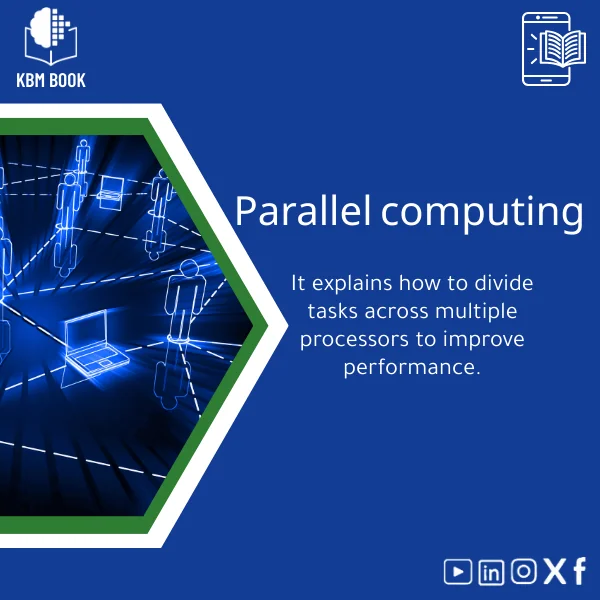
Parallel Computing Book: A Guide to Task Partitioning Techniques
Original price was: 199.00 $.159.00 $Current price is: 159.00 $.
A focused, hierarchical KBM module that turns parallel and distributed computing theory into a searchable, practical reference for students, researchers, and professionals who need reliable task-partitioning techniques and templates for real projects and labs.
Key benefits & value for the buyer
The “Parallel Computing book” KBM prioritizes structured, reusable knowledge over narrative text. Each chapter is a module that works as a standalone unit or part of a larger learning path. Translate theory into practice faster: identify the partitioning approach, estimate communication cost, and apply a tested template within minutes.
What you gain
- Speed: Save hours by using curated partitioning templates and annotated pseudocode.
- Clarity: Clear decision trees to select block, cyclic, recursive, or task-based partitioning.
- Reliability: Proven patterns with complexity analyses and caveats for edge cases.
- Reusability: Exportable modules you can adapt for assignments, research experiments, or production prototypes.
Use cases & real-life scenarios
Examples of how the parallel computing textbook KBM is used day-to-day:
University course — Lab and assignment
An instructor assembles a lab: students receive a KBM module with a problem statement, partitioning alternatives, a sample implementation (MPI/OpenMP), and graded test cases. The instructor reuses the module each semester and customizes the difficulty level.
Research prototype — Experimentation
A researcher exploring graph-processing algorithms compares recursive partitioning vs. edge-cut methods. The KBM provides complexity models, sample datasets, scripts to measure throughput, and a checklist to reproduce results.
Professional project — Performance tuning
An engineer optimizing a simulation pipeline uses the KBM’s decision tree to convert a sequential workload into a task-parallel pipeline, with communication minimization templates and benchmark commands to quantify gains.
Who is this product for?
The KBM is tailored for:
- Computer science students preparing assignments or exams in parallel computing.
- Graduate researchers designing distributed algorithms or running HPC experiments.
- Software engineers and data scientists who need quick, reliable references when parallelizing code.
- Lecturers and trainers building modular course content from a reusable KBM library.
How to choose the right format & edition
The KBM is available in multiple digital formats to fit workflows. Choose based on how you work:
- Interactive KBM (recommended): Searchable modules, cross-reference links, and code snippets — best for research and teaching.
- PDF edition: Printable, linear reading — good for offline study and annotation.
- Code bundle: Contains runnable examples (MPI/OpenMP/CUDA) and scripts for benchmarks — ideal for engineers.
Pick the interactive KBM if you often search or integrate modules into courseware. Choose the code bundle if you need runnable artifacts immediately.
Quick comparison with typical alternatives
When you consider a parallel computing textbook vs. this KBM module:
- Traditional textbooks: Broad theory, long chapters, less direct templates — good for deep study, slower to apply.
- Research papers: Narrow and detailed, but one-off and not organized for learning steps.
- MOOCs & videos: Good for guided learning but non-searchable and hard to extract reusable artifacts.
- This KBM: Balanced: concise theoretical background, structured decision flows, and exportable practical templates for immediate use.
Best practices & tips to get maximum value
- Start with the decision tree for partitioning to match algorithm class and data layout.
- Run the provided benchmarks on a small cluster before scaling to production.
- Use the cross-referenced modules (synchronization, fault tolerance) to anticipate integration issues early.
- Customize pseudocode templates to match your communication library and measure communication-to-computation ratios.
Common mistakes when buying/using similar products and how to avoid them
- Buying a narrative-only textbook: Avoid if your goal is immediate application; choose this KBM for templates and searchable modules.
- Assuming one-size-fits-all partitions: Use the KBM’s criterion checklist—data shape and network cost change the optimal pattern.
- Skipping reproducibility steps: Always run the included benchmarks and follow the experiment checklist to validate results.
- Ignoring integration costs: Check the KBM’s notes on communication libraries and runtime overhead before committing to an approach.
Product specifications
- Format: Interactive KBM module (HTML + JSON index) + optional PDF and code bundle.
- Topics covered: Task partitioning strategies, communication cost models, load balancing, synchronization primitives, parallel algorithm patterns.
- Depth: From introductory concepts to advanced partitioning techniques with formal complexity analysis.
- Files included: Search index, annotated pseudocode, runnable examples (MPI/OpenMP/CUDA), benchmark scripts, instructor notes.
- Language: English (technical terminology)
- License: Personal, academic, and commercial license options (see checkout).
- Delivery: Instant download after purchase; online access to updates for 12 months.
FAQ
Is this a textbook or a KBM? Which should I choose?
This product is a Knowledge Base Module (KBM) designed for fast lookup and reuse. If you need long-form narrative and extended proofs, pair this KBM with a traditional parallel computing textbook. If you need applied templates, experiment scripts, and searchable modules, the KBM is the more practical choice.
Can I use the included code in commercial projects?
Yes, commercial licenses are available at checkout. The bundle includes licensing information and attribution guidelines. For full production use, select the commercial license option.
What platforms do the examples target?
Examples target common HPC and development environments: Linux clusters, MPI implementations (OpenMPI, MPICH), OpenMP, and CUDA for GPU examples. Benchmarks include instructions for running on cloud VMs and on-prem clusters.
How often is the KBM updated?
KBMBook provides updates and minor revisions for 12 months after purchase. Major new editions are announced on the product page; buyers receive update notifications if they opt in.
Ready to accelerate your parallel development and research?
Convert theory into working prototypes with clear partitioning choices, ready-to-run examples, and reproducible benchmarks. Purchase the KBM to get instant, searchable access and the code bundle to start experimenting today.
Related products

Astronomy Observational Techniques Guide for Celestial Motion

Comprehensive Evolutionary Biology Book on Natural Selection

Electromagnetism Book: A Comprehensive Guide to Fields and Circuits

Materials Physics Guide: Understanding Solid-State Properties
Organic Chemistry Guide: Carbon Chains and Reactions
Quantum Mechanics: A Beginner’s Guide to Superposition and Waves

Thermal Physics Guide: Understanding Heat, Energy, and Entropy
A downloadable, hierarchically structured Knowledge Base Module (KBM) that converts university-level thermodynamics into a searchable, practical digital database. Ideal for students, researchers, and professionals who need fast, reliable access to fundamentals and advanced topics in thermal physics.

Reviews
Clear filtersThere are no reviews yet.