


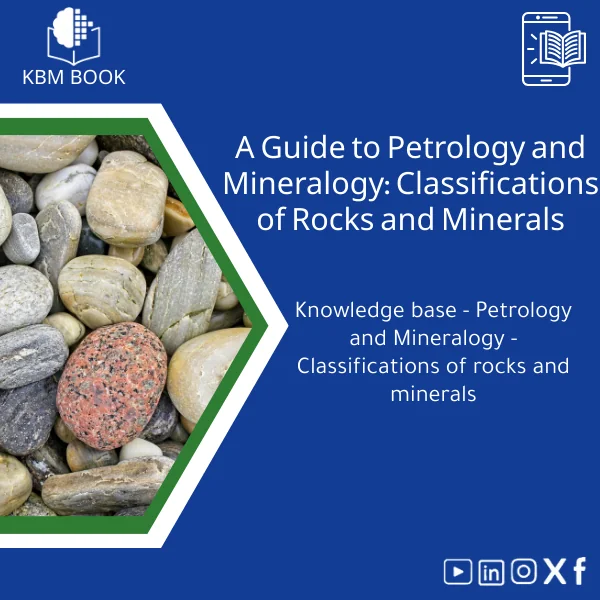
Petrology and Mineralogy Guide: Rock Types and Minerals
Original price was: 179.00 $.139.00 $Current price is: 139.00 $.
A structured, searchable Knowledge Base Module (KBM) that converts Petrology and Mineralogy into a hierarchical, practical reference — a single-download resource for identifying rock types, classifying minerals, and applying laboratory and field workflows quickly and reliably.
Key benefits & value for students, researchers, and professionals
This KBM transforms scattered textbooks, lecture notes, and tables into a single, consistent reference built for fast retrieval and practical use. Instead of reading long chapters to find a classification scheme or mineral diagnostic, you get:
- Time savings: Instant access to classification charts (QAPF, TAS), mineral optical tables, and normative calculations.
- Accuracy & consistency: Standardized definitions and cross-referenced entries reduce ambiguity between courses and labs.
- Actionable outputs: Templates for thin-section reports, field logs, and sample metadata exportable to GIS or lab databases.
- Integrable data: Machine-readable CSV/JSON exports let researchers embed definitions and lookups into scripts, LMS, or GIS workflows.
Whether you need a quick mineral diagnostic by hardness & cleavage, or a full petrogenetic summary with references and recommended analyses (XRD, SEM, XRF), this KBM is designed to give the right information with minimal friction.
Use cases & real-life scenarios
Field mapping and rapid identification
On a mapping day, use the compact field checklist to triage samples: identify rock type, note texture and grain size, and record key mineral assemblages. Export a CSV for immediate upload to your mapping app.
Lab workflows and thin-section analysis
From polarizing microscope protocols to birefringence tables and refractive indices, the KBM includes templates for systematic thin-section descriptions and a checklist to reduce observer bias.
Teaching and exam preparation
Instructors can assign module sections with exact learning outcomes. Students use the stepwise classification guides to practice QAPF and modal analysis problems with self-checked examples.
Research and data integration
Researchers extract standardized mineral codes and chemical ranges via JSON exports for statistical analysis, ensuring reproducible classification across datasets.
Who is this product for?
Designed for anyone who needs reliable, structured geological knowledge quickly:
- Undergraduate and graduate students in geology, earth sciences, and materials science.
- Field geologists, petrographers, and mineralogists conducting routine mapping and lab analysis.
- Researchers needing consistent classification rules and machine-readable mineral/rock metadata.
- Professors and trainers building curricula or practical lab assignments.
How to choose the right format (PDF, CSV, JSON, interactive HTML)
Choose based on how you work:
- PDF: Readable, printable, best for study and offline reading.
- CSV/JSON: For researchers and developers who need to import structured data into R, Python, GIS, or databases.
- Interactive HTML: Fast browsing, linked cross-references, and in-browser search — ideal for lab benches and desktop use.
Most buyers select the bundle (all three formats) to cover field, lab, and analysis needs. If budget is a concern, prioritize CSV/JSON for research or PDF for coursework.
Quick comparison with typical alternatives
Compared to a traditional textbook or scattered online articles, this KBM offers:
- Faster lookup: Structured entries and search beats reading chapters or scrolling long web pages.
- Less redundancy: Focused entries without duplicated explanatory text found across many articles.
- Data-ready: Export formats let you reuse content in analyses — textbooks rarely provide this.
If you need narrative depth for historical context, pair the KBM with a classic textbook; if you need action-oriented reference and data, the KBM replaces long manual searches.
Best practices & tips to get maximum value
- Start with the quick-start checklist for field sessions—reduce cognitive load by following the template.
- Use the JSON export to standardize mineral naming in your research pipeline.
- Customize your PDF excerpt for course handouts by selecting module sections relevant to your syllabus.
- Keep a local copy of the interactive HTML for offline labs and remote fieldwork.
Common mistakes when buying or using geological references — and how to avoid them
- Mistake: Buying only a PDF while needing data integration. Fix: Choose the CSV/JSON bundle.
- Mistake: Expecting a narrative textbook level of theory. Fix: Use KBM for structured reference and pair with a recommended textbook for theory.
- Mistake: Not checking update or license terms. Fix: Review the included update policy and permitted uses before purchase.
Product specifications
- Category: KBM Book – Natural Sciences Section
- Title: Petrology and Mineralogy Guide: Rock Types and Minerals
- Format: PDF (readable), CSV & JSON (data), interactive HTML index
- Content scope: Mineral entries (≥ 700), Rock types & classification charts, Optical & physical property tables, Field & lab templates
- Language: English (primary). Glossary includes Arabic labeling for common terms.
- File size (bundle): ~120 MB (compressed)
- License: Personal, educational, and institutional use options (see licensing details)
- Delivery: Instant download after purchase; offline HTML available
FAQ
Is this a replacement for a petrology textbook?
No — the KBM is a structured reference and practical database designed for fast lookup, workflows, and data export. It complements textbooks that provide extended theory and historical context. Use both together for best results.
Can I import the mineral data into GIS or R?
Yes. The CSV and JSON exports are formatted for direct import into GIS, R, Python (pandas), and other analysis tools. Field metadata templates match common GIS attribute structures.
How often is the content updated?
The KBM receives scheduled content reviews and updates. Purchase includes one-year access to updates; extended update plans are available at checkout.
Is there a preview or sample before buying?
A sample chapter (PDF excerpt) and a short JSON sample are available on the product page so you can inspect structure and quality before purchase.
Ready to make Petrology and Mineralogy instantly usable?
Download a structured, practical reference that works in the field, lab, and data pipeline. Confidently classify rocks, identify minerals, and produce reproducible reports with templates included.
Secure checkout • Instant download • One-year updates included (bundle options available)
Related products
Analytical Chemistry Book: Qualitative and Quantitative Methods Guide
Astronomy Observational Techniques Guide for Celestial Motion
Biological Anthropology Study Guide on Human Evolution
Cell Biology Guide: Structure, Division, and Transport Insights
General Biology Book: A Guide to Cells, Genetics & Taxonomy
Materials Physics Guide: Understanding Solid-State Properties

Modern Physics Book: Quantum, Relativity, and Tech Applications Guide
A structured, searchable Knowledge Base Module (KBM) that turns modern physics — quantum mechanics, special & general relativity, and contemporary technological applications — into a hierarchical, practical reference for students, researchers, and professionals who need quick, reliable access to advanced concepts and formulas.
Thermal Physics Guide: Understanding Heat, Energy, and Entropy
A downloadable, hierarchically structured Knowledge Base Module (KBM) that converts university-level thermodynamics into a searchable, practical digital database. Ideal for students, researchers, and professionals who need fast, reliable access to fundamentals and advanced topics in thermal physics.
Reviews
Clear filtersThere are no reviews yet.