


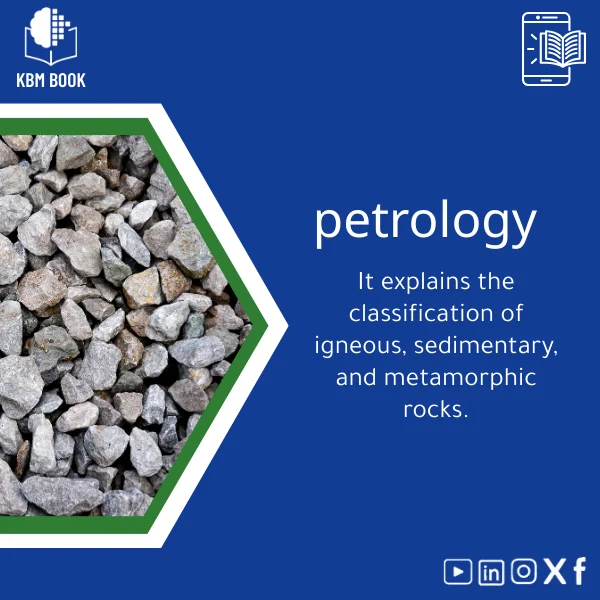
Petrology: Guide to Igneous, Sedimentary, and Metamorphic Rocks
Original price was: 179.00 $.139.00 $Current price is: 139.00 $.
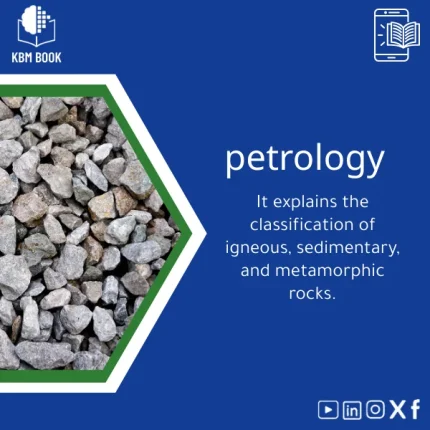
A hierarchical, searchable knowledge base module (KBM) that converts petrology — classification, field identification, laboratory parameters, and applied interpretation of igneous, sedimentary, and metamorphic rocks — into a practical digital reference for students, researchers, and professionals.
Key benefits & value for the buyer
From fragmented notes to a single, reliable knowledge source
Petrology KBM synthesizes core concepts and applied procedures into a single, hierarchical database. Instead of hunting across textbooks, lecture slides, and field notes, you get a structured reference where each rock type links to its diagnostic features, typical textures, geochemical classification rules, and common interpretive notes.
Time savings with measurable outcomes
Use the KBM to prepare field reports 30–60% faster: prebuilt checklists and ID keys guide you through observation steps and ensure you capture lab-ready descriptions. For students, the module reduces revision time by organizing content into progressive learning paths: basics → identification → interpretation.
Reliable and consistent content for reproducible work
Content is curated to avoid duplication and present standard classification schemes (e.g., QAPF, Folk, metamorphic facies) with examples, citations, and practical thresholds — making your notes and results easier to compare and reproduce.
Use cases & real-life scenarios
Scenario: Undergraduate field mapping
A field group uses the KBM checklist on tablets to standardize observations across teams. Students submit field logs that follow the KBM taxonomy, allowing instructors to assess consistency across maps quickly.
Scenario: Research synthesis and literature review
A researcher preparing a regional metamorphism study extracts the KBM’s metamorphic facies definitions and reference examples, filters entries by P–T conditions, and imports the JSON subset into their data analysis pipeline for comparison to new samples.
Scenario: Rapid laboratory workflow
Lab technicians use the petrology KBM to populate thin-section descriptions: standardized terminology, suggested photomicrograph angles, and a checklist of key minerals to quantify reduce ambiguity in reports.
Who is this product for?
- Geology and Earth science students needing a concise, exam-focused petrology textbook alternative.
- Researchers and graduate students assembling rock datasets or writing methods sections.
- Field geologists and petrophysicists who require quick, reliable rock classification criteria on-site.
- Instructors and lab managers who want standardized teaching materials and lab protocols.
How to choose the right KBM variant
The Petrology KBM is offered in three delivery formats. Choose based on how you work:
- Student pack (PDF + CSV index): Optimized for study and exam revision — printable tables and condensed ID keys.
- Research pack (JSON + searchable PDF): Includes structured data for programmatic use, full references, and expanded examples.
- Lab & field pack (CSV templates + checklists): Minimal bandwidth, mobile-friendly checklists and printable forms for immediate field use.
If unsure, select the Research pack for maximum interoperability; the formats are compatible with common geology software and reference managers.
Quick comparison with typical alternatives
Traditional textbooks and lecture slides are comprehensive but often redundant and not machine-readable. The Petrology KBM trades narrative length for structured access: concise, non-repeating entries, explicit classification criteria, and formats designed for search and reuse. Compared to ad-hoc notes, the KBM adds consistency, citations, and integration-ready files.
Best practices & tips to get maximum value
- Start with the “Identification checklist” in the first chapter for fieldwork — it saves time and avoids missed observations.
- Use the JSON export when combining KBM data with geochemical datasets for automated classification scripts.
- Integrate the CSV index into your lab’s LIMS to standardize rock type labels across projects.
- Assign the “progressive pathways” to students: Basic → Diagnostic features → Interpretive notes — to build understanding stepwise.
Common mistakes when buying/using petrology resources and how to avoid them
Buyers often pick resources based on price or perceived completeness. Avoid these pitfalls:
- Buying a long narrative without structure: If you need quick lookup or machine use, prefer structured KBMs over narrative textbooks.
- Assuming compatibility: Confirm format compatibility with your tools (CSV/JSON/PDF). The Petrology KBM lists formats in the specs so you can match it to your workflow.
- Overlooking update policy: Check whether the product includes updates or errata. KBMBook provides version notes and update guidance to keep references current.
Product specifications
- Title: Petrology: Guide to Igneous, Sedimentary, and Metamorphic Rocks
- Format options: searchable PDF, CSV index, JSON export
- Content depth: hierarchical KBM covering diagnostic features, classification keys (QAPF, Folk, metamorphic facies), thin-section descriptors, and geochemical thresholds
- Images: photomicrograph examples and annotated field photos included (high-resolution)
- Size: ~250 indexed entries with cross-references and 50+ illustrative figures
- Delivery: digital download after purchase; immediate access link
- Licensing: single-user license by default; institutional licenses available
- Compatibility: works with standard GIS, spreadsheet, and data analysis software
- Support: documentation and changelog included; email support for format questions
FAQ
Is this a replacement for a traditional petrology textbook?
The KBM is not a narrative textbook; it is a structured reference designed for quick lookup, reproducible workflows, and data integration. It complements textbooks by providing concise classification criteria, checklists, and machine-readable data for practical use.
Which format should I download if I need to integrate with my analysis scripts?
Choose the JSON export (Research pack). JSON provides hierarchical structure and is the easiest to ingest into scripts for automated classification, filtering, and merging with geochemical datasets.
Do you provide updates when classification schemes change?
KBMBook issues version notes and provides updated files for registered purchasers. Major revisions are documented in the changelog and distributed as incremental downloads when applicable.
Can I use the KBM in a classroom or for commercial projects?
Single-user licenses cover personal, academic, and internal research use. For classroom distribution or commercial deployment, contact sales for an institutional or enterprise license.
Ready to upgrade how you work with rocks?
Purchase the Petrology KBM to get a field-ready, lab-ready, and research-ready petrology knowledge base that saves time, enforces consistency, and integrates with your tools. Immediate download after purchase — choose the format that matches your workflow.
Related products
Analytical Chemistry Book: Qualitative and Quantitative Methods Guide

Atomic Physics Guide: Understanding Atomic and Electron Properties
Knowledge Base — Atomic/Electron Properties & Electromagnetic Interactions. A structured, searchable KBM for students, researchers, and professionals who need an authoritative atomic physics reference that organizes concepts, formulas, experiments, and practical applications from basics of atomic physics to advanced electron properties.
Cell Biology Guide: Structure, Division, and Transport Insights
Comprehensive Genetics Book: DNA, Mendelian Genetics & Engineering
A structured, searchable knowledge base module (KBM) that turns genetics theory and practice into an immediately usable digital reference — from DNA structure to Mendelian genetics and contemporary genetic engineering techniques — optimized for students, researchers, and professionals who need reliable answers fast.

Reviews
Clear filtersThere are no reviews yet.