


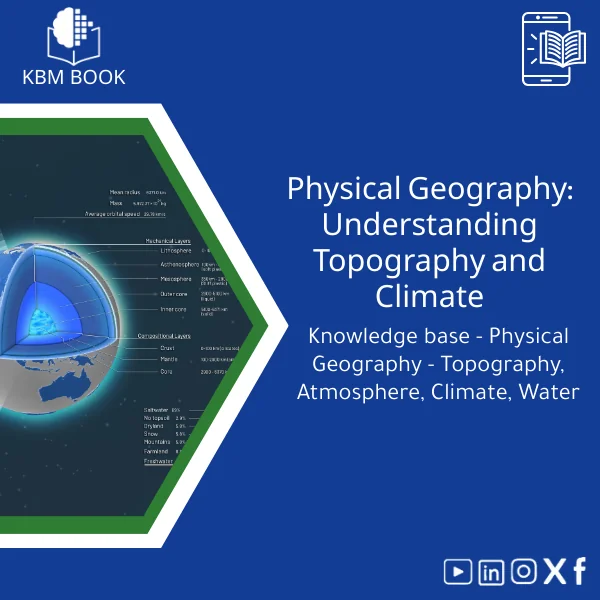
Physical Geography Book: Understanding Landforms and Climate
Original price was: 139.00 $.99.00 $Current price is: 99.00 $.
A structured, searchable Knowledge Base Module (KBM) that organizes physical geography—from landforms and surface waters to atmosphere and climate—into a hierarchically sequenced reference you can query, cite, and integrate into research, coursework, or professional reports.
Key benefits & value for students, researchers, and professionals
This Physical Geography book is built as a Knowledge Base Module (KBM) so every section is atomic, referenced, and cross-linked. Instead of reading long chapters to find one equation or diagram, you access the exact node you need—landform classification, atmospheric circulation patterns, river discharge formulas, or climate indices—within seconds.
From feature to outcome
- Feature: Hierarchical structure with indexed nodes. Benefit: Faster literature reviews and lecture preparation.
- Feature: Downloadable CSV/JSON tables for datasets and glossary. Benefit: Immediate import into analysis workflows and GIS.
- Feature: Ready citations and reference list. Benefit: Produce accurate bibliographies and field reports without hunting sources.
- Feature: Practical appendices (field methods, instrumentation, sample calculations). Benefit: Shorten lab prep time and improve data quality.
Use cases & real-life scenarios
Students
Use the KBM as a compact physical geography textbook for exam revision. Jump to “Glacial landforms” to compare cirque, arête, and horn formation with diagrams and sample exam questions. Export glossary entries into flashcards for efficient memorization.
Researchers
Integrate the physical geography PDF and the CSV sample datasets into your research pipeline. When preparing a methods section, cite the standard measurement protocols included in the KBM. Use the climate indices module to calculate and compare drought metrics across study sites.
Professionals & educators
Lecturers can extract diagrams and slide-ready summaries; environmental consultants can reference standardized definitions and best-practice field methods when writing reports or designing sampling campaigns.
Who is this product for?
This Physical Geography book is designed for:
- Undergraduate and graduate students needing a structured physical geography textbook and quick-reference material.
- Researchers who want cleanly organized modules—landforms, atmosphere, climate, waters—for reproducible analyses.
- Field professionals and consultants who require practical measurement protocols and standardized definitions.
- Teachers and trainers preparing syllabi, labs, and assessments with reliable, citable content.
How to choose the right version
The KBM is offered in formats tailored to common workflows. Choose based on how you work, not only on device:
- PDF + index: Best if you prefer a classic physical geography textbook layout with searchability.
- PDF + CSV/JSON bundle: Best for researchers who need machine-readable tables, sample datasets, and glossary exports.
- Team license: Best for departments or consultancies that need shared access and annual updates.
If you are unsure which version fits your needs, choose the PDF + CSV/JSON bundle for maximum flexibility; it covers both reading and data integration needs.
Quick comparison with typical alternatives
Common alternatives include traditional textbooks, scattered articles, and open web resources. Compared to those, the Physical Geography KBM offers:
- Faster retrieval: hierarchical nodes vs long chapters or multiple papers.
- Practical integration: machine-readable datasets vs static figures.
- Cleaner citation and reduced duplication: each concept has a single canonical entry.
Where a full printed textbook gives narrative depth, the KBM gives targeted utility: faster answers, ready data, and fewer irrelevant digressions.
Best practices & tips to get maximum value
- Pin or export the specific nodes you use most (e.g., “Hydrological cycle – runoff calculations”) into personal notes for quick reuse.
- Import CSV tables into R, Python, or your GIS to automate calculations based on the KBM’s standard variables.
- Use the provided citation snippets directly in manuscripts to ensure consistent referencing.
- Check the update notes—modules are versioned so you can track changes in methods or indices.
Common mistakes when buying or using similar products — and how to avoid them
- Buying a single-format resource when you need data exports. Solution: pick the PDF + CSV/JSON bundle.
- Relying on unreferenced summaries. Solution: use KBM entries that include source lists for verification.
- Not checking licensing for shared use. Solution: choose the team license for multiple users to avoid legal issues.
Product specifications
- Title: Physical Geography Book — Landforms, Atmosphere, Climate, Waters
- Formats: PDF (searchable), CSV (tables), JSON (indexed nodes)
- Length/size: ~280 indexed nodes; ~350 pages equivalent in PDF; datasets ~10–50 KB per table (compressed)
- Structure: Hierarchical KBM; modules → submodules → nodes → references
- License options: Single-user, Academic multi-user, Team (commercial)
- Compatibility: Desktop & mobile PDF readers; CSV/JSON importable into common GIS and analysis tools
- Delivery: Instant download after purchase; update notifications for licensed users
FAQ
What formats are included and can I import data into GIS or Python?
The KBM includes a searchable PDF plus CSV and JSON exports. CSV tables are formatted for direct import into GIS software and analysis environments (R, Python/pandas). JSON provides node-level indexing for programmatic lookups.
How often is the Physical Geography book updated?
Licensed users receive update notifications. Minor corrections are issued as needed; major updates (new modules or datasets) follow an annual cycle. Team licenses include update privileges per the license terms.
Can I use content from the KBM in my published work?
Yes—every entry includes a recommended citation. The license permits citation and reuse of small extracts for academic work. For redistribution or embedding the KBM in commercial products, please select the appropriate team or commercial license.
What if the KBM doesn’t cover a niche topic I need?
Submit a request via support—KBMBook accepts content suggestions and may add niche modules to future updates. For urgent needs, the CSV/JSON structure makes it straightforward to extend or annotate your local copy.
Ready to get structured physical geography knowledge?
Purchase a practical, research-ready Physical Geography book that moves beyond traditional textbooks—organized for fast answers, accurate citations, and data-driven workflows.
Instant download. Choose the bundle that fits your workflow: PDF only, PDF + CSV/JSON, or team license for shared access and updates.
Related products
Astronomy Observational Techniques Guide for Celestial Motion

Comprehensive Evolutionary Biology Book on Natural Selection
Cosmology Book: Guide to Big Bang and Galaxy Evolution

General and Special Relativity Book on Einstein’s Theory
A structured, searchable Knowledge Base Module (KBM) that converts Einstein's General and Special Relativity into a clear, hierarchical reference: formulas, derivations, worked examples, practical applications (GPS, astrophysics), and a compact research bibliography — ready to download and integrate into study, teaching, or research workflows.

General Biology Book: A Guide to Cells, Genetics & Taxonomy

Materials Physics Guide: Understanding Solid-State Properties

Modern Physics Book: Quantum, Relativity, and Tech Applications Guide
A structured, searchable Knowledge Base Module (KBM) that turns modern physics — quantum mechanics, special & general relativity, and contemporary technological applications — into a hierarchical, practical reference for students, researchers, and professionals who need quick, reliable access to advanced concepts and formulas.

Reviews
Clear filtersThere are no reviews yet.