


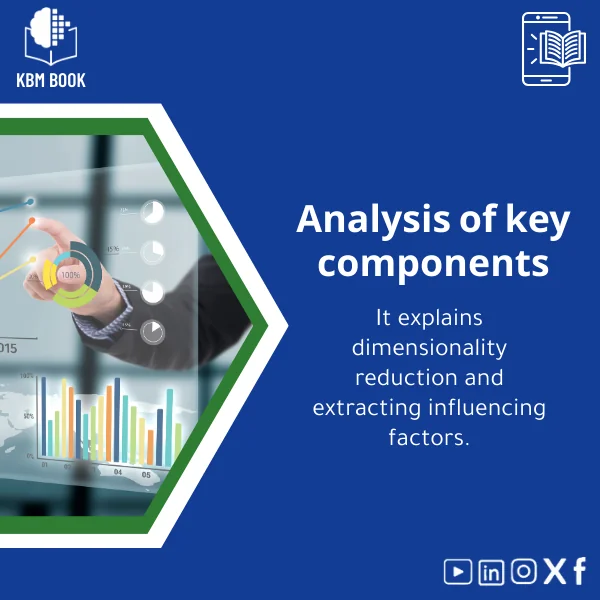
Principal Component Analysis Guide for Dimensionality Reduction
Original price was: 199.00 $.159.00 $Current price is: 159.00 $.
A complete, hierarchical Knowledge Base Module (KBM) that turns Principal Component Analysis into a ready-to-use dimensionality reduction model: step-by-step theory, practical PCA Excel workpaper, annotated examples, and best-practice templates for students, researchers, and professionals who need fast, reliable access to core factors.
Key benefits & value for the buyer
This Principal Component Analysis KBM converts theoretical knowledge into operational tools. Instead of reading multiple papers or assembling scattered spreadsheets, you get a single, organized database that:
- Saves time: Pre-structured workflows reduce setup time from hours to minutes.
- Reduces error: Validated formulas and checks in the PCA Excel workpaper minimize manual mistakes in covariance, eigen decomposition, and rotation steps.
- Improves clarity: Visualizations and annotated loadings help explain results to supervisors or stakeholders.
- Scale-ready: Modular components let you reuse steps for larger datasets or integrate with other KBMs (e.g., clustering, regression).
Benefit-focused features translate directly into faster analyses, cleaner reports, and more defensible findings for coursework, thesis work, lab research, or consultancy deliverables.
Use cases & real-life scenarios
1. Undergraduate / graduate coursework
Follow the step-by-step PCA tutorial in the KBM to complete labs and assignments. The PCA Excel workpaper includes a worked example with simulated data and exercises to practice interpreting loadings and variance.
2. Research papers & theses
Reproduce factor extraction and include reproducible code snippets and tables in your methods section. The KBM’s hierarchical layout makes it easy to document exactly which preprocessing and rotation choices were made.
3. Professional analytics & reporting
Use the template to reduce sensor, survey, or financial indicators to core factors before modeling. Export charts and tables directly into reports or dashboards, saving time on client deliverables.
Who is this product for?
Designed for students, researchers, and professionals who need structured knowledge databases across fields for quick access to reliable information. Specifically:
- Data science and statistics students learning dimensionality reduction.
- Researchers needing reproducible PCA workflows for publications.
- Analysts who must compress multivariate data into actionable factors.
- Instructors and trainers who want polished teaching materials and exercises.
How to choose the right version
The KBM is offered in modular versions—pick based on your level and workflow:
- Basic: Theory summary, worked example, and a simple PCA Excel workpaper (ideal for students).
- Standard: Full KBM with multiple examples, preprocessing checks, and annotated Excel templates (recommended for researchers).
- Pro: Extended modules with batch-processing guidelines, integration notes for Python/R, and additional case studies (for professionals and instructors).
Choose Standard for a balance of depth and practicality. Upgrade to Pro if you need automation and multiple-case workflows.
Quick comparison with typical alternatives
Common alternatives include textbooks, academic papers, or ad-hoc spreadsheets. Compared to those, this KBM:
- Is more practical than textbooks — it focuses on executable steps, not just theory.
- Is more organized than papers — you get a connected, searchable knowledge base instead of separate articles.
- Is more reliable than ad-hoc spreadsheets — templates include sanity checks and clear documentation to prevent common calculation errors.
Best practices & tips to get maximum value
- Start with the preprocessing checklist (scaling, missing values, outlier handling) before running PCA.
- Use the scree plot and cumulative explained variance provided in the template to choose component count — avoid arbitrary selection.
- Document each transformation in the KBM to maintain reproducibility for reviewers or collaborators.
- Integrate the PCA outputs with downstream models (regression, clustering) and preserve component loadings to interpret model behavior.
Common mistakes when buying/using PCA resources — and how to avoid them
- Buying theory-only guides: If you need deliverables, choose a KBM with templates. This product includes an Excel workpaper to run PCA immediately.
- Skipping preprocessing: The KBM enforces preprocessing steps to prevent misleading component extraction.
- Ignoring reproducibility: Use the KBM’s documentation sections to record versions and parameter choices for repeatable analyses.
Product specifications
- Format: ZIP download containing KBM (HTML/Markdown), PCA Excel workpaper (.xlsx), printable PDF summary.
- Coverage: Theory, preprocessing, eigen decomposition, rotations, interpretation, reporting templates.
- File size: Approximately 5–15 MB depending on selected version.
- Compatibility: Excel 2016+ (Windows/Mac), viewable on LibreOffice with limited chart fidelity. Supplementary notes for Python (NumPy, scikit-learn) and R (prcomp).
- Language: English with structured, search-friendly headings.
- License: Single-user digital license; institutional and classroom licenses available (see product page).
- Support: Email support and update notes for 12 months after purchase.
Frequently asked questions
What exactly is included in the PCA Excel workpaper?
The workpaper contains sample datasets, preprocessing checks (normalization and missing-data handling), covariance/correlation matrices, eigenvalues/eigenvectors, component scores, loadings table, scree plot, cumulative variance table, and annotated cells explaining each calculation.
Can I use the KBM with Python or R?
Yes. The KBM includes notes and code snippets for reproducing the same PCA steps in Python (scikit-learn) and R (prcomp). The Excel template is ideal for quick exploration; code snippets support production workflows.
Is this suitable for teaching a class?
Absolutely. The KBM’s hierarchical layout and exercises make it suitable for lecture preparation and lab sessions. For classroom use, consider the Pro version or contact us for a group license.
What if the template doesn’t fit my dataset size?
The templates are designed for moderate-sized datasets (hundreds to low thousands of rows). For very large datasets, use the KBM’s guidance to shift to Python/R implementations; the KBM includes a workflow to scale processing.
Ready to simplify dimensionality reduction?
Purchase a structured, reliable Principal Component Analysis template that saves time, reduces errors, and produces reproducible results. The KBM is built for people who prefer organized, actionable knowledge over fragmented notes.
Not sure which version fits you? Choose Standard for most research needs; contact support for a quick recommendation based on your workflow.
Related products
Analytical Chemistry Book: Qualitative and Quantitative Methods Guide

Comprehensive Evolutionary Biology Book on Natural Selection

Comprehensive Microbiology Book on Bacteria, Viruses, and Fungi
General Biology Book: A Guide to Cells, Genetics & Taxonomy

Inorganic Chemistry Guide: Bonding and Crystal Solids
A structured, searchable Knowledge Base Module (KBM) that converts inorganic chemistry fundamentals and advanced topics—bonding models, lattice structures, defects, and solid-state properties—into a practical digital reference for students, researchers, and professionals who need fast, reliable answers without wading through textbooks.


Reviews
Clear filtersThere are no reviews yet.