


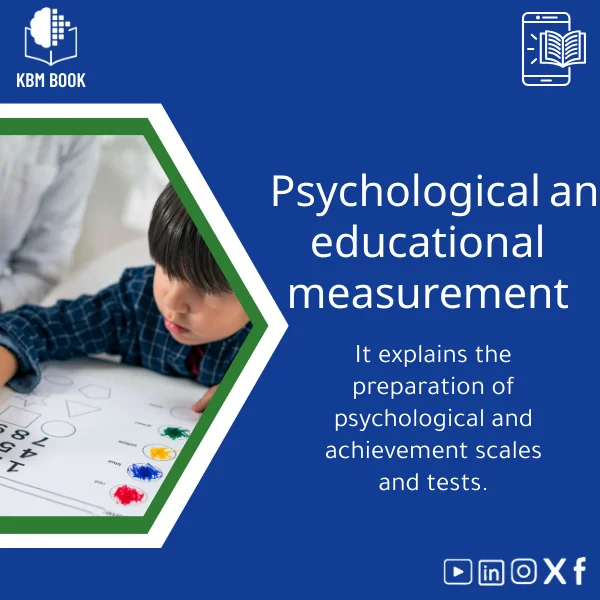
Psychometrics Educational Measurement Guide for Test Development
Original price was: 349.00 $.279.00 $Current price is: 279.00 $.
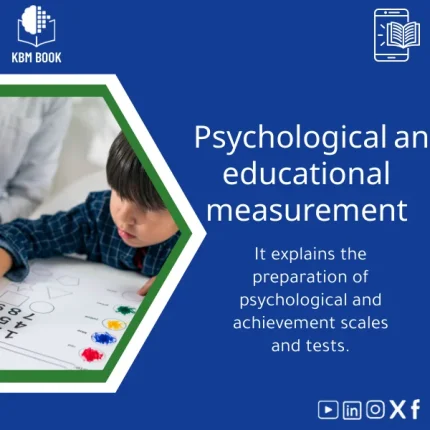
A practical, hierarchical knowledge base for building reliable psychological and achievement tests — from theory to ready-to-use item banks, scoring rules, and validation checklists. Designed for students, researchers, and professionals who need fast access to authoritative procedures in psychometrics educational measurement.
Key benefits & value for the buyer
This psychometrics educational measurement KBM converts scattered technical literature into a single, searchable, and practically oriented database. Each feature translates into measurable value:
- Save time: Ready-made item bank templates and analysis scripts reduce test development time by weeks.
- Increase validity: Systematic validity frameworks and evidence logs help produce defensible assessments for research or high-stakes use.
- Improve reliability: Clear procedures for reliability estimation and item revision reduce guesswork and variability across administrations.
- Reusable assets: Exportable modules let you reuse items, scoring rules, and documentation across courses, studies, and clients.
The KBM is practical: no unnecessary theory without application. Where theory is needed, it’s paired with checklists, example datasets, and executable analysis steps.
Use cases & real-life scenarios
University students and thesis researchers
Use the KBM to build pilot instruments, calculate sample-size for IRT models, and produce reproducible validity reports. Example: a master’s student adapts the item-writing template to create a 30-item midterm, runs classical item analysis using the included script, and documents revisions using the KBM’s evidence log.
Educational measurement teams
Teams can adopt the KBM as an operational manual: standards for item review, bilingual translation protocols, and chained workflows from item drafting to standard-setting panels. Integrate item banks into your LMS with provided CSV schemas.
Consultants and psychometricians
Quickly generate client-ready deliverables: score reports, DIF (differential item functioning) checks, and equating plans. The KBM’s templates speed report production while maintaining methodological rigor.
Who is this product for?
- Graduate students in measurement, educational psychology, and related fields.
- Researchers designing achievement or diagnostic assessments.
- Professionals and assessment specialists who need standardized procedures and artifact templates.
- Trainers and instructional designers preparing assessment literacy modules.
How to choose the right KBM for your needs
Consider three dimensions: scope (classical vs. IRT vs. mixed), output format (document templates vs. item-bank exports), and level of guidance (concise checklist vs. step-by-step protocol).
- If you need quick classroom tests: choose the “Practical Classroom” module with item-writing and short analysis scripts.
- If you require psychometric modeling: select the “IRT & Scaling” submodule that includes sample code and simulated datasets.
- For high-stakes or published research: use the full KBM package with validation and standard-setting workflows.
Quick comparison with typical alternatives
Alternatives include textbooks, article collections, or standalone software. Compared to those:
- Textbooks explain concepts but rarely provide reusable item banks or export formats; the KBM provides immediately deployable artifacts.
- Article collections require synthesis; the KBM organizes knowledge hierarchically, avoiding redundancy and missing steps.
- Software computes statistics but doesn’t provide the policy, documentation, and item drafting frameworks the KBM supplies.
Best practices & tips to get maximum value
- Start with the item-writing checklist before drafting items — prevents common validity issues.
- Pilot small (n=100–200) using the pilot protocol in the KBM and iterate before large-scale deployment.
- Use provided scripts to generate reproducible reports; keep raw data and evidence logs together for auditability.
- Adapt templates to local contexts but preserve the core validation steps to maintain comparability.
Common mistakes when buying/using similar resources — and how to avoid them
- Mistake: Buying fragmented resources that lack exportable assets. Fix: Choose a KBM with CSV/JSON exports and templates.
- Mistake: Skipping pilot testing. Fix: Follow the pilot-study checklist included in this KBM.
- Mistake: Treating theoretical descriptions as operational instructions. Fix: Use the KBM’s step-by-step protocols tied to example datasets.
Product specifications
- Format: Downloadable KBM package (PDF manuals, editable DOCX templates, CSV/XLS item banks, JSON metadata, R/Python example scripts)
- Modules: Item writing, Classical Test Theory, IRT & scaling, Reliability, Validity & evidence, DIF analysis, Standard-setting
- Language: English (structured for easy translation)
- License: Single-user commercial license with academic use permissions (see license file included)
- File size: Approx. 35–100 MB depending on optional datasets included
- Usage notes: Downloadable and integrable into LMS, research pipelines, or consultancy deliverables
FAQ
Is this KBM suitable for beginner students?
Yes. Modules are layered from foundational concepts to applied procedures. Beginners can follow the guided workflows and sample datasets; advanced users can jump directly to IRT models and validation protocols.
What software do I need to use the provided scripts and files?
The KBM includes scripts compatible with R and Python (notebooks). For item banks and templates, standard office software (Excel, Word) is sufficient. No proprietary software is required.
Can I adapt the item banks for commercial use with clients?
Yes— the single-user commercial license permits use with clients. Redistribution of raw KBM files or resale of modules is not allowed; see the license included with the download for full terms.
How does this KBM ensure methodological quality?
Each module references primary standards and provides checklists for evidence collection. Templates enforce documentation of sample characteristics, administration conditions, and analytic choices to support methodological transparency.
Ready to build reliable assessments faster?
Purchase a practical, research-backed KBM that makes psychometrics educational measurement usable in real projects. The KBM reduces planning time, enforces quality controls, and delivers reusable artifacts for future work.
Related products
Classical Mechanics Guide: Newton’s Laws and Dynamics
A searchable, hierarchical Knowledge Base Module (KBM) that turns classical mechanics into a practical, ready-to-use reference for fast problem solving, lecture preparation, and applied engineering. Designed for students, researchers, and professionals who need precise access to Newton’s laws, rotational motion, and applied dynamics without the noise of textbooks.
Comprehensive Botany Book on Plant Taxonomy and Photosynthesis
A structured, searchable botany book designed as a Knowledge Base Module (KBM) — an end-to-end reference on plant taxonomy, organ structure, and the biochemistry of photosynthesis. Built for students, researchers, and professionals who need reliable, hierarchical knowledge they can search, cite, and apply immediately.

Comprehensive Microbiology Book on Bacteria, Viruses, and Fungi

Comprehensive Nuclear Physics Book on Structure and Radioactivity

Cosmology Book: Guide to Big Bang and Galaxy Evolution
Introductory General Chemistry Book on Matter and Reactions
A structured, searchable Knowledge Base Module (KBM) that converts core general chemistry concepts — matter, elements, reactions, stoichiometry and molarity — into a hierarchical reference you can query, teach from, or integrate into study workflows. Ideal as a concise General Chemistry book alternative for students, researchers, and professionals who need accurate, practical chemistry knowledge fast.


Reviews
Clear filtersThere are no reviews yet.