


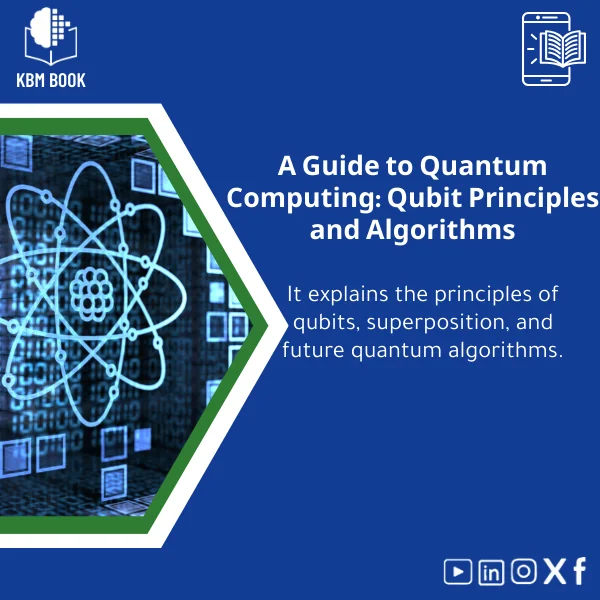
Quantum Computing Guide: Understanding Qubits and Superposition
Original price was: 349.00 $.279.00 $Current price is: 279.00 $.
A compact, structured Knowledge Base Module (KBM) that converts core quantum computing concepts—qubits, superposition, entanglement, and early quantum algorithms—into a searchable, hierarchical reference you can use for study, research, or implementation planning.
Key benefits & value for the buyer
This KBM turns complex topics from an introduction to quantum computing into a practical, navigable reference. Each entry is concise, cross-referenced, and arranged hierarchically so you can:
- Save research time: Look up “qubits and superposition basics” and get a clear definition, maths intuition, and example circuits in one place.
- Apply quickly: Step-by-step examples show how to construct simple quantum circuits, simulate them, and interpret results.
- Teach or present: Slides and lesson outlines derived from the KBM make classroom and workshop prep faster.
- Integrate into workflows: Machine-readable exports let you import the KBM into note apps, LMS, or internal knowledge systems.
Use cases & real-life scenarios
Student preparing for exams
Use the KBM as a revision scaffold: core definitions, worked examples, and a self-test bank on qubits, Bloch sphere visualization, and basic algorithms (Deutsch–Jozsa, Grover conceptual overview).
Researcher designing experiments
Quickly review noise models, qubit connectivity patterns, and gate decomposition tactics with references to primary literature—reducing the time spent locating practical hardware-relevant details.
Professional building a learning module
Export the KBM to PDF for distribution or use the JSON export to populate an LMS, creating interactive labs and graded assessments without building content from scratch.
Who is this product for?
- Undergraduate and graduate students taking an introduction to quantum computing course.
- Researchers and lab engineers needing a concise reference to qubits, noise, and gate sets.
- Trainers and instructors building curricula or short professional workshops.
- Product managers and consultants who require a reliable primer to evaluate quantum-related proposals.
How to choose the right format
The KBM is offered in several formats. Choose based on how you plan to use it:
- PDF (quantum computing book pdf): Ideal for reading, printing, and sharing—searchable and optimized for quick lookup.
- JSON / CSV: Best for integration with apps, building quizzes, or importing into a knowledge-management system.
- Combined package: For instructors and teams who want both human-readable and machine-readable assets.
If you want a lightweight primer, select the condensed module; for teaching and research use the full KBM with examples and references.
Quick comparison with typical alternatives
Compared with textbooks, articles, or video courses, this KBM emphasizes structured retrieval and reusability:
- Textbooks: deep but linear—KBM provides the same core material organized for targeted lookup rather than sequential reading.
- Articles & blogs: good for specific topics—KBM aggregates verified, referenced content across topics to avoid fragmentation.
- Video courses: engaging but hard to search—KBM is searchable and can be used as the authoritative script behind lessons.
Best practices & tips to get maximum value
- Start with the “Fundamentals” node: qubits, Bloch sphere, measurement — then expand to algorithms.
- Use the JSON export to tag parts you want to include in your LMS or personal notes.
- Run the included example circuits in a simulator to reinforce intuition—answers and walkthroughs are provided.
- Combine with a lab notebook: paste key fragments and add your experimental observations for reproducibility.
Common mistakes when buying/using quantum resources—and how to avoid them
- Mistake: Buying a general textbook expecting fast lookup. Fix: Choose this KBM for targeted retrieval and practical examples.
- Mistake: Relying on outdated notes. Fix: This KBM references recent introductory materials and notes update practices in the spec.
- Mistake: Ignoring machine-readable formats. Fix: Use JSON/CSV exports to integrate the KBM with your workflow.
Product specifications
- Title: Quantum Computing Guide — Qubits and Superposition
- Formats: PDF (searchable), JSON (structured KBM), CSV (tables & glossary)
- Content size: ~75 pages equivalent; 120+ indexed nodes (definitions, examples, references)
- Includes: Circuit diagrams, annotated pseudocode, exercises with solutions, bibliography
- Language: English
- License: Personal & educational use; commercial redistribution requires a commercial license (see purchase options)
- Delivery: Instant download after purchase; files available in your KBMBook account
- Updates: Minor corrections included for 12 months; option to subscribe for extended updates
FAQ
Is this a book or a database? What is a KBM?
It is a Knowledge Base Module (KBM): a structured, hierarchical database of concise entries. You receive both human-readable (PDF) and machine-readable (JSON/CSV) formats so you can read it like a book or integrate it into systems.
Can I get the quantum computing book PDF only?
Yes. You may choose the PDF-only package if you want a downloadable, searchable “quantum computing book pdf” focused on qubits, superposition, and algorithm overviews.
Does the KBM include runnable code or simulator instructions?
The KBM contains annotated pseudocode and simulator instructions compatible with common open-source simulators. Full runnable code snippets are included as examples; adapt them for your target platform.
What if the content doesn’t meet my needs?
We prioritize accurate, verifiable content. If the module does not match the advertised scope, contact support within 14 days for a resolution or refund—see our purchase terms for details.
Ready to get structured, reliable quantum knowledge?
Download a focused, professionally organized KBM that saves you hours of research and gives you reusable assets for teaching, labs, and projects.
Related products
Astronomy Observational Techniques Guide for Celestial Motion
Cell Biology Guide: Structure, Division, and Transport Insights
Introductory General Chemistry Book on Matter and Reactions
A structured, searchable Knowledge Base Module (KBM) that converts core general chemistry concepts — matter, elements, reactions, stoichiometry and molarity — into a hierarchical reference you can query, teach from, or integrate into study workflows. Ideal as a concise General Chemistry book alternative for students, researchers, and professionals who need accurate, practical chemistry knowledge fast.
Materials Physics Guide: Understanding Solid-State Properties
Modern Physics Book: Quantum, Relativity, and Tech Applications Guide
A structured, searchable Knowledge Base Module (KBM) that turns modern physics — quantum mechanics, special & general relativity, and contemporary technological applications — into a hierarchical, practical reference for students, researchers, and professionals who need quick, reliable access to advanced concepts and formulas.
Organic Chemistry Guide: Carbon Chains and Reactions
Physical Chemistry Guide: Energy, Thermodynamics & Interactions
A structured Knowledge Base Module (KBM) for Physical Chemistry that converts core theory, worked examples, and applied datasets into a searchable, hierarchical database — ideal for students, researchers, and professionals who need fast, reliable access to chemical thermodynamics basics and molecular interaction models.
Thermal Physics Guide: Understanding Heat, Energy, and Entropy
A downloadable, hierarchically structured Knowledge Base Module (KBM) that converts university-level thermodynamics into a searchable, practical digital database. Ideal for students, researchers, and professionals who need fast, reliable access to fundamentals and advanced topics in thermal physics.
Reviews
Clear filtersThere are no reviews yet.