


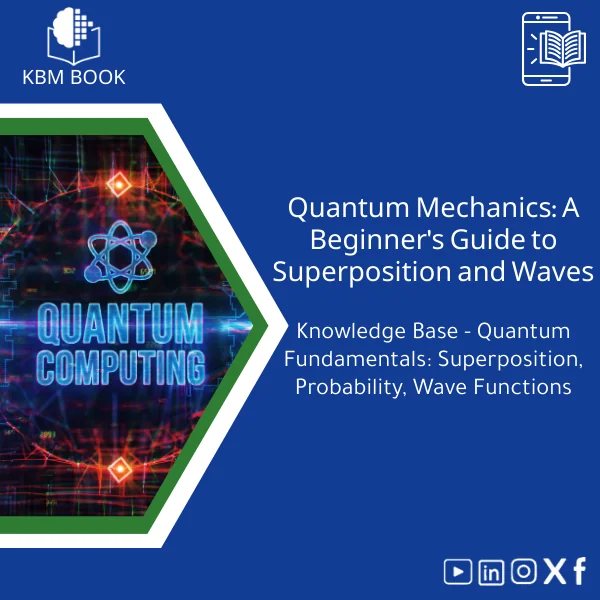
Quantum Mechanics: A Beginner’s Guide to Superposition and Waves
Original price was: 179.00 $.139.00 $Current price is: 139.00 $.
A concise, structured Knowledge Base Module (KBM) that converts quantum basics into a searchable, hierarchical reference — perfect for students,
researchers, and professionals who need reliable, quickly accessible explanations of superposition, probabilities, and wavefunctions.
Key benefits & value for students, researchers, and professionals
This KBM turns “Quantum Mechanics” — a subject often scattered across lectures, notes, and long textbooks — into a compact, practical database.
Each entry is short, self-contained, and linked to related topics so you can move from “superposition explained” to “wavefunction normalization” in seconds.
The emphasis is on usable knowledge: derivations are summarized into step lists, equations come with parameter guides, and conceptual points include one-line analogies for teaching.
What you get — benefits translated from features
- Save time: Searchable short entries let you find definitions, derivations, and examples in seconds (faster than skimming a textbook).
- Reduce errors: Standardized templates for setting up quantum problems reduce common setup mistakes in homework and research.
- Teach better: Classroom-ready summaries and visual prompts make explaining superposition and wavefunctions clearer.
- Integrate easily: Exportable formats let you plug the KBM into note apps, LMS, or local knowledge bases.
Use cases & real-life scenarios
The KBM is designed around practical workflows. Below are common scenarios and exactly how the KBM fits them.
Undergraduate study
Use the “Introduction to quantum mechanics” module to review lecture concepts before exams. Each concept includes quick-check questions and a one-page summary suitable for flashcards or a last-minute review.
Graduate research
Researchers use the KBM to recall specific derivations (e.g., time-evolution operators, perturbation theory templates) without re-reading full chapters. Export math snippets to LaTeX-ready text.
Teaching and labs
Instructors and lab facilitators use the KBM to build problem sets and lab instructions. The “superposition explained” entry provides classroom analogies and a stepwise example of two-state systems.
Interdisciplinary professionals
Engineers and data scientists working with quantum-inspired algorithms or simulations can extract the minimum theoretical background needed to validate models, saving hours compared to reading full texts.
Who is this product for?
This KBM is built for anyone who needs structured, reliable coverage of quantum mechanics basics:
- Undergraduate and graduate students looking for a compact “quantum basics guide”
- Researchers needing quick reference entries and derivation outlines
- Instructors and trainers preparing concise teaching materials
- Professionals who require a dependable introduction to quantum concepts without the weight of multiple textbooks
How to choose the right format & license
Available formats and advice for selecting the right option:
- PDF (readable, printable): Best for students and instructors who want a fixed-layout reference and printable summaries.
- CSV/JSON (machine-readable): Choose these if you need to import entries into a knowledge management system or search index.
- Combined pack: Includes PDF + JSON for maximum flexibility — recommended for research groups and course creators.
- License notes: Single-user vs. institutional licenses are available. Institutional license permits distribution within a class or department; single-user is for personal study.
Quick comparison with typical alternatives
How this KBM compares to common choices:
- Long textbooks: Textbooks provide depth but are slower to search. The KBM provides a distilled, fast-access layer without replacing primary sources.
- Lecture notes & articles: Often fragmented. The KBM is edited for consistency and linked hierarchically to avoid duplication and gaps.
- Video courses: Great for intuition; KBM is better for quick fact-checking, formula lookup, and integration into workflows.
Best practices & tips to get maximum value
- Start with the “Concept Map” page to see how topics connect before deep-diving into examples.
- Use the JSON export to build a searchable index in your note-taking app; tag entries by course, difficulty, and use-case.
- Combine with original references: use KBM for practical steps and canonical texts for detailed proofs.
- Regularly sync updates: KBMBook issues periodic corrections and clarifications; enable updates for institutional packs.
Common mistakes when buying or using similar knowledge products — and how to avoid them
- Buying unstructured notes: Avoid materials that lack hierarchy — they’re hard to search. Choose this KBM for its modular structure.
- Expecting complete replacements: KBM is a practical reference, not a replacement for deep theoretical study. Use it to complement textbooks and lectures.
- Ignoring format needs: If you plan to integrate material into software, get the JSON/CSV — a PDF-only purchase creates friction later.
- Overlooking licensing: Confirm institutional vs. individual use before distributing copies in a course.
Product specifications
- Title: Quantum Mechanics: A Beginner’s Guide to Superposition and Waves
- Type: Knowledge Base Module (KBM) — Natural Sciences
- Formats: PDF (print-friendly), JSON, CSV
- Size: PDF ~4–12 MB depending on format; JSON/CSV depend on export options
- Structure: Hierarchical modules — Concepts, Equations, Worked Examples, Problem Templates, References
- Language: English (with Arabic metadata available on KBMBook platform)
- Compatibility: Works with common note apps, LaTeX workflows, and LMS imports
- Updates: Minor corrections included for 12 months; option for extended update plans
- Delivery: Instant download after purchase
Frequently asked questions
Is this a full textbook or an introductory “quantum mechanics book pdf”?
This KBM is a focused, structured reference that covers introductory and intermediate quantum topics concisely. It is not a full-length textbook
but provides practical derivations, examples, and links to canonical sources. It is ideal as a companion or quick-reference PDF.
Can I import the content into my note app or LMS?
Yes. Choose the JSON/CSV export to import entries into knowledge management systems or LMS platforms. The PDF is optimized for printing and quick reading.
How accurate and up-to-date are the derivations and references?
Entries are curated and cross-checked against standard references. The KBM includes concise citations and receives periodic corrections. Extended update plans are available for institutional purchasers.
Which format should I choose if I want to teach a course?
The combined pack (PDF + JSON) is recommended for instructors: PDF for handouts and JSON to integrate examples into course platforms or auto-generate problem sets.
Ready to turn quantum confusion into clear, searchable knowledge?
Get an organized, practical KBM that saves study time and improves accuracy in problem setup. Instant download — choose single-user or institutional license at checkout.
Still unsure? Contact support or download the free sample of the “Concept Map” to inspect structure and sample entries before purchase.
Related products
Astronomy Observational Techniques Guide for Celestial Motion
Biochemistry Book: Understanding Chemical Processes in Living Systems

Cell Biology Guide: Structure, Division, and Transport Insights
Comprehensive Evolutionary Biology Book on Natural Selection
Comprehensive Nuclear Physics Book on Structure and Radioactivity
Cosmology Book: Guide to Big Bang and Galaxy Evolution
Electromagnetism Book: A Comprehensive Guide to Fields and Circuits
Physical Chemistry Guide: Energy, Thermodynamics & Interactions
A structured Knowledge Base Module (KBM) for Physical Chemistry that converts core theory, worked examples, and applied datasets into a searchable, hierarchical database — ideal for students, researchers, and professionals who need fast, reliable access to chemical thermodynamics basics and molecular interaction models.
Reviews
Clear filtersThere are no reviews yet.