


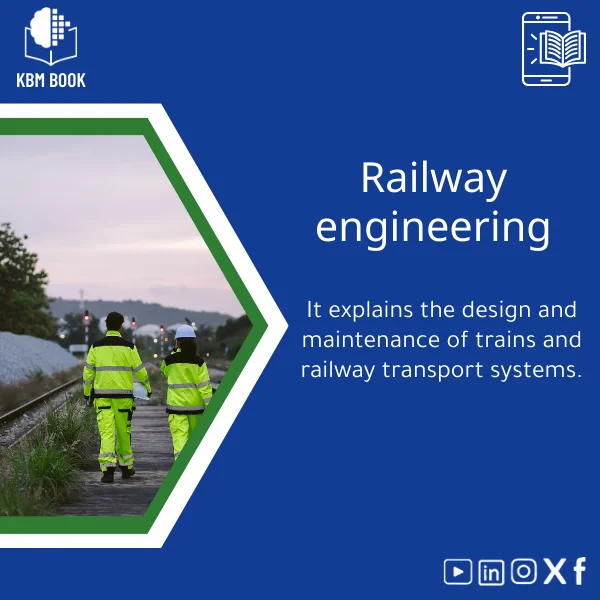
Railway Engineering Course: Design and Maintenance Guide
Original price was: 179.00 $.139.00 $Current price is: 139.00 $.
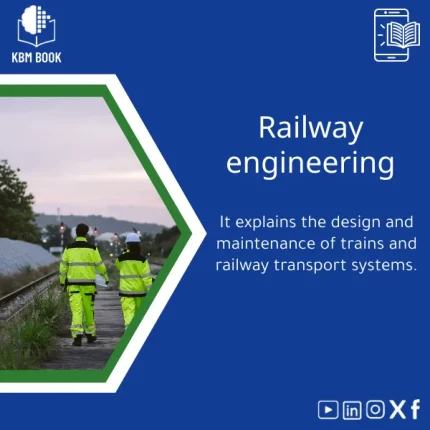
A structured, searchable knowledge base for Railway engineering: concise theories, applied procedures, and ready-to-use templates for railway track design, rolling-stock maintenance, and systems engineering — built for students, researchers, and professionals who need reliable technical reference fast.
Key benefits & value for the buyer
This Railway engineering KBM translates complex technical knowledge into a practical, re-usable format. Instead of scanning articles or fragmented PDFs, you get:
- Time savings: find design rules, formulas, and inspection criteria in seconds using structured indexes and search-ready files.
- Practical readiness: downloadable templates (inspection checklists, track alignment calculators, maintenance plans) you can adapt instantly.
- Reliability: logically organized topics—track geometry, track superstructure, drainage, signaling interfaces, and maintenance strategies—minimizing repetition and gaps.
- Scalability: integrate KBM content into research datasets, classroom materials, or engineering management systems without manual reformatting.
Use cases & real-life scenarios
For students
Prepare coursework and exams efficiently: use the “fundamentals of railway engineering” module for concise theory, and the worked examples for numerical problem practice.
For researchers
Rapid literature synthesis and model validation: extract standard parameters and track design references to compare with experimental data and support publications.
For maintenance engineers and planners
Build inspection schedules and maintenance plans using ready-made checklists and failure-mode tables. Practical calculation sheets speed up condition assessment and life-cycle budgeting.
For trainers and curriculum designers
Assemble lessons or modules from the KBM’s hierarchical structure to deliver consistent, repeatable training, from basics to advanced topics.
Who is this product for?
The Railway Engineering Course KBM is built for:
- Undergraduate and graduate students in civil and railway engineering.
- Academic researchers needing consolidated technical references.
- Railway designers and track engineers responsible for alignment and superstructure design.
- Maintenance supervisors and asset managers planning inspections and lifecycle interventions.
- Consultants and instructors assembling practical courseware.
How to choose the right KBM level
KBMs are modular and labelled by depth:
- Introductory: fundamentals of railway engineering—best for students and early-stage learners.
- Practitioner: common design tasks, maintenance procedures, and templates—suitable for engineers and technicians.
- Advanced: specialized topics such as high-speed track dynamics, advanced signaling interfaces, and optimization methods for researchers and senior designers.
Choose based on your immediate need: if you require operational checklists and templates, select Practitioner; if preparing a thesis or advanced design study, choose Advanced.
Quick comparison with typical alternatives
Alternatives include textbooks, scattered PDFs, and online articles. Compared with those, this KBM offers:
- Structured access: hierarchical topics and indexed files versus linear chapters in books.
- Immediate usability: exportable templates and calculation sheets versus static prose.
- Searchability: fast lookups in JSON/Excel vs. long manual searches through PDFs or books.
If you need a reference to cite in research or a template to run real-world checks, the KBM consolidates both needs in one purchase.
Best practices & tips to get maximum value
- Start with the fundamentals module to align terminology before using advanced modules.
- Import CSV/Excel tables into your asset-management software to standardize inspections.
- Adapt templates to local standards (gauge, load factors, climatic allowances) and document changes for auditability.
- Use the worked examples to validate your calculation routines and reduce design errors.
Common mistakes when buying/using similar products and how to avoid them
- Mistake: Buying a generic book expecting reusable templates. Fix: Choose a KBM with explicit exportable templates and data files.
- Mistake: Skipping basics and using advanced modules incorrectly. Fix: Follow the KBM hierarchy: fundamentals → practitioner → advanced.
- Mistake: Assuming one-size-fits-all standards. Fix: Use the KBM as a baseline and adapt parameters to local regulations and track conditions.
Product specifications
- Format: Structured Knowledge Base Module (KBM) — includes JSON, CSV, Excel, and printable PDF manuals.
- Structure: Multi-level hierarchy — Fundamentals / Practitioner / Advanced modules with cross-references.
- Content scope: Track geometry, rail profiles, superstructure components, drainage & earthworks, signalling interfaces, rolling stock basics, maintenance strategies.
- Files included: Calculation templates, inspection checklists, sample project specs, worked numerical examples, bibliographic references.
- Language: English (technical terminology aligned with international standards).
- Delivery: Immediate digital download after purchase; transferable license for individual use or institutional bundles (see license notes).
- Usage notes: Editable files for integration into design workflows; best used with standard engineering software for calculations.
Frequently asked questions
What formats are included and can I export the templates into my software?
Yes. The KBM includes JSON, CSV, and Excel files for direct import into most asset-management and spreadsheet applications, plus printable PDFs for offline use.
Is the content suitable for academic citation and research use?
The KBM provides bibliographic references and standard equations used in railway engineering. It is designed as a technical reference and can be cited alongside primary sources; verify citation format per your institution.
How frequently is the KBM updated to reflect new standards?
KBMBook issues periodic updates. Purchase includes current release; updates policy and options for versioned bundles are described on the product page.
What if I only need a short module (e.g., track design basics)?
You can select the Fundamentals or Practitioner modules separately. Check the module list and choose the level that matches your immediate need — full bundles are recommended for long-term use.
Ready to make Railway engineering part of your toolkit?
Purchase a practical, structured railway engineering knowledge base that moves you from theory to hands-on application. Immediate download — integrate into coursework, research, or daily engineering tasks.
If you have questions about licensing for teams or institutional access, contact KBMBook support before purchase to ensure the bundle matches your deployment needs.
Related products
Atomic Physics Guide: Understanding Atomic and Electron Properties
Knowledge Base — Atomic/Electron Properties & Electromagnetic Interactions. A structured, searchable KBM for students, researchers, and professionals who need an authoritative atomic physics reference that organizes concepts, formulas, experiments, and practical applications from basics of atomic physics to advanced electron properties.
Cell Biology Guide: Structure, Division, and Transport Insights
Comprehensive Genetics Book: DNA, Mendelian Genetics & Engineering
A structured, searchable knowledge base module (KBM) that turns genetics theory and practice into an immediately usable digital reference — from DNA structure to Mendelian genetics and contemporary genetic engineering techniques — optimized for students, researchers, and professionals who need reliable answers fast.

Comprehensive Microbiology Book on Bacteria, Viruses, and Fungi
Modern Physics Book: Quantum, Relativity, and Tech Applications Guide
A structured, searchable Knowledge Base Module (KBM) that turns modern physics — quantum mechanics, special & general relativity, and contemporary technological applications — into a hierarchical, practical reference for students, researchers, and professionals who need quick, reliable access to advanced concepts and formulas.
Organic Chemistry Guide: Carbon Chains and Reactions
Physical Chemistry Guide: Energy, Thermodynamics & Interactions
A structured Knowledge Base Module (KBM) for Physical Chemistry that converts core theory, worked examples, and applied datasets into a searchable, hierarchical database — ideal for students, researchers, and professionals who need fast, reliable access to chemical thermodynamics basics and molecular interaction models.
Reviews
Clear filtersThere are no reviews yet.