


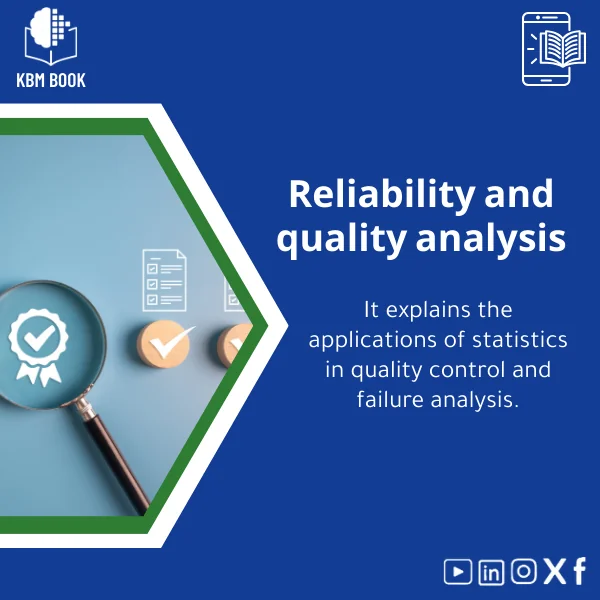
Reliability Quality Analysis Guide for Data and Quality Control
Original price was: 349.00 $.279.00 $Current price is: 279.00 $.
A searchable, hierarchical Knowledge Base Module (KBM) that converts statistical methods for quality control and failure analysis into practical, ready-to-use tools — ideal for students, researchers, and professionals who need fast access to reliable, validated methods.
Key benefits & value for buyers
This KBM distills “reliability quality analysis” into an actionable database rather than a long narrative. Each feature below translates directly into time-savings, reproducibility, and better outcomes.
Faster decision-making
Indexed methods, decision trees and quick-reference tables reduce the time from problem identification to corrective action. Instead of searching dozens of papers, you query a single module and get validated methods with implementation notes.
Reproducible analysis
Ready-to-run R/Python snippets, sample datasets, and exportable CSVs make it straightforward to reproduce results and integrate them into reports, dashboards, or lab notebooks.
Depth without repetition
The KBM hierarchy avoids duplicate content by linking concepts across modules: control charts reference capability indices, capability indices reference failure modes, and so on — creating a coherent learning and operational flow.
Use cases & real-life scenarios
Practical examples show how this reliability and quality book becomes part of everyday workflows:
Quality engineer — process control
A quality engineer uses the KBM to select and configure SPC charts, calibrate control limits using historic datasets provided, and generate a standardized report template for management. The KBM’s checklist reduces the time to sign-off and ensures traceable choices.
Researcher — failure analysis
A researcher conducting failure mode analysis accesses Weibull fitting guidance, sample code, and annotated datasets to test hypotheses quickly. The module includes guidance on censoring, confidence intervals, and model selection.
Student — exam prep & projects
Students can follow the hierarchal modules to learn concepts in sequence, access example problems with solutions, and export the data to practice real analyses in class assignments.
Who is this product for?
This KBM is designed for:
- Students learning statistical quality control and reliability engineering.
- Researchers needing reproducible failure analysis workflows and reference methods.
- Industry professionals (QA, manufacturing, maintenance, data analytics) who require quick, reliable answers and templates.
- Trainers and instructors who want modular teaching units and graded examples.
If you need a compact, searchable reference that blends theory with ready-to-use practice, this module is built for you.
How to choose the right edition
Choose based on scope and integration needs:
- Individual / Student: Use this core KBM to study theory, work through example problems, and run sample scripts locally.
- Professional / Team: Opt for the version with extended case studies, multiple datasets, and more report templates to standardize team workflows.
- Research / Enterprise: Use the full KBM including advanced modules (system reliability, Bayesian failure analysis) and a ready SQLite database for integration.
If uncertain, start with the core KBM — you can expand later by adding modules tailored to your field.
Quick comparison with typical alternatives
How this KBM differs from other options you might consider:
- Versus textbooks: Textbooks explain theory but rarely include searchable datasets and runnable scripts. The KBM is action-oriented and immediately usable.
- Versus articles & papers: Papers provide depth in one area; the KBM links methods across domains and provides practical templates and checklists.
- Versus generic online resources: The KBM is curated for accuracy, organized hierarchically to avoid repetition, and packaged for offline use and reproducibility.
Best practices & tips to get maximum value
- Start with the module checklist to scope your analysis before diving into scripts.
- Use the sample datasets to validate your environment and then replace them with your operational data.
- Leverage the decision tables to choose between parametric and non-parametric approaches.
- Document each step using the included report templates to make audits and peer reviews faster.
Common mistakes when buying/using similar products and how to avoid them
Common pitfalls and how the KBM prevents them:
- Buying a long textbook: You may get theory but no reproducible tools. Our KBM pairs theory with scripts and templates.
- Using ad-hoc scripts: Scripts without documentation can’t be maintained. The KBM includes annotated scripts and version notes.
- Overfitting methods to limited data: The KBM explains assumptions and includes validation checks to prevent misuse.
Product specifications
- Format: Downloadable KBM package (searchable SQLite DB + CSV sample datasets + Markdown modules + R/Python script files)
- Modules: 12 hierarchical modules (Fundamentals → SPC → Failure Analysis → Advanced Reliability)
- Content volume: ~480 indexed entries; 30+ case studies; 120+ key formulas and interpretation notes
- Sample data: Multiple CSV datasets for practice (right-censored, left-censored, time-to-failure)
- Compatibility: Works on Windows/macOS/Linux; scripts tested with R 4.x and Python 3.8+
- Delivery: Instant download after purchase; includes a user guide and change log
- Usage notes: Commercial and academic use allowed per license — see included license file for details
Frequently asked questions
Does this KBM include runnable code for analysis?
Yes. The KBM includes tested R and Python snippets for common tasks (SPC charts, Weibull fitting, survival analysis). Each script is annotated and paired with sample datasets so you can run them immediately.
Is the content suitable for beginners or only experts?
The KBM is layered: early modules cover foundational concepts for students and beginners, while advanced modules and case studies serve researchers and experienced professionals. Follow the recommended learning path for best results.
How is this different from a reliability and quality book?
Unlike a traditional book, this KBM is an interactive, searchable database with exportable datasets, reproducible scripts, and modular teaching units — built for application, not just reading.
What if I need team-wide deployment or custom modules?
Contact KBMBook for team licensing and customization options. The KBM is designed to be extensible; custom modules and integration services are available for enterprise needs.
Ready to apply reliability quality analysis in your projects?
Download a structured, practical KBM that turns statistical quality control and failure analysis into repeatable, auditable workflows. Accelerate learning, standardize team practices, and deliver reliable results faster.
Instant download. Includes datasets, scripts, and a user guide — ideal for students, researchers, and professionals focused on data analytics for quality.
Related products
Analytical Chemistry Book: Qualitative and Quantitative Methods Guide

Astronomy Observational Techniques Guide for Celestial Motion

Comprehensive Evolutionary Biology Book on Natural Selection
Comprehensive Genetics Book: DNA, Mendelian Genetics & Engineering
A structured, searchable knowledge base module (KBM) that turns genetics theory and practice into an immediately usable digital reference — from DNA structure to Mendelian genetics and contemporary genetic engineering techniques — optimized for students, researchers, and professionals who need reliable answers fast.

Comprehensive Microbiology Book on Bacteria, Viruses, and Fungi

General Biology Book: A Guide to Cells, Genetics & Taxonomy
Introductory General Chemistry Book on Matter and Reactions
A structured, searchable Knowledge Base Module (KBM) that converts core general chemistry concepts — matter, elements, reactions, stoichiometry and molarity — into a hierarchical reference you can query, teach from, or integrate into study workflows. Ideal as a concise General Chemistry book alternative for students, researchers, and professionals who need accurate, practical chemistry knowledge fast.

Reviews
Clear filtersThere are no reviews yet.