


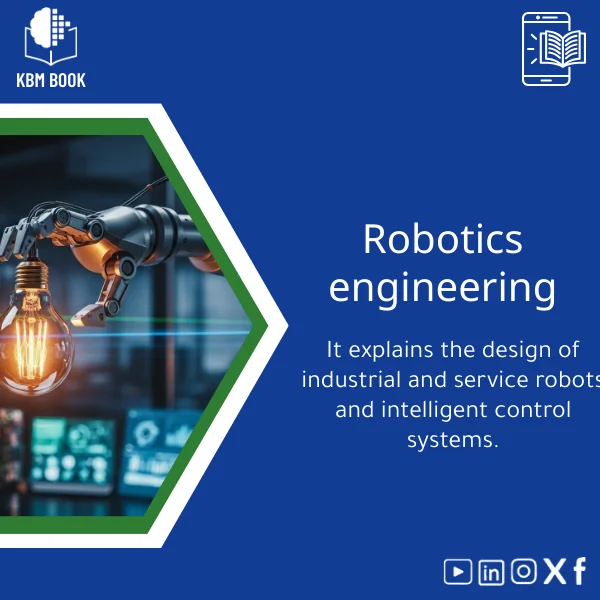
Robotics Engineering Guide to Industrial and Service Robots
Original price was: 349.00 $.279.00 $Current price is: 279.00 $.
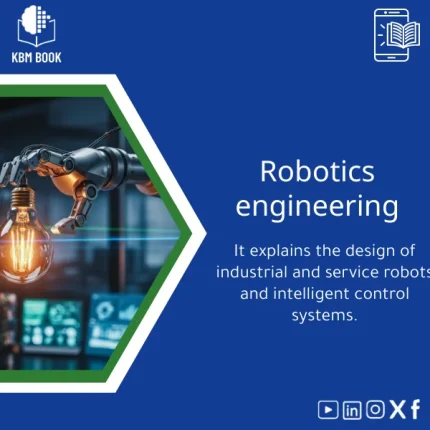
A structured, searchable Knowledge Base Module (KBM) that converts core Robotics Engineering concepts — from industrial robotics basics to service robots design — into a practical, hierarchical reference you can query, embed, and apply immediately.
Key benefits & value for the buyer
This KBM shifts the time you spend searching for fundamentals into time building and testing designs. It packages Robotics Engineering knowledge into discrete, linked entries so you can:
- Make faster decisions: Use compact procedure cards (e.g., DH parameter setup, Jacobian computation, trajectory generation) instead of scanning chapters.
- Reduce errors: Step-by-step checklists and worked examples minimize common modeling and control mistakes.
- Apply directly: Copy-ready control law pseudocode, calibration flows, and sensor integration checklists speed prototype work.
- Learn progressively: Hierarchical structure that takes a beginner from industrial robotics basics to advanced service robots design guide topics.
Use cases & real-life scenarios
Student lab & coursework
Replace disparate lecture notes with a single searchable KBM: quickly pull the kinematics derivation for homework, or access a simulation-ready controller template when building lab demos.
Research & prototyping
Researchers use the KBM to consolidate reference equations, sensor fusion patterns, and experimental setups. Example: replicate a published workspace mapping pipeline by following the module sequence and scripts.
Professional engineering & integration
Engineering teams adopt parts of the KBM as onboarding material: mechanical engineers review actuator selection checklists; controls engineers use PID and model-based controller templates; integrators follow safety and compliance checkpoints for industrial deployments.
Who is this product for?
Tailored for students, researchers, and professionals who need reliable, structured knowledge rather than scattered texts. Specific target segments:
- Undergraduate and graduate students learning Robotics Engineering or Mechatronics.
- Research assistants needing repeatable experiment recipes and reference derivations.
- Junior engineers and lab technicians implementing industrial robotics basics for automation cells.
- Designers of service robots requiring modular guidance on human-robot interaction, safety, and perception.
How to choose the right KBM format for your work
KBMBook delivers several package options; choose based on how you work:
- Interactive KBM (recommended): Full searchable dataset for rapid queries and integration into tooling — best for ongoing research and lab use.
- PDF companion: Printable summaries and diagrams — ideal for offline study or course packs (includes a “robotics engineering book pdf” style companion).
- Code-ready snippets: Example controllers and scripts for simulators and microcontrollers — use these when prototyping.
If you need both quick reference and runnable examples, choose the full package with searchable KBM + PDF companion.
Quick comparison with typical alternatives
Unlike textbooks or scattered articles, this KBM is:
- Modular: Breaks content into reusable units you can use independently.
- Search-friendly: Designed for lookup, not linear reading — find “industrial robotics basics” without scanning chapters.
- Practical: Includes checklists, templates, and code — not just theory.
If you need a service robots design guide rather than a single narrative, a KBM provides a task-oriented route from problem to solution.
Best practices & tips to get maximum value
- Start with the “Fundamentals” module: complete the kinematics and dynamics checklists before using advanced control templates.
- Use the PDF companion as a cheat-sheet during labs; keep the searchable KBM open for solver parameters and code snippets.
- Integrate KBM entries into your project wiki — copy checklists verbatim to ensure standardization across team members.
- Backup the KBM and maintain version notes when you customize templates for a specific robot or environment.
Common mistakes when buying or using robotics resources — and how to avoid them
- Mistake: Buying a long textbook expecting ready-to-run code. Fix: Choose a KBM that includes code snippets and scripts.
- Mistake: Skipping calibration checklists. Fix: Follow the KBM’s calibration module before testing closed-loop controllers.
- Mistake: Assuming one template fits all robots. Fix: Use the modular approach: adapt actuator selection and controller gains per your hardware profile.
Product specifications
- Title: Robotics Engineering Guide to Industrial and Service Robots (KBM)
- Formats: Searchable KBM package (JSON + indexing), PDF companion (print-ready), example code (Python/ROS snippets)
- Coverage: Kinematics, dynamics, control, sensors, perception basics, actuation, safety, HRI, integration
- Estimated equivalent length: 350–450 pages of structured content (modular entries, not linear text)
- Language: English (clear technical English with Arabic-friendly structure for regional educators)
- Delivery: Instant digital download after purchase; updates available periodically
- License: Single-user digital license with options for team licenses
FAQ
Is this a textbook or a robotics engineering book pdf?
The product includes a concise PDF companion formatted like a reference booklet, but its core is a structured, searchable KBM designed for lookup and reuse — not a linear textbook. If you want a “robotics engineering book pdf” feel, download the PDF companion included in the package.
Will the KBM help me with industrial robotics basics for an automation project?
Yes. The KBM contains step-by-step modules on kinematics, actuator selection, safety, and PLC/robot integration checklists tailored to industrial automation tasks.
Does it include examples for service robots design guide topics (navigation, HRI)?
Yes. Modules cover perception basics, navigation patterns, HRI considerations, and lightweight control templates for mobile and social robots.
What if I’m concerned about price and long-term value?
Consider the time saved: faster troubleshooting, fewer design iterations, and reusable templates. KBMBook also provides update notes and upgrade paths so your KBM stays relevant as standards and practices evolve.
Ready to stop searching and start building?
Purchase the Robotics Engineering KBM now and get immediate access to a practical, structured knowledge base that supports both learning and engineering work.
Related products

Analytical Chemistry Book: Qualitative and Quantitative Methods Guide
Astrophysics Book: Understanding Stars, Galaxies, and Dark Energy
A searchable, hierarchical Knowledge Base Module (KBM) that converts astrophysics and cosmology into a practical, exam-ready and research-ready reference. Designed for students, researchers, and professionals who need immediate access to reliable explanations, equations, and data models for stars, galaxies, and dark energy.
Biological Anthropology Study Guide on Human Evolution
Comprehensive Genetics Book: DNA, Mendelian Genetics & Engineering
A structured, searchable knowledge base module (KBM) that turns genetics theory and practice into an immediately usable digital reference — from DNA structure to Mendelian genetics and contemporary genetic engineering techniques — optimized for students, researchers, and professionals who need reliable answers fast.
Comprehensive Nuclear Physics Book on Structure and Radioactivity

General and Special Relativity Book on Einstein’s Theory
A structured, searchable Knowledge Base Module (KBM) that converts Einstein's General and Special Relativity into a clear, hierarchical reference: formulas, derivations, worked examples, practical applications (GPS, astrophysics), and a compact research bibliography — ready to download and integrate into study, teaching, or research workflows.

Reviews
Clear filtersThere are no reviews yet.