


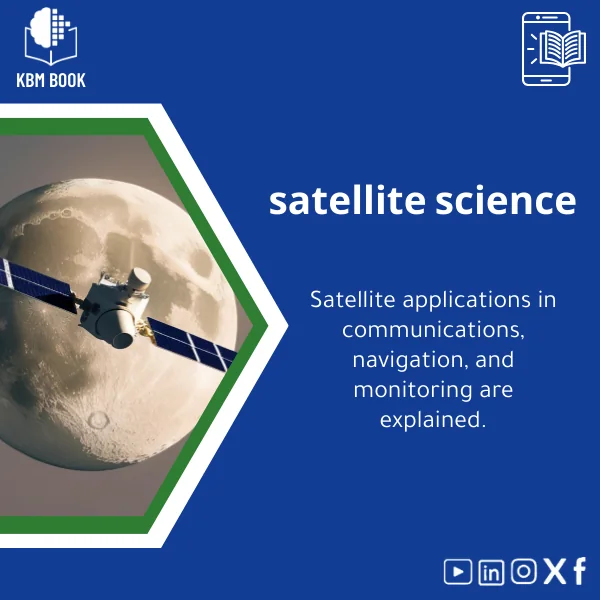
Satellite Sciences Guide: Applications in Communication, Navigation, and Earth Observation
Original price was: 179.00 $.139.00 $Current price is: 139.00 $.
A structured, searchable Knowledge Base Module (KBM) that converts satellite sciences into a step-by-step professional reference — from foundational physics to applied systems for communication, navigation and Earth observation. Ideal for students, researchers, and professionals who need fast access to reliable, hierarchical content.
Key benefits & value for the buyer
This KBM is designed to replace fragmented notes, scattered PDFs, and lengthy textbooks with a concise, hierarchical database that surfaces precise answers and workflows. Benefits include:
Fast, reliable answers
Search and navigate directly to the formula, diagram, or procedure you need — e.g., link budget steps for satellite communications, GNSS error components, or radiometric calibration for Earth observation sensors.
Practical, project-ready content
Each module ends with checklists, example calculations, and exportable tables so you can apply the material immediately to lab assignments, design reports, or mission planning.
Learning path from basic to advanced
Start with orbital mechanics basics, move to RF propagation and modulation, and finish with mission-level case studies that show how satellite navigation and Earth observation integrate into operational systems.
Use cases & real-life scenarios
Below are concrete ways the Satellite Sciences KBM is used daily by our target audience.
Undergraduate and graduate coursework
Students use module sequences to prepare lab reports: step-by-step derivations for Doppler shift in LEO, sample MATLAB scripts for orbit propagation, and graded problem sets with solutions.
Research and prototyping
Researchers reference validated formulas and configuration templates when designing communication payloads, building GNSS integrity models, or evaluating satellite imagery processing chains.
Engineering and mission planning
Professionals use the KBM to run quick link budget checks, generate antenna pointing procedures, and assemble mission requirement documents — saving time compared to searching multiple sources.
Training and instruction
Instructors and trainers use the KBM to build modules for short courses, with clear learning outcomes and linked practical exercises.
Who is this product for?
This KBM targets three main segments:
- Students who need a compact, authoritative reference for coursework and labs.
- Researchers requiring curated formulas, reference datasets, and reproducible workflows.
- Professionals (systems engineers, mission planners, data analysts) who want fast access to procedures and templates used in real projects.
If you repeatedly search for “satellite sciences book pdf” or “satellite applications in communication” and still end up piecing answers together, this KBM centralizes that knowledge into a single, reusable dataset.
How to choose the right version
We offer formats tuned to different workflows — choose based on how you work:
- Student edition (light): compact modules, solved exercises, summary sheets — ideal for coursework and exams.
- Professional edition (full): complete hierarchies, templates, exportable CSV/TXT tables, and mission case studies for immediate application.
- Research pack (extended): includes supplementary datasets, reproducible scripts, and advanced derivations for publication-grade work.
Prefer digital convenience? Select the PDF + database bundle for searchable offline use and easy integration with citation managers.
Quick comparison with typical alternatives
How this KBM differs from books, scattered PDFs, and online articles:
- Books: deep but linear — KBM is modular and searchable, enabling direct access to the exact procedure you need.
- Scattered PDFs/notes: inconsistent and redundant — KBM is curated, de-duplicated, and professionally organized.
- Web articles: variable quality — KBM provides vetted formulas, traceable references, and applied templates.
Best practices & tips to get maximum value
- Start the learning path: follow the recommended module order for coherent progression.
- Use built-in templates: adapt the link-budget and sensor-tasking templates to your project to save hours.
- Export early: export tables and diagrams for reproducible lab reports and appendices.
- Cross-reference: use links between navigation, communication, and EO modules to understand integrated mission trade-offs.
Common mistakes when buying/using similar products — and how to avoid them
- Buying a single-format resource: Prefer a bundle (PDF + database) if you need both offline reference and searchable datasets.
- Using uncurated sources: rely on vetted KBM modules to avoid contradictory formulas or outdated unit conventions.
- Skipping templates: failing to use ready templates means redoing routine calculations — use the provided checklists to standardize results.
Product specifications
- Title: Satellite Sciences Guide — Applications in Communication, Navigation, and Earth Observation
- Format: Hierarchical KBM database + searchable PDF (optional export formats: CSV, JSON, Markdown)
- Language: English
- Coverage: orbital mechanics, RF systems, GNSS fundamentals, EO sensor models, mission case studies
- Modules: Core (24 modules) + Appendices (formulas, unit tables, scripts)
- File size: varies by edition (Student light ~30MB PDF; Professional bundle includes database exports)
- License: single-user digital license with commercial use option for professional edition (details included at download)
- Compatibility: Windows, macOS, Linux (PDF + text exports); import-ready for analysis tools
- Delivery: instant download after purchase
- Updates: minor corrections and clarifications included for 12 months
FAQ
Can I cite modules from this KBM in academic papers?
Yes. Each module includes full references and a recommended citation format. The Research pack adds DOIs for included datasets where applicable.
Is there a preview or table of contents I can inspect before buying?
Yes. The product page includes a full module list and sample pages. If you need additional preview material for course adoption, contact support for instructor access options.
Does this replace traditional textbooks?
Not always. The KBM is complementary: it focuses on applied procedures, ready templates, and searchable references. For extensive theoretical depth you may still use textbooks, but the KBM accelerates application and project work.
What if I need team or site licenses?
Team and institutional licenses are available. Contact sales for pricing and deployment instructions that include shared database access.
Ready to get precise answers faster?
Order the Satellite Sciences KBM now and replace scattered resources with a structured, project-ready knowledge base that saves time and improves accuracy.
Instant download. Includes 12 months of updates and full module citations for academic and professional use.
Related products
Atomic Physics Guide: Understanding Atomic and Electron Properties
Knowledge Base — Atomic/Electron Properties & Electromagnetic Interactions. A structured, searchable KBM for students, researchers, and professionals who need an authoritative atomic physics reference that organizes concepts, formulas, experiments, and practical applications from basics of atomic physics to advanced electron properties.
Cell Biology Guide: Structure, Division, and Transport Insights
Comprehensive Evolutionary Biology Book on Natural Selection
General Biology Book: A Guide to Cells, Genetics & Taxonomy
General Physics Book: Fundamentals of Force, Motion, Energy
Introductory General Chemistry Book on Matter and Reactions
A structured, searchable Knowledge Base Module (KBM) that converts core general chemistry concepts — matter, elements, reactions, stoichiometry and molarity — into a hierarchical reference you can query, teach from, or integrate into study workflows. Ideal as a concise General Chemistry book alternative for students, researchers, and professionals who need accurate, practical chemistry knowledge fast.
Modern Physics Book: Quantum, Relativity, and Tech Applications Guide
A structured, searchable Knowledge Base Module (KBM) that turns modern physics — quantum mechanics, special & general relativity, and contemporary technological applications — into a hierarchical, practical reference for students, researchers, and professionals who need quick, reliable access to advanced concepts and formulas.
Reviews
Clear filtersThere are no reviews yet.