


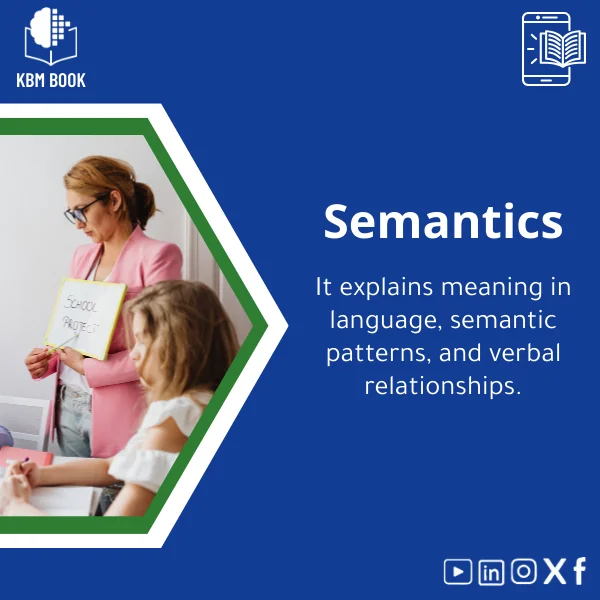
Semantics Book: Understanding Semantic Patterns and Lexical Relations
Original price was: 179.00 $.139.00 $Current price is: 139.00 $.
A compact, structured Knowledge Base Module (KBM) that converts core theories and practical analyses of meaning in language into a searchable, hierarchical resource — designed to speed research, coursework, and professional reference for students, researchers, and language professionals.
Key benefits & value for the buyer
This Semantics book KBM transforms theoretical content into a pragmatic reference system. Instead of a long linear text, you receive modular entries that can be searched, filtered, and reused — reducing lookup time and improving learning retention.
What you gain
- Time savings: Immediate access to definitions, patterns, and example sentences arranged by concept and use-case.
- Consistency: Unified terminology and cross-referenced nodes reduce ambiguity across lessons, papers, or projects.
- Practical readiness: Exportable tables and annotated datasets that plug directly into assignments, NLP experiments, or lesson plans.
- Scalability: Use as a standalone primer or integrate into a larger KBM library for broader curricula.
Use cases & real-life scenarios
Examples of how the Semantics book KBM is applied day-to-day:
- Undergraduate study: Students preparing for exams extract concise summaries and example sets for revision sessions.
- MA/PhD research: Researchers map lexical relations and track citation-ready definitions while designing annotation schemes.
- Translation & localization: Professionals consult semantic patterns to resolve ambiguity and ensure consistent terminology across targets.
- NLP & computational linguistics: Engineers use the lexical relations matrices and labeled examples to bootstrap feature engineering and evaluation sets.
- Instructors: Create quizzes and lecture slides quickly by importing categorized entries and examples.
Who is this product for?
The Semantics book KBM is built for anyone who needs precise, structured knowledge about meaning in language:
- Linguistics students and tutors (introductory through advanced courses).
- Researchers needing a compact, citation-ready reference and example pools.
- Translators and terminologists resolving semantic ambiguity.
- NLP practitioners preparing datasets or developing semantic features.
- Curriculum designers and professional trainers building modules on lexical semantics.
How to choose the right KBM version
This is a digital knowledge module with a few variant options to match workflow and technical needs. Choose based on your tools and level of depth required:
- Student pack: Condensed modules, highlights, and practice exercises — best for exam prep.
- Researcher pack: Full theoretical coverage, citations, and expanded example corpus.
- Developer pack: Includes JSON/CSV exports and labeling guides for immediate integration into NLP pipelines.
If unsure, start with the Researcher pack for maximum coverage; exported formats make it easy to pare down or reuse content.
Quick comparison with typical alternatives
Compared with a printed textbook or scattered articles, the Semantics book KBM prioritizes accessibility and reusability:
- Vs. textbooks: Faster lookup and modular use. Textbooks are narrative; KBMs are reference-first and export-ready.
- Vs. online articles: Single-source consistency, cross-references, and downloadable structured data.
- Vs. courses: Courses teach by schedule; a KBM supports on-demand consultation and asset reuse for many courses.
Best practices & tips to get maximum value
- Import JSON/CSV into your notes app or analysis tool and link semantic nodes to your project files for fast retrieval.
- Create a personal index of the KBM nodes you use most — reduces search time further.
- Combine the Semantics KBM with other KBMs (syntax, pragmatics) to build interdisciplinary lesson plans or experiments.
- Use the annotated examples as seeds for annotation guidelines when building corpora.
Common mistakes when buying or using similar resources — and how to avoid them
- Buying raw PDFs: PDFs are hard to repurpose. Choose a KBM with exportable structured formats.
- Assuming one-size-fits-all: Match the KBM variant (student/researcher/developer) to your workflow.
- Neglecting updates: Check the product’s update policy — semantic theory evolves; pick a KBM with version notes.
- Poor integration: Plan how to import data into your tools before purchase to ensure compatibility.
Product specifications
- Title: Semantics Book: Understanding Semantic Patterns and Lexical Relations
- Format: Multi-format download — JSON, CSV, Markdown, and printable PDF summary
- Structure: Hierarchical KBM — modules, submodules, examples, exercises, and references
- Size: ~120 KBM nodes; ~450 annotated example sentences; lexical relations matrices included
- Language: English (primary) — Arabic summary available on KBMBook platform
- License: Single-user license with academic and professional use allowed; commercial redistribution restricted
- Delivery: Instant download after purchase; version notes and updates available on the product page
- Compatibility: Readable by common note apps and data tools; import scripts included for common workflows
FAQ
What file formats are included and will they work with my tools?
The KBM includes JSON and CSV for data workflows, Markdown for textual notes, and a printable PDF for quick offline reference. Import scripts are provided for common note-taking apps and basic instructions for loading into NLP tools.
How does this differ from a regular semantics textbook?
Unlike a textbook, this KBM is modular, searchable, and exportable. It focuses on structured access to definitions, patterns, and examples that you can reuse directly in research, teaching, or development — not just linear reading.
Can I use this for commercial projects or include it in a course I sell?
The purchase includes a single-user academic/professional license. You may use content in your projects and teaching; redistribution, resale, or inclusion in commercial products is restricted. Contact support for institutional or multi-user licensing.
What if I need the KBM updated or find an error?
KBMBook maintains version notes and provides updates for content corrections and significant theoretical additions. Report errors through the product page; critical fixes are issued in patch updates and subscribers are notified.
Ready to get structured, usable knowledge on semantics?
Download a structured semantics textbook alternative that’s designed for study, research, and applied work. Immediate access, multiple formats, and clear licensing — start using it in your projects today.
Need a variant for a classroom or lab? Contact KBMBook for multi-user options and institutional bundles.
Related products
Astronomy Observational Techniques Guide for Celestial Motion
Comprehensive Genetics Book: DNA, Mendelian Genetics & Engineering
A structured, searchable knowledge base module (KBM) that turns genetics theory and practice into an immediately usable digital reference — from DNA structure to Mendelian genetics and contemporary genetic engineering techniques — optimized for students, researchers, and professionals who need reliable answers fast.
Cosmology Book: Guide to Big Bang and Galaxy Evolution
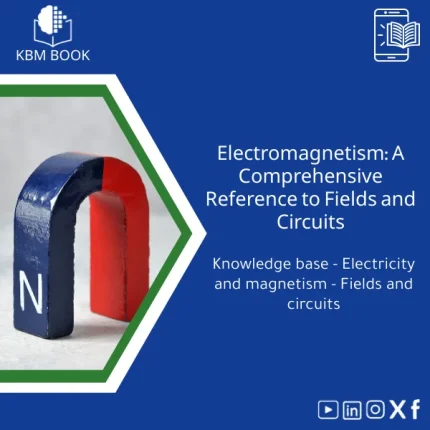
Electromagnetism Book: A Comprehensive Guide to Fields and Circuits
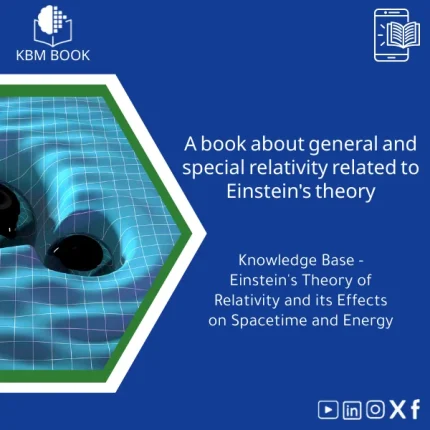
General and Special Relativity Book on Einstein’s Theory
A structured, searchable Knowledge Base Module (KBM) that converts Einstein's General and Special Relativity into a clear, hierarchical reference: formulas, derivations, worked examples, practical applications (GPS, astrophysics), and a compact research bibliography — ready to download and integrate into study, teaching, or research workflows.
General Physics Book: Fundamentals of Force, Motion, Energy
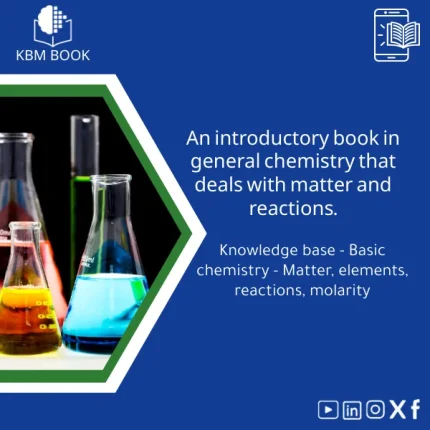
Introductory General Chemistry Book on Matter and Reactions
A structured, searchable Knowledge Base Module (KBM) that converts core general chemistry concepts — matter, elements, reactions, stoichiometry and molarity — into a hierarchical reference you can query, teach from, or integrate into study workflows. Ideal as a concise General Chemistry book alternative for students, researchers, and professionals who need accurate, practical chemistry knowledge fast.
Reviews
Clear filtersThere are no reviews yet.