


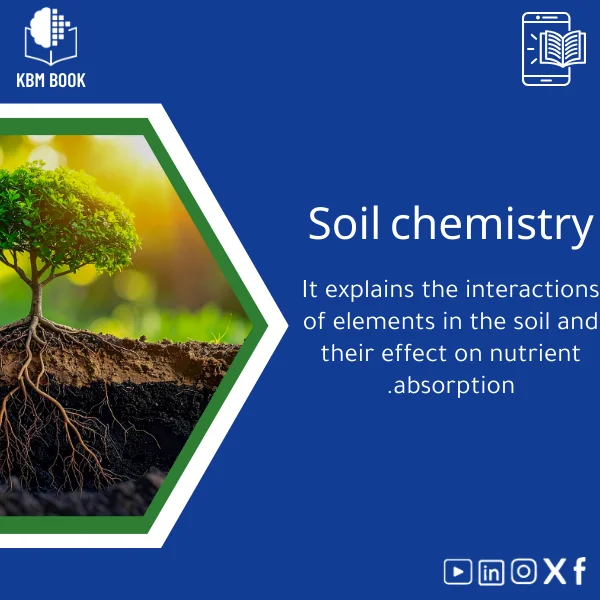
Soil Chemistry Guide: Nutrient Reactions and Plant Uptake
Original price was: 179.00 $.139.00 $Current price is: 139.00 $.
A professionally structured knowledge base module (KBM) that converts soil chemistry into a searchable, practical reference — from ion reactions in the rhizosphere to quantitative plant uptake models — ideal for students, researchers and field professionals who need fast, reliable answers.
Key benefits & value for the buyer
This Soil Chemistry KBM translates complex concepts into a practical digital tool. Below are the main benefits you gain immediately after download:
From features to real benefits
- Hierarchical, non-redundant structure: Learn or reference progressively — no repeated sections, quicker orientation for assignments or reports.
- Comprehensive coverage of soil nutrient reactions: Detailed reaction pathways (phosphate sorption, cation exchange, redox reactions) with interpretation notes — saves hours of literature search.
- Quantitative plant uptake models: Empirical and mechanistic uptake equations with worked examples to convert soil test units into expected plant availability.
- Downloadable data & tools: CSVs, spreadsheets and sample calculation sheets to integrate into lab workflows or teaching material.
- Cross-referenced citations: Source-backed entries for academic use and quick literature verification.
Use cases & real-life scenarios
How the Soil Chemistry KBM is used in practice — concise scenarios that reflect daily academic and professional workflows.
Students
Use the KBM to prepare lab reports and exams: concise reaction diagrams, conversion tables (ppm ↔ mg/kg), and solved problems that mirror course assessments.
Researchers
Accelerate literature reviews and modelling by extracting reaction kinetics, parameter ranges, and sample datasets — compatible with data analysis workflows.
Agronomists & Extension Agents
Translate soil tests into fertilizer recommendations: follow the step-by-step uptake calculation, adjust for crop stage and local soil buffering capacity.
Lab technicians
Standardize reporting templates and ensure consistent units and reaction descriptions across tests and clients.
Who is this product for?
Designed for users who need immediate, reliable access to agricultural soil chemistry knowledge:
- Undergraduate and graduate students in soil science, agronomy and environmental chemistry.
- Academic and industry researchers modelling nutrient cycles and plant uptake.
- Agricultural consultants, crop advisors and extension officers making field recommendations.
- Lab managers and technicians standardizing soil test interpretation.
How to choose the right version
Because this is a digital KBM, “size” refers to depth and included tools. Pick the version that matches your workflow:
- Basic (PDF): Concise reference guide and reaction cheat-sheets — best for students and quick lookups.
- Standard (KBM + Spreadsheets): Full hierarchical content plus Excel templates for uptake calculations — ideal for agronomists and lab techs.
- Pro (Complete package): Includes CSV/JSON datasets, sample Jupyter notebook examples and an indexed searchable file — for researchers and consultants needing reproducible workflows.
Choose Standard if you need a balance between price and functionality. Upgrade to Pro when integrating into modelling pipelines or teaching labs.
Quick comparison with typical alternatives
Common alternatives are textbooks, scattered PDFs, or bespoke spreadsheets. Here’s how this KBM compares:
- Textbooks: Deep but not searchable or modular — KBM offers targeted lookup and exportable tables.
- Individual articles: Accurate but fragmented — KBM aggregates and normalizes findings into one structured resource.
- Custom spreadsheets: Useful but often undocumented — KBM includes documented templates and worked examples you can trust.
Best practices & tips to get maximum value
- Start with the overview module to understand the hierarchical flow of concepts.
- Use the included spreadsheets with your lab’s raw data; check unit consistency before calculations.
- Cross-check nutrient reaction notes with local soil pH and redox conditions before making field recommendations.
- Integrate the KBM’s CSV datasets into your GIS or modelling workflow for batch analysis.
- Keep a local copy for offline field use and reference the citations for academic reports.
Common mistakes when using soil chemistry resources and how to avoid them
- Ignoring pH and buffering: Always consider soil pH when interpreting nutrient availability; the KBM highlights pH-dependent reactions.
- Unit mismatches: Convert ppm, mg/kg and meq/100g carefully — use the included conversion tables.
- Assuming textbooks match field conditions: Use the KBM’s field-adjustment notes to adapt recommendations to local soil tests.
- Using outdated values: Check the KBM’s citation dates and choose Pro for the most complete dataset and update notes.
Product specifications
- Format: Digital KBM package (PDF guide + optional spreadsheets and datasets)
- Files included: PDF (main guide), Excel (.xlsx) templates, CSV and JSON datasets, sample Jupyter notebook (Pro)
- Language: English
- Structure: 5 hierarchical levels; modules include basics, reactions, plant uptake, crop-specific notes, worked examples
- Entries: ~300 indexed topics; ~120 reaction diagrams; ~40 worked calculation examples
- Compatibility: Excel, Google Sheets, Python (pandas), common GIS tools
- License: Single-user or team licenses available (see purchase options)
- Delivery: Instant download after purchase; printable PDF
Frequently asked questions
Is this a soil chemistry book or a collection of PDFs?
The product is a Knowledge Base Module (KBM): it includes a readable PDF guide (like a book) plus structured, machine-readable tables and spreadsheets that let you extract and reuse data — more practical than a single PDF.
Does it include sample calculations for plant uptake?
Yes. The KBM contains step-by-step uptake calculations for common crops, example datasets and Excel templates so you can apply the methods to your own soil test results immediately.
Can I use the data in my research and cite sources?
Absolutely. Entries include references and citation details. For academic use, follow the citation notes included with each module. Pro users get expanded source lists and dataset provenance.
What if the KBM doesn’t meet my needs?
We provide a satisfaction policy: if the content does not match the described scope, contact support within the stated refund window for a review and resolution. Check the purchase page for full terms.
Ready to work smarter with soil chemistry?
Download a structured, citation-backed, and immediately usable knowledge base that turns soil nutrient reactions into actionable field and lab tools. Choose the version that fits your workflow and start saving time on literature search and calculation errors.
Instant download. Includes PDF + templates. Secure checkout and license options for individuals and teams.
Related products
Astrophysics Book: Understanding Stars, Galaxies, and Dark Energy
A searchable, hierarchical Knowledge Base Module (KBM) that converts astrophysics and cosmology into a practical, exam-ready and research-ready reference. Designed for students, researchers, and professionals who need immediate access to reliable explanations, equations, and data models for stars, galaxies, and dark energy.
Biochemistry Book: Understanding Chemical Processes in Living Systems
Comprehensive Botany Book on Plant Taxonomy and Photosynthesis
A structured, searchable botany book designed as a Knowledge Base Module (KBM) — an end-to-end reference on plant taxonomy, organ structure, and the biochemistry of photosynthesis. Built for students, researchers, and professionals who need reliable, hierarchical knowledge they can search, cite, and apply immediately.
Cosmology Book: Guide to Big Bang and Galaxy Evolution
Electromagnetism Book: A Comprehensive Guide to Fields and Circuits
General and Special Relativity Book on Einstein’s Theory
A structured, searchable Knowledge Base Module (KBM) that converts Einstein's General and Special Relativity into a clear, hierarchical reference: formulas, derivations, worked examples, practical applications (GPS, astrophysics), and a compact research bibliography — ready to download and integrate into study, teaching, or research workflows.
General Physics Book: Fundamentals of Force, Motion, Energy
Thermal Physics Guide: Understanding Heat, Energy, and Entropy
A downloadable, hierarchically structured Knowledge Base Module (KBM) that converts university-level thermodynamics into a searchable, practical digital database. Ideal for students, researchers, and professionals who need fast, reliable access to fundamentals and advanced topics in thermal physics.
Reviews
Clear filtersThere are no reviews yet.