


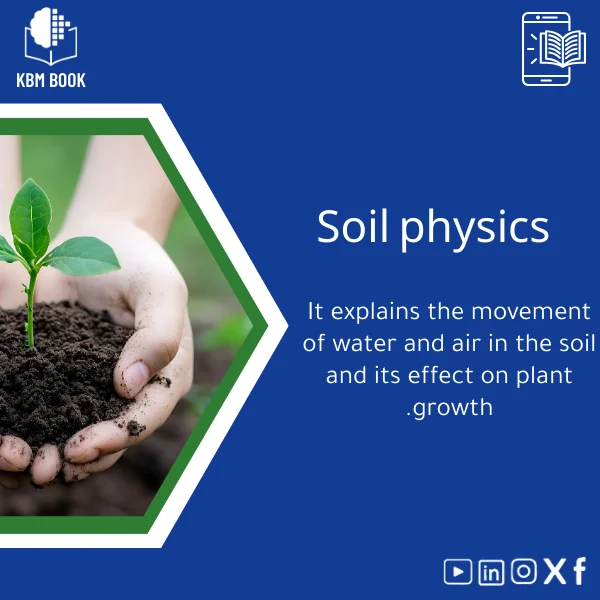
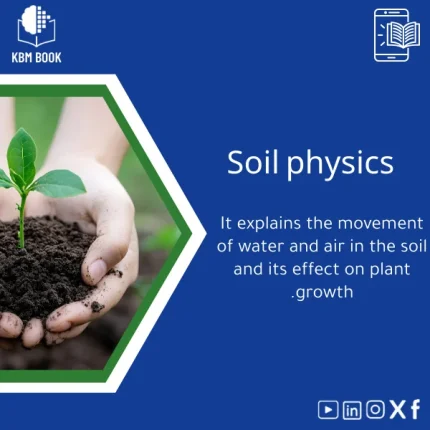
Soil Physics Guide to Water Movement and Plant Growth
Original price was: 179.00 $.139.00 $Current price is: 139.00 $.
A compact, hierarchical Knowledge Base Module (KBM) that turns soil physics into a searchable, usable
digital reference — ideal for students, researchers and professionals who need fast access to reliable
explanations of water and air movement, pore-scale processes, and their effects on plant growth.
Key benefits & value for the buyer
The “Soil Physics Guide to Water Movement and Plant Growth” translates core soil physics concepts into an
immediately usable knowledge base. Each module is designed to save you time and reduce uncertainty when
working on experiments, model runs, or agronomic decisions.
Features mapped to outcomes
- Hierarchical modules: Learn step-by-step — reduces learning curve for complex concepts like capillarity and hydraulic conductivity.
- Equations with context: Every formula includes units, typical parameter ranges, and example calculations — so you can apply them without second-guessing.
- Data-ready tables: Soil texture classes, van Genuchten/ Brooks-Corey parameter sets, and field calibration notes are exportable to modeling software.
- Field & lab checklists: Practical protocols to collect the right measurements for water retention and infiltration tests.
Use cases & real-life scenarios
University coursework and labs
Students use the KBM to prepare lab reports: step-by-step instructions for ponding infiltration tests, sample calculations for matric potential, and ready diagrams for lab notebooks.
Research & publications
Researchers reference the KBM for reproducible parameterization: downloadable CSV tables of hydraulic parameters shorten model setup time for soil-plant-atmosphere simulations.
Extension services and field technicians
Field teams use the quick-reference sheets and printable charts to diagnose irrigation efficiency issues and recommend management actions based on soil physics and hydrology principles.
Who is this product for?
This KBM is built for:
- Undergraduate and graduate students in soil science, agronomy, and hydrology needing a dependable study resource.
- Researchers who require consistent, exportable parameter sets for models.
- Agronomists, irrigation engineers, and field technicians seeking quick diagnostic tools and checklists.
- Trainers and course creators looking to embed authoritative content in workshops and curricula.
How to choose the right version
The KBM is offered in three delivery options. Choose based on your workflow:
- Reader (PDF): Best for students and instructors who need a readable, printable book with diagrams and worked examples.
- Data + Reader (PDF + CSV/JSON): Recommended for researchers and modelers who want direct imports to simulation software.
- Full KBM (interactive): Includes searchable fields, layered modules, and export templates — ideal for professionals and trainers building courses.
If you’re unsure, choose Data + Reader for the best balance of usability and technical depth.
Quick comparison with typical alternatives
Compared to a traditional textbook:
- Faster to use: KBM is searchable and modular — find a parameter or test protocol in seconds.
- Data-first: Includes exportable tables for models; a printed book rarely provides this convenience.
- Lower total cost: Digital download avoids shipping and long wait times; updates are easy to distribute.
Best practices & tips to get maximum value
- Start with the “Field Measurement” module to align your sampling methods with the KBM’s parameter tables.
- Use the included CSV parameter sets as placeholders in models, then replace them with local calibration data.
- Integrate printable checklists into your lab or field SOPs — they reduce measurement variability across teams.
- Back up the KBM files in your lab repository and version-control any edited parameter sets.
Common mistakes when buying or using soil physics resources — and how to avoid them
- Buying a single-format book: If you plan to model or share data, choose a KBM with CSV/JSON exports rather than PDF-only.
- Skipping field calibration: Standard parameter sets are starting points — always run simple in-situ tests before applying them to models.
- Ignoring units: The KBM clearly labels units for each parameter — use those to avoid model errors from unit mismatches.
Product specifications
- Title: Soil Physics Guide to Water Movement and Plant Growth
- Formats: PDF (readable KBM), CSV, JSON (data tables), printable diagrams
- Pages (PDF): ~220 pages of modules, examples and diagrams
- Data tables: Van Genuchten & Brooks-Corey parameter sets, texture-class lookups, retention curves
- License: Single-user digital license; institutional upgrade available
- Compatibility: Any PDF reader; CSV/JSON importable to R, Python, HYDRUS, SWAP, and similar tools
- Language: English (structured for international use)
- Updates: Minor updates provided to buyers for 12 months; major version upgrades available at discounted price
FAQ
Can I download a sample or preview before purchase?
Yes — a free sample chapter with table of contents, an example calculation, and one downloadable CSV parameter set is available. Use it to confirm format and coverage before buying.
Is this the same as a soil physics book PDF?
It includes a PDF reader-friendly edition, but it’s more than a static book: the KBM contains exportable data, checklists, and modular content designed for practical use in research and fieldwork.
Can I use the data tables in commercial projects?
The single-user license allows use in applied projects and reports. For redistribution or multi-user lab access, choose the institutional license or contact our support for a commercial use agreement.
How do I get technical support after purchase?
Technical support is provided via email with response commitments in the license notes. The KBM also includes documentation on importing CSV/JSON files into common modeling tools.
Ready to turn soil physics into usable knowledge?
Download a searchable, data-ready KBM that shortens research setup time, improves model consistency, and supports teaching.
Instant access — start applying soil physics and hydrology principles to real problems today.
Prefer an institutional package or need a site license? Contact KBMBook support after purchase or request a quote from our store page.
Related products
Astronomy Observational Techniques Guide for Celestial Motion
Astrophysics Book: Understanding Stars, Galaxies, and Dark Energy
A searchable, hierarchical Knowledge Base Module (KBM) that converts astrophysics and cosmology into a practical, exam-ready and research-ready reference. Designed for students, researchers, and professionals who need immediate access to reliable explanations, equations, and data models for stars, galaxies, and dark energy.
Atomic Physics Guide: Understanding Atomic and Electron Properties
Knowledge Base — Atomic/Electron Properties & Electromagnetic Interactions. A structured, searchable KBM for students, researchers, and professionals who need an authoritative atomic physics reference that organizes concepts, formulas, experiments, and practical applications from basics of atomic physics to advanced electron properties.
Comprehensive Genetics Book: DNA, Mendelian Genetics & Engineering
A structured, searchable knowledge base module (KBM) that turns genetics theory and practice into an immediately usable digital reference — from DNA structure to Mendelian genetics and contemporary genetic engineering techniques — optimized for students, researchers, and professionals who need reliable answers fast.

Comprehensive Microbiology Book on Bacteria, Viruses, and Fungi
General Biology Book: A Guide to Cells, Genetics & Taxonomy
Molecular Biology Guide: Transcription, Translation & Repair
Physical Chemistry Guide: Energy, Thermodynamics & Interactions
A structured Knowledge Base Module (KBM) for Physical Chemistry that converts core theory, worked examples, and applied datasets into a searchable, hierarchical database — ideal for students, researchers, and professionals who need fast, reliable access to chemical thermodynamics basics and molecular interaction models.
Reviews
Clear filtersThere are no reviews yet.