


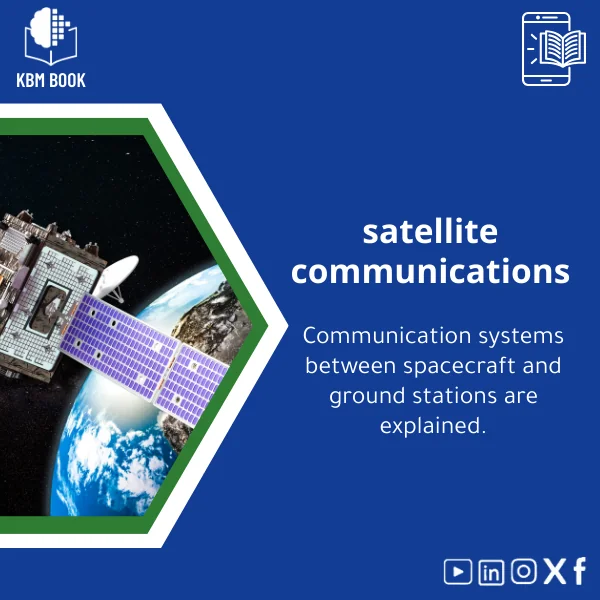
Space Communications Guide for Spacecraft and Ground Stations
Original price was: 179.00 $.139.00 $Current price is: 139.00 $.
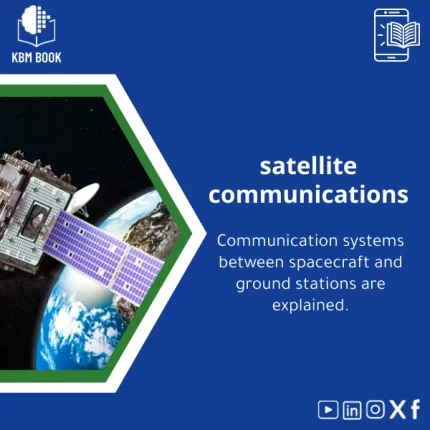
A structured, searchable knowledge base module (KBM) that converts core theory and engineering practice of space communications into an instantly usable reference — from link budgets and modulation to ground network operations and interoperability.
Key benefits & value for the buyer
This KBM converts the broad topic of space communications into an ordered, actionable resource. Instead of reading multiple textbooks and scattered articles, you get:
- Faster decision-making: Pre-built link budget templates and RF component checklists reduce setup time for lab and mission work.
- Reliable references: Each entry cites canonical standards and typical parameter ranges used in satellite communication systems and space communication engineering.
- Reusable assets: Exportable tables and simulation-ready datasets support research and student assignments.
- Scalable learning path: Modules progress from fundamentals (propagation, modulation) to advanced topics (delay-tolerant networking, crosslink routing).
Use cases & real-life scenarios
University course support
Professors can extract lecture-ready slides and example problems (e.g., computing Eb/N0 for low-earth orbit links), while students use the KBM for targeted revision and practical exercises.
Mission planning and systems engineering
Systems engineers use the KBM to assemble RF subsystem requirement sheets, perform quick compatibility checks between spacecraft transceivers and ground station antennas, and generate contingency procedures for link loss.
Research & prototype development
Researchers copy structured datasets directly into simulation tools. The KBM reduces data-cleaning time and ensures parameter consistency across experiments.
Who is this product for?
Designed specifically for students, researchers, and professionals who need structured knowledge databases across various fields for quick access to reliable information. Typical buyers:
- Undergraduate and graduate students in aerospace, electrical engineering, and telecommunications.
- Researchers developing satellite experiments, prototypes, or publications.
- Engineers in small satellite teams and ground station operators needing operational references.
- Technical educators and trainers building curricula or practical labs.
How to choose the right KBM configuration
This KBM is offered in multiple downloadable configurations. Choose based on how you’ll use it:
- Reader pack (PDF + diagrams): If you want a fast, printable reference for study or teaching.
- Research pack (JSON/CSV): If you need data for simulations or publications—includes labeled fields and units.
- Full pack (all formats + templates): If you want both human-readable and machine-readable assets plus template link budgets and test procedures.
If your primary need is classroom use or quick reading, the Reader pack is cost-effective. For lab work and integration with tools, choose the Research or Full pack.
Quick comparison with typical alternatives
Compared with scattered articles, lecture slides, or single-author books, this KBM emphasizes structured, non-redundant coverage and immediate usability:
- Versus textbooks: More modular and searchable; not a replacement for deep theoretical study but superior for practical application and quick lookups.
- Versus research papers: Aggregates standard approaches and practical guidelines rather than presenting a single study’s narrow scope.
- Versus online forums: Curated, vetted and referenced content—no contradictory threads or missing context.
Best practices & tips to get maximum value
- Start with the high-level taxonomy to map which modules are relevant for your mission or course.
- Use the example link budgets as templates—replace nominal parameters with your measured values and re-run calculations.
- Integrate JSON exports into your simulation pipeline to keep parameter sources consistent across experiments.
- Keep the KBM as a living document: apply the included change log template to record updates or mission-specific deviations.
Common mistakes when choosing or using space communications references—and how to avoid them
- Mistake: Assuming one source fits all missions. Avoid: Use the KBM’s taxonomy to isolate orbit-specific guidance (LEO vs GEO vs deep space).
- Mistake: Copying parameters without unit checks. Avoid: Use the KBM’s unit-checked tables and export formats.
- Mistake: Neglecting operational procedures. Avoid: Follow the provided ground-station checklist and failure-mode procedures for mission readiness.
Product specifications
- Title: Space Communications Guide for Spacecraft and Ground Stations
- Format: PDF (searchable), JSON, CSV; diagrams in SVG/PNG
- Modules: Hierarchical KBM with fundamentals → systems → operations → troubleshooting
- Content types: Explanations, worked examples, link budget templates, checklists, standards references
- Language: English (with key terms cross-listed in Arabic where relevant)
- License: Single-user digital license; team and institutional licenses available at checkout
- Delivery: Instant download after purchase
- Updates: Minor corrections and clarifications provided free for 12 months; major revisions available as optional upgrades
Frequently asked questions
Is this a textbook or a practical guide?
The KBM is a hybrid: it summarizes the necessary theory but emphasizes practical, repeatable procedures, templates, and data exports for engineering work and research. It is intended as an applied reference rather than a substitute for in-depth theoretical courses.
Which file formats are best for integration with simulation tools?
Use the JSON or CSV exports. Fields are labeled with units and standard parameter names to simplify import into MATLAB, Python, or custom simulators.
How often is the KBM updated?
Minor corrections and clarifications are free for 12 months. Major content updates (e.g., new modules) may be released as paid upgrades; buyers receive notifications and upgrade options.
Can I use the templates for commercial projects?
The single-user license permits use in professional work; redistribution is prohibited. Team and institutional licenses are available if you need broader rights. See the license terms at checkout.
Ready to get structured, practical space communications knowledge?
Download a KBM built for fast retrieval and real work. Whether you’re solving a link-margin question, preparing a lab, or documenting a ground-station procedure, this KBM shortens the path from question to answer.
Instant download, multiple formats, and a clear license—purchase includes detailed usage instructions and a starter checklist for mission-ready communications.
Related products
Atomic Physics Guide: Understanding Atomic and Electron Properties
Knowledge Base — Atomic/Electron Properties & Electromagnetic Interactions. A structured, searchable KBM for students, researchers, and professionals who need an authoritative atomic physics reference that organizes concepts, formulas, experiments, and practical applications from basics of atomic physics to advanced electron properties.
Biochemistry Book: Understanding Chemical Processes in Living Systems
Biological Anthropology Study Guide on Human Evolution

Comprehensive Microbiology Book on Bacteria, Viruses, and Fungi
Cosmology Book: Guide to Big Bang and Galaxy Evolution
Materials Physics Guide: Understanding Solid-State Properties
Modern Physics Book: Quantum, Relativity, and Tech Applications Guide
A structured, searchable Knowledge Base Module (KBM) that turns modern physics — quantum mechanics, special & general relativity, and contemporary technological applications — into a hierarchical, practical reference for students, researchers, and professionals who need quick, reliable access to advanced concepts and formulas.
Reviews
Clear filtersThere are no reviews yet.