


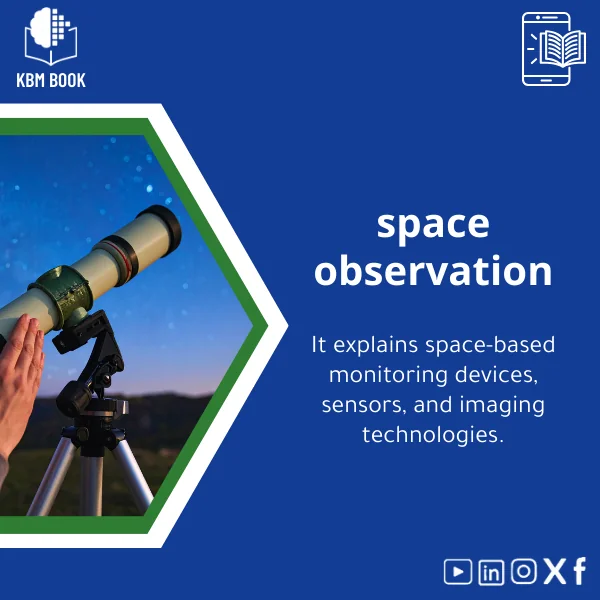
Space Observation Guide for Imaging and Sensing Technologies
Original price was: 179.00 $.139.00 $Current price is: 139.00 $.
A hierarchical, searchable Knowledge Base Module (KBM) that organizes spaceborne instruments, imaging sensors, and measurement methods into a step-by-step reference. Designed for students, researchers, and professionals who need quick access to reliable space observation data, workflows, and practical examples.
Key benefits & value for students, researchers, and professionals
This KBM translates fragmented literature and scattered datasheets into a coherent, searchable knowledge database focused on space observation. Rather than reading multiple papers or sifting through vendor PDFs, users get:
- Speed: Immediate access to sensor specs, calibration steps, and end-to-end imaging chains—save hours on every project.
- Reliability: Hierarchical structure separates fundamentals (optics, detectors) from advanced topics (radiometric correction, onboard processing), reducing confusion and repetition.
- Practicality: Real measurement examples, template scripts, and data validation checklists make it simple to apply concepts to experiments or mission studies.
- Interoperability: Exportable tables and JSON modules integrate with lab notebooks, data pipelines, or classroom LMS systems.
Use cases & real-life scenarios
Undergraduate and graduate coursework
Instructors can assign KBM modules (e.g., “Imaging Spectrometers — Calibration”) instead of scattered readings. Students follow stepwise procedures to simulate sensor response, design lab exercises, and complete reproducible reports.
Research and thesis work
Researchers use the sensor selection matrix and noise-budget templates to justify instrument choices, estimate Signal-to-Noise Ratios, and document calibration protocols—shortening proposal preparation time.
Industry and mission planning
Engineers and analysts reference the KBM for trade studies: compare space monitoring instruments by platform constraints (mass, power, bandwidth), or extract spectral response functions directly into simulation tools.
Teaching & training
Trainers deliver structured modules for workshops on remote sensing fundamentals, advanced sensors, and algorithm validation without rebuilding slides from scratch.
Who is this product for?
The KBM is tailored for:
- Students studying remote sensing, aerospace engineering, or applied physics who need a clear learning path for space observation.
- Researchers and thesis students needing reproducible protocols and instrument reference data.
- Professionals and engineers evaluating advanced space sensors for mission concepts or product development.
- Instructors and trainers preparing structured modules for classroom or corporate workshops.
How to choose the right format and integration
The KBM is offered in multiple download formats to suit workflows and tools. Choose by your primary use-case:
- Searchable PDF — best for reading, annotation, and offline study (ideal for students and instructors).
- CSV tables — best for data import (sensor specs, calibration coefficients) into spreadsheets or simulation tools.
- JSON modules — best for developers and research teams who want to programmatically integrate KBM entries into pipelines or apps.
- Bundle — includes all formats and example scripts for immediate application in MATLAB/Python workflows.
If unsure, the bundle is the most flexible choice and reduces the chance of format mismatch.
Quick comparison with typical alternatives
Traditional textbooks and vendor datasheets are useful but fragmented:
- Textbooks: deep on theory but rarely supply ready-to-use calibration or data-processing templates.
- Vendor datasheets: focused on single instruments and lack comparative matrices or pedagogical structure.
- Journal articles: high-quality results but often narrow and not formatted for practical application.
The KBM combines breadth and practicality: structured modules, ready exports, and application-oriented examples in one downloadable package — designed for immediate use.
Best practices & tips to get maximum value
- Start with the fundamentals module before moving to advanced sensor processing to ensure consistent terminology and units.
- Use CSV tables to populate simulation inputs; validate with the provided example datasets.
- Adopt the KBM’s calibration checklist in every lab session to standardize results and simplify reproducibility.
- Integrate JSON modules into version-controlled repositories for collaborative research.
Common mistakes when buying/using similar resources — and how to avoid them
- Mistake: Buying a single-format resource that doesn’t integrate with your tools. Fix: Choose the bundle or verify format compatibility first.
- Mistake: Assuming vendor specs are directly comparable. Fix: Use the KBM’s normalization tables to align units and measurement conditions.
- Mistake: Skipping calibration procedures and relying on nominal sensor parameters. Fix: Follow the included step-by-step calibration modules for accurate results.
Product specifications
- Title: Space Observation Guide for Imaging and Sensing Technologies
- Format: Searchable PDF, CSV tables, JSON modules. Bundle option available.
- Content scope: Sensor fundamentals, optics, detectors, calibration, radiometry, imaging chains, noise budgeting, examples, templates.
- Length: ~220 KBM entries; equivalent to 250–350 pages of structured reference material (PDF).
- Language: English (technical terms standardized); Arabic metadata available on KBMBook portal.
- License: Single-user and institutional license options (see purchase page for terms).
- Delivery: Instant download after purchase; includes a versioning policy with minor updates for 12 months.
- Usage notes: Exportable modules are ready for integration but may require unit checks depending on your toolchain.
Frequently asked questions
Can I download a sample chapter or preview before buying?
Yes. A free preview module covering fundamentals of detector physics and a sample instrument comparison table are available for immediate download on the product page—use them to verify scope and format compatibility.
Is the KBM kept up to date with the latest instrument specs and techniques?
The purchase includes 12 months of minor updates and corrections. Major revisions and new modules are released periodically; institutional buyers can request update schedules or bespoke module integrations.
Which format should I choose for classroom use?
For classroom use, the searchable PDF plus CSV tables are recommended. PDFs are easy to distribute and annotate, while CSVs allow educators to build hands-on exercises quickly.
How do license terms work for team or institutional access?
Licensing options include single-user, multi-seat, and institutional site licenses. Choose a license that matches the number of concurrent users and contact KBMBook for volume pricing and integration support.
Ready to streamline your space observation workflow?
Get an integrated, searchable knowledge base that turns theory into reproducible practice. The KBM is designed to save time, reduce errors, and give you a trusted reference for spaceborne instruments and advanced space sensors.
Instant download. Multiple formats. 12 months of updates included. Secure your copy and begin integrating space observation knowledge into your next project today.
Related products
Astrophysics Book: Understanding Stars, Galaxies, and Dark Energy
A searchable, hierarchical Knowledge Base Module (KBM) that converts astrophysics and cosmology into a practical, exam-ready and research-ready reference. Designed for students, researchers, and professionals who need immediate access to reliable explanations, equations, and data models for stars, galaxies, and dark energy.
Comprehensive Botany Book on Plant Taxonomy and Photosynthesis
A structured, searchable botany book designed as a Knowledge Base Module (KBM) — an end-to-end reference on plant taxonomy, organ structure, and the biochemistry of photosynthesis. Built for students, researchers, and professionals who need reliable, hierarchical knowledge they can search, cite, and apply immediately.
Cosmology Book: Guide to Big Bang and Galaxy Evolution
General and Special Relativity Book on Einstein’s Theory
A structured, searchable Knowledge Base Module (KBM) that converts Einstein's General and Special Relativity into a clear, hierarchical reference: formulas, derivations, worked examples, practical applications (GPS, astrophysics), and a compact research bibliography — ready to download and integrate into study, teaching, or research workflows.
Introductory General Chemistry Book on Matter and Reactions
A structured, searchable Knowledge Base Module (KBM) that converts core general chemistry concepts — matter, elements, reactions, stoichiometry and molarity — into a hierarchical reference you can query, teach from, or integrate into study workflows. Ideal as a concise General Chemistry book alternative for students, researchers, and professionals who need accurate, practical chemistry knowledge fast.
Modern Physics Book: Quantum, Relativity, and Tech Applications Guide
A structured, searchable Knowledge Base Module (KBM) that turns modern physics — quantum mechanics, special & general relativity, and contemporary technological applications — into a hierarchical, practical reference for students, researchers, and professionals who need quick, reliable access to advanced concepts and formulas.
Molecular Biology Guide: Transcription, Translation & Repair
Thermal Physics Guide: Understanding Heat, Energy, and Entropy
A downloadable, hierarchically structured Knowledge Base Module (KBM) that converts university-level thermodynamics into a searchable, practical digital database. Ideal for students, researchers, and professionals who need fast, reliable access to fundamentals and advanced topics in thermal physics.
Reviews
Clear filtersThere are no reviews yet.