


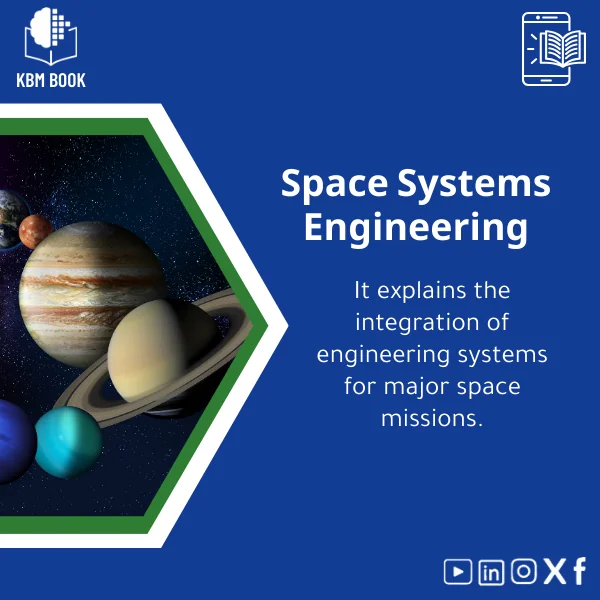
Space Systems Engineering Guide for Major Missions
Original price was: 349.00 $.279.00 $Current price is: 279.00 $.
A hierarchical, searchable knowledge base module that turns systems integration theory into practical, mission-ready processes — designed for students, researchers, and professionals who need reliable, structured Space Systems Engineering reference material at their fingertips.
Key benefits & value for the buyer
This Space Systems Engineering KBM translates the complex domain of spacecraft systems design into a structured, reusable database. Instead of reading scattered papers or long textbooks, you get:
- Faster decision-making: Standardized design patterns, requirement templates, and trade-off matrices reduce evaluation time by providing ready-to-use artifacts.
- Consistent integration workflows: End-to-end traceability from requirements to verification avoids rework and supports auditability for research and regulated projects.
- Reliable references: Curated technical definitions and equations with citations enable confident use in reports and theses.
- Practical templates: Checklists for systems engineering reviews (SRR, PDR, CDR), interface control documents, and test plans you can adapt immediately.
Use cases & real-life scenarios
Undergraduate and graduate coursework
Use the KBM to assemble lecture modules: extract topic sequences (satellite bus, payload integration, thermal control), assign readings, and provide lab checklists for model-based systems engineering exercises.
Research teams and thesis work
Create a reproducible trace from problem statement to verification approach. Researchers can copy validated formulas for orbital dynamics, mass budgeting, and reliability analysis into simulation scripts.
Project engineering and mission integration
Systems engineers working on major missions use the KBM’s interface matrices and verification matrices to coordinate multiple subsystems (ADCS, power, comms) and shorten integration cycles.
Who is this product for?
This KBM is built for learners and professionals who need structured, actionable knowledge:
- Engineering students studying space systems engineering and spacecraft systems design.
- Researchers requiring reproducible documentation and quick access to domain equations and standards.
- Systems engineers, mission integrators, and technical leads managing complex integration and verification tasks.
- Instructors and trainers creating course material for space mission systems integration.
How to choose the right KBM for your needs
When evaluating a space systems engineering book or KBM, prioritize:
- Coverage breadth vs depth: Do you need a high-level syllabus or deep verification procedures? This KBM provides layered depth—overview chapters with drill-down technical nodes.
- Format compatibility: Look for CSV/JSON/SQLite export if you plan to import tables into tools; PDFs are useful for reading and citation.
- Update policy: Choose a KBM with regular updates and versioning—critical in a field where standards and best practices evolve.
- Licensing and reuse: Confirm whether extracts can be used in reports, presentations, or commercial projects; this KBM includes clear usage notes.
Quick comparison with typical alternatives
How this KBM differs from common options:
- Textbooks: Textbooks provide narrative depth but are linear and slow to search. The KBM is modular and searchable for direct reuse in projects.
- Research papers: Papers are specific and fragmented. The KBM aggregates validated methods, context, and templates with citations to the original literature.
- Online articles and forums: Useful for quick tips but inconsistent in quality. The KBM is curated, referenced, and structured to avoid contradictions and redundancy.
Best practices & tips to get maximum value
- Start with the architecture overview to align terminology across your team.
- Use the requirement templates and traceability matrices during design reviews to document decisions as they happen.
- Import relevant data tables into your analysis tools; maintain a local version and track updates from KBMBook.
- Combine KBM checklists with your project management workflows (Gantt, Jira, or equivalent) to reduce integration risk.
Common mistakes when buying/using similar products — and how to avoid them
- Buying an overly broad resource: Choose targeted KBMs rather than massive compendia if your goal is rapid application.
- Ignoring format constraints: If you can’t import data into your tools, you’ll waste time reformatting—check exports before purchase.
- Assuming single-use: A KBM is most valuable when integrated into workflows—plan for reuse across projects and teaching.
Product specifications
- Product type: Digital Knowledge Base Module (KBM) — Space Systems Engineering
- Format: Structured datasets (JSON, CSV), SQLite export, searchable PDF, and plain-text templates
- Size: ~250 hierarchical nodes, 90+ decision/checklist templates, 50+ traceability matrices
- Compatibility: Import-ready for spreadsheet, database, and MBSE tools
- Language: English (authoritative citations included)
- License: Single-user commercial use; team and academic licenses available (see purchase options)
- Updates: Versioned updates and errata for 12 months; optional extended update plans
- Usage notes: Ready to integrate into coursework, research repositories, and mission engineering folders
Frequently asked questions
Is this a textbook or a digital database?
This is a digital Knowledge Base Module (KBM): organized, searchable datasets and templates designed for reuse. It includes PDF summaries for reading, but the core value is the structured, importable data for systems engineering workflows.
Can I use the templates in my commercial project?
Yes. The standard purchase grants single-user commercial rights. Team and institutional licenses are available if you plan to distribute or use the KBM across multiple engineers—contact KBMBook for options.
How often is the KBM updated?
Minor corrections and errata are issued continuously; substantive updates (standards, new templates) are released periodically. The purchase includes 12 months of free updates; extended plans can be purchased.
Will the KBM replace formal training or mentors?
No. The KBM is a structured reference and toolkit that accelerates learning and project work, but it complements—rather than replaces—hands-on training, supervision, and domain experience.
What if I need only a subset (e.g., verification matrices)?
KBMs are modular. You can extract specific sections for immediate use without adopting the entire module. Guidance for extraction and import is provided.
Ready to accelerate your systems integration work?
Purchase the Space Systems Engineering Guide for Major Missions and get a practical, importable knowledge base that saves time and reduces integration risk on coursework, research, and real missions.
Related products
Analytical Chemistry Book: Qualitative and Quantitative Methods Guide
Astronomy Observational Techniques Guide for Celestial Motion
Biological Anthropology Study Guide on Human Evolution
Comprehensive Genetics Book: DNA, Mendelian Genetics & Engineering
A structured, searchable knowledge base module (KBM) that turns genetics theory and practice into an immediately usable digital reference — from DNA structure to Mendelian genetics and contemporary genetic engineering techniques — optimized for students, researchers, and professionals who need reliable answers fast.


Reviews
Clear filtersThere are no reviews yet.