


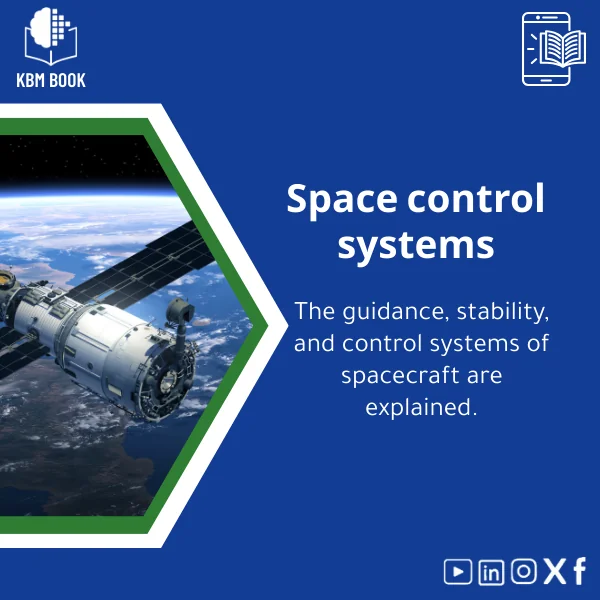
Spacecraft Control Systems Guide for Stability and Navigation
Original price was: 229.00 $.179.00 $Current price is: 179.00 $.
A structured, searchable knowledge base module that converts spacecraft guidance, stability, and control theory into a practical reference you can query, integrate, and apply—designed for students, researchers, and working engineers who need fast access to reliable spacecraft control systems information.
Key benefits & value for the buyer
This KBM turns the textbook “spacecraft control systems” content into a practical, structured reference you can use day one. It saves time, reduces errors in design iterations, and standardizes learning for teams and courses.
Concrete benefits
- Faster problem-solving: Pre-built control law templates (PD, PID, LQR, adaptive) with parameter selection guides.
- Reliable reference: Consolidated derivations for attitude dynamics, orbital frame transforms, and linearization around nominal trajectories.
- Integration-ready: Code snippets (MATLAB/Simulink, Python) and signal-flow diagrams to accelerate prototyping.
- Consistency for teams: Unified terminology and cross-referenced sections reduce miscommunication between students, researchers, and engineers.
Use cases & real-life scenarios
Examples of how professionals use the Spacecraft Control Systems KBM in daily workflows.
University course & labs
Instructors use the KBM to build lab assignments: students download the attitude control module, implement a PD controller in Simulink, and compare predicted and measured settling times using provided test vectors.
Research & algorithm development
Researchers use the KBM to benchmark new guidance and control algorithms. The module contains standard reference problems (detumbling, momentum management, station-keeping) and reproducible test cases.
Industry & small satellite projects
Smallsat teams use the KBM as a checklist: sensor selection tradeoffs, actuator sizing (thrusters, reaction wheels), and flight software architecture patterns that minimize integration risk.
Who is this product for?
This KBM is built for the target audience who need structured knowledge databases across fields for quick access to reliable information:
- Undergraduate and graduate students learning spacecraft guidance and control.
- Researchers validating control concepts or writing reproducible experiments.
- Engineers on mission teams who need quick, authoritative references during design reviews.
- Trainers and technical authors preparing course material or technical documentation.
How to choose the right KBM variant
KBMBook offers modular downloads and full stacks. Choose based on your immediate needs:
- Core module (recommended): Fundamentals, equations, block diagrams — suitable for students and initial design work.
- Applied module: Code examples, case studies, and hardware-in-the-loop notes — ideal for researchers and teams building prototypes.
- Full bundle: All modules plus instructor notes and test datasets — best for course adoption or mission-critical teams.
If you need guidance, consult the included “How to map the KBM to your project” checklist to match content depth to your workflow.
Quick comparison with typical alternatives
Traditional textbooks, research papers, and ad-hoc notes each have gaps that this KBM addresses:
- Textbooks: Deep theory but not immediately searchable or modularized for engineering tasks.
- Research papers: Narrow innovations without integration-ready examples or standardized notation.
- Internal notes: Hard to scale across teams and often inconsistent.
This KBM occupies the practical middle ground: authoritative derivations, standardized format, and ready-to-use examples for engineering and education.
Best practices & tips to get maximum value
- Start with the summary flowcharts to orient on system architecture before diving into equations.
- Use the provided test cases to validate your implementation step-by-step.
- Adopt the KBM notation across your team to reduce rework during peer review.
- Leverage the code snippets as templates — adapt parameters instead of rewriting from scratch.
Common mistakes when buying or using similar products — and how to avoid them
- Mistake: Expecting a single PDF to replace hands-on examples.
Fix: Choose the applied module for code and test data. - Mistake: Using inconsistent conventions across team documents.
Fix: Use the KBM’s standardized notation as the team baseline. - Mistake: Skipping validation tests.
Fix: Run included benchmark scenarios before claiming performance.
Product specifications
- Product type: Digital Knowledge Base Module (KBM) — Spacecraft control systems
- Format: Searchable JSON/Markdown bundle + PDF summary + MATLAB/Python example files
- Module count: Fundamentals, Guidance, Attitude Control, Actuators & Sensors, Case Studies
- Language: English (technical Arabic notes available on request)
- Delivery: Instant download after purchase
- Updates: One year of free content updates; optional annual subscription thereafter
- Compatibility: Integrates with common documentation tools and code editors
FAQ
What formats are included, and can I integrate examples into my codebase?
The KBM includes modular JSON/Markdown entries, a concise PDF reference, and working examples in MATLAB and Python. The code is commented and licensed for integration into non-commercial and commercial projects per the purchase license—see license terms included in the download.
Is this suitable for beginner students or only advanced users?
Yes. Content is layered: introductory modules cover fundamentals and notation, while advanced modules contain control-law proofs and research-level examples. Start with the core module and progress to applied topics as you gain confidence.
How often is the KBM updated and how do I get updates?
KBMBook provides regular updates for one year after purchase. Updates addressing corrections, new case studies, or additional code snippets are posted to your account for download. Annual update subscriptions are available for teams that require continuous revisions.
I’m on a tight budget — is this worth the cost?
This KBM consolidates material that otherwise requires multiple textbooks and weeks of literature review. For students and teams, the time savings, reduced risk, and design acceleration typically justify the cost. If budget is the constraint, consider the core module first and upgrade later.
Ready to accelerate your work with authoritative spacecraft control systems guidance?
Download a structured, practical KBM that reduces design time, clarifies control concepts, and provides reproducible examples. Instant access and team licensing options are available.
Need assistance choosing a module or purchasing a site license? Contact KBMBook support—our team helps match the KBM to your course or project requirements.
Related products
Analytical Chemistry Book: Qualitative and Quantitative Methods Guide
Astronomy Observational Techniques Guide for Celestial Motion

Comprehensive Evolutionary Biology Book on Natural Selection
Comprehensive Genetics Book: DNA, Mendelian Genetics & Engineering
A structured, searchable knowledge base module (KBM) that turns genetics theory and practice into an immediately usable digital reference — from DNA structure to Mendelian genetics and contemporary genetic engineering techniques — optimized for students, researchers, and professionals who need reliable answers fast.
General Biology Book: A Guide to Cells, Genetics & Taxonomy
Materials Physics Guide: Understanding Solid-State Properties
Modern Physics Book: Quantum, Relativity, and Tech Applications Guide
A structured, searchable Knowledge Base Module (KBM) that turns modern physics — quantum mechanics, special & general relativity, and contemporary technological applications — into a hierarchical, practical reference for students, researchers, and professionals who need quick, reliable access to advanced concepts and formulas.
Reviews
Clear filtersThere are no reviews yet.