


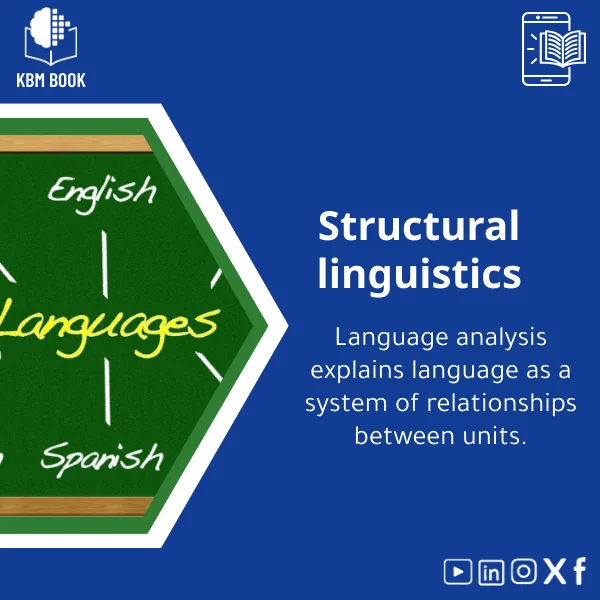
Structural Linguistics Guide: Understanding Language Systems
Original price was: 199.00 $.159.00 $Current price is: 159.00 $.
A compact, hierarchical knowledge base module that explains structural linguistics as a relational system — designed for fast reference, classroom use, research preparation, and professional practice. Get a searchable KBM that turns complex theory into step-by-step, actionable entries.
Key benefits & value for students, researchers and professionals
Structural linguistics is most useful when the analyst can access concise definitions, comparative structures and worked examples quickly. This KBM translates that need into a practical resource:
- Speed: find definitions, diagrams and diagnostic checklists in seconds with the built-in index and node numbering.
- Clarity: hierarchical organization avoids repetition — concepts build on one another from phoneme inventories up to clause structure.
- Practicality: includes annotated examples, step-by-step analytical procedures (e.g., segmentation → morpheme glossing → tree construction).
- Interoperability: formats include searchable PDF and exportable nodes so you can integrate content into reference managers, LMS or analytic scripts.
- Reliability: curated citations and suggested reading lists for each node make academic use and literature review faster.
Use cases & real-life scenarios
Students (undergraduate and graduate)
Replace scattered lecture notes with a single structured KBM. Example: preparing for a syntax exam — jump to ‘Transformations & constituency’ node, review two summary diagrams, and practice with three graded exercises that come with suggested answers.
Researchers
Build reproducible analyses: export morphological paradigms and node metadata (CSV) for corpus tagging. Use the KBM as a template to document methods and share a consistent analytical approach with collaborators.
Translators & language professionals
Quick-reference rules and contrastive matrices help resolve structure-related translation choices (e.g., nominalization strategies, clause combining). Create custom printouts for classroom handouts or client reports.
Who is this product for?
This KBM is built for anyone who needs structural linguistics as an applied, searchable toolkit:
- Linguistics & translation students preparing assignments, exams, and theses.
- Researchers who document language structure, design experiments, or prepare fieldwork protocols.
- Professionals (translators, language teachers, computational linguists) who require reliable structural descriptions quickly.
How to choose the right version & format
We provide formats to match different workflows:
- Standard KBM (PDF + index): best if you need a polished, printable reference (ideal for students and instructors).
- Research Pack (PDF + CSV/JSON exports): choose this for integration with corpus tools and reproducible workflows.
- Instructor Pack: includes slides and printable exercises to use in class.
If you are unsure which to pick: select the Standard KBM for study use, Research Pack for data-driven projects, or upgrade later as your needs grow.
Quick comparison with typical alternatives
How this KBM differs from a standard structural linguistics book or a single long PDF article:
- Traditional book: comprehensive but linear; slower to search and extract actionable nodes.
- Articles or lecture slides: focused but fragmented; typically lack a unified node structure and exportability.
- KBM: modular, searchable, and exportable — designed to be both a learning and a working resource (not just passive reading).
Best practices & tips to get maximum value
- Start with the “Core Concepts” node to align terminology with your course or project.
- Use CSV exports for any corpus tagging work — the field labels match common annotation schemas.
- Create personal flashcards from node summaries for exam revision.
- When teaching, assign a single KBM node per session and use the included exercises as graded tasks.
Common mistakes when buying or using similar products — and how to avoid them
- Mistake: Buying a single long PDF expecting modular use. Fix: choose a KBM with exportable nodes for reusability.
- Mistake: Assuming structure equals methodology. Fix: use the step-by-step procedures in the KBM to apply structural analysis reliably.
- Mistake: Overlooking citation needs. Fix: use the KBM’s suggested citation format for each node to keep references consistent.
Product specifications
- Title: Structural Linguistics Guide: Understanding Language Systems
- Formats: Searchable PDF, downloadable CSV and JSON node exports, optional instructor slides (PDF)
- Structure: Hierarchical KBM with ~120 nodes + 40 annotated examples + 15 exercises
- Language: English (technical terms with glosses)
- Delivery: Instant digital download after purchase
- Compatibility: Works with any PDF reader; CSV/JSON compatible with spreadsheets and corpus tools
- License: Single-user license; institutional upgrades available (see product page for terms)
- Support & updates: Minor corrections and errata updates provided; major version updates available as paid upgrades
FAQ
Is this a “structural linguistics book” or an interactive database?
It is a Knowledge Base Module (KBM): structured like a database of linked nodes, delivered as a searchable PDF plus exportable data formats. You can read it like a book, but also extract parts for analysis, teaching, or integration with tools.
Does the package include a PDF and a “structural linguistics pdf” download?
Yes — each purchase includes a downloadable, searchable PDF. Research Packs also include CSV/JSON exports for each node so you can programmatically access content.
Can I cite the KBM in academic work?
Yes. Each node includes a suggested citation format and full bibliographic pointers so you can reference specific nodes reliably in papers and theses.
What if I need a license for a classroom or department?
Institutional and classroom licenses are available. After purchase, contact support via the product page for upgrade options and volume licensing terms.
How does this help me “buy structural linguistics” as a usable resource?
Buying this KBM gives you a usable, exportable toolkit — not just a single narrative. The structure is designed so you can immediately apply theory, reproduce analyses, and teach from a common, reliable source.
Ready to streamline your structural linguistics work?
Get instant access to a structured, citation-ready resource that fits study, research and professional needs. Download the Standard KBM or choose a Research Pack if you plan to integrate content with corpora and analytic tools.
Need a preview first? See the sample node on the product page and compare formats before you buy.
Related products
Atomic Physics Guide: Understanding Atomic and Electron Properties
Knowledge Base — Atomic/Electron Properties & Electromagnetic Interactions. A structured, searchable KBM for students, researchers, and professionals who need an authoritative atomic physics reference that organizes concepts, formulas, experiments, and practical applications from basics of atomic physics to advanced electron properties.
Comprehensive Genetics Book: DNA, Mendelian Genetics & Engineering
A structured, searchable knowledge base module (KBM) that turns genetics theory and practice into an immediately usable digital reference — from DNA structure to Mendelian genetics and contemporary genetic engineering techniques — optimized for students, researchers, and professionals who need reliable answers fast.
Comprehensive Nuclear Physics Book on Structure and Radioactivity
Electromagnetism Book: A Comprehensive Guide to Fields and Circuits
General and Special Relativity Book on Einstein’s Theory
A structured, searchable Knowledge Base Module (KBM) that converts Einstein's General and Special Relativity into a clear, hierarchical reference: formulas, derivations, worked examples, practical applications (GPS, astrophysics), and a compact research bibliography — ready to download and integrate into study, teaching, or research workflows.
General Physics Book: Fundamentals of Force, Motion, Energy

Modern Physics Book: Quantum, Relativity, and Tech Applications Guide
A structured, searchable Knowledge Base Module (KBM) that turns modern physics — quantum mechanics, special & general relativity, and contemporary technological applications — into a hierarchical, practical reference for students, researchers, and professionals who need quick, reliable access to advanced concepts and formulas.
Thermal Physics Guide: Understanding Heat, Energy, and Entropy
A downloadable, hierarchically structured Knowledge Base Module (KBM) that converts university-level thermodynamics into a searchable, practical digital database. Ideal for students, researchers, and professionals who need fast, reliable access to fundamentals and advanced topics in thermal physics.
Reviews
Clear filtersThere are no reviews yet.