


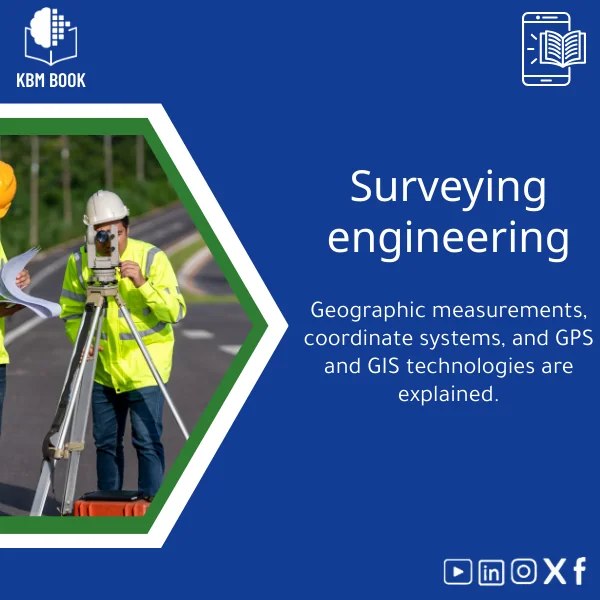
Surveying Engineering Guide: Geomatics, GPS, and GIS Techniques
Original price was: 179.00 $.139.00 $Current price is: 139.00 $.
A structured, searchable Knowledge Base Module (KBM) that converts surveying engineering theory into practical, reusable datasets and workflows — from coordinate systems and GNSS survey planning to GIS integration and error propagation — built for students, researchers, and professionals who need fast, reliable access to structured knowledge.
Key benefits & value for buyer
This Surveying Engineering KBM translates traditional surveying engineering book content into an applied, modular knowledge database. Instead of reading long chapters, you search, extract, and apply:
- Faster decisions: Immediate access to coordinate transformation formulas, datum parameters, and GPS baseline processing recipes.
- Reduced errors: Pre-validated workflows for least-squares adjustments, error budgets, and QA/QC checks reduce trial-and-error in the field and office.
- Reproducible work: Exportable scripts and tables make methods repeatable and auditable for reports and research.
- Learning that scales: Stepwise modules let a novice progress to professional practice without missing prerequisites.
Use cases & real-life scenarios
Practical classroom & lab use
A surveying lab instructor assigns a campus control exercise. Students use the KBM to quickly reference EPSG codes, set up GNSS baseline processing steps, and validate results against theoretical errors. The KBM supplies example datasets and grading checklists.
Field campaigns and survey reporting
A field engineer preparing a topographic survey consults the GPS/GNSS planning module to choose observation durations and satellite masks. The KBM’s checklist and post-processing recipes ensure the deliverable coordinates match the client’s coordinate system and reporting standard.
Research & spatial modelling
A researcher combining historical maps with modern LiDAR downloads coordinate transformation parameters and datum shift matrices from the KBM, applies them in a reproducible script, and documents the provenance for publication.
Who is this product for?
Designed for the target audience of KBMBook: students, researchers, and professionals who need structured knowledge databases across fields for quick access to reliable information. Specific segments:
- Undergraduate and graduate students learning surveying engineering and geomatics.
- Researchers conducting spatial analysis or preparing reproducible workflows.
- Surveyors and field technicians who require checklists, coordinate transforms, and GNSS procedures.
- GIS professionals needing integration guidance between surveying outputs and GIS systems.
How to choose the right edition
The KBM is modular. Choose by purpose rather than size.
- Student edition: Focused tutorials, solved problems, exam-ready summaries, and small datasets.
- Professional edition: Full workflows, reporting templates, GIS integration guides, and script-ready exports.
- Researcher bundle: Extended datasets, provenance metadata, and reproducible analysis notebooks.
If you need a single quick reference for course work, the Student edition suffices. If you produce deliverables or integrate with enterprise GIS, select Professional or Researcher bundles.
Quick comparison with typical alternatives
How this KBM differs from a conventional surveying engineering book or scattered online articles:
- Books: Provide narrative depth but lack immediate, machine-readable datasets and templates. KBM provides both knowledge and tools.
- Online articles & forums: Fragmented and variable quality. KBM is curated, structured, and internally consistent.
- Software manuals: Explain tools but rarely teach the underlying theory and reproducible procedures in a searchable format. KBM bridges theory and tool-ready outputs.
Best practices & tips to get maximum value
- Start with the “Coordinate Systems” module before processing GNSS data — saves transformation errors later.
- Use the provided checklists in the field to standardize observation setup and metadata capture.
- Export examples into your GIS or Python environment and run the included test datasets to validate your pipeline.
- Keep the KBM open when writing reports — the reproducible templates speed up documentation and audits.
Common mistakes when buying or using similar products and how to avoid them
- Mistake: Buying a single-format PDF expecting reusable datasets. Solution: Choose a KBM with exportable formats (CSV/JSON/notebooks).
- Mistake: Skipping datum checks and assuming coordinates are interchangeable. Solution: Use the KBM’s datum transformation tables and automated checks.
- Mistake: Overlooking reproducibility; losing processing steps. Solution: Use the included script templates and provenance metadata layer.
Product specifications
- Format: Knowledge Base Module (KBM) — structured JSON + CSV datasets, searchable index, printable PDF index.
- Modules included: Coordinate Systems, Geodetic Datums, GNSS/GPS Processing, Total Station Procedures, GIS Integration, Error Analysis.
- Deliverables: Exportable scripts (Python/R), reusable templates, sample datasets, field checklists, reporting templates.
- Language: English (technical terms with common translations in Arabic where relevant).
- Compatibility: Integrates with common GIS and survey workflows; scripts tested in Python 3.x and QGIS.
- Licensing: Single-user commercial license with optional site license for institutions; updates provided for major edition changes.
- Size: Modular download; typical full bundle 150–300 MB depending on included datasets.
FAQ
What file formats are included and can I import them into QGIS or survey software?
The KBM includes CSV, GeoJSON, and JSON metadata, plus sample Python notebooks. GeoJSON and CSV import directly into QGIS; coordinate transforms include EPSG codes and transformation parameters compatible with most survey and GIS tools.
Is this a replacement for a surveying engineering book or a supplement?
It is a practical complement. The KBM focuses on structured, actionable knowledge and reusable artifacts (scripts, templates, datasets). For deep theoretical reading, pair it with a core textbook; for applied workflows and reproducibility, the KBM stands alone.
How are updates delivered and how often?
Major edition updates are issued annually with corrections and new modules. Purchasers receive update notifications and access links according to the license terms provided at checkout.
Can I preview the table of contents or a sample module before purchase?
Yes — the product page includes a sample index and one downloadable sample module that demonstrates structure, export formats, and example datasets so you can validate compatibility before buying.
Ready to streamline your surveying work?
Get a structured, searchable Surveying Engineering KBM that turns theory into repeatable practice. Downloadable modules and script-ready datasets make it easier to finish assignments, produce deliverables, and document reproducible workflows.
Need institutional access or team licensing? Contact KBMBook support after purchase for volume licensing options and deployment guidance.
Related products

Astrophysics Book: Understanding Stars, Galaxies, and Dark Energy
A searchable, hierarchical Knowledge Base Module (KBM) that converts astrophysics and cosmology into a practical, exam-ready and research-ready reference. Designed for students, researchers, and professionals who need immediate access to reliable explanations, equations, and data models for stars, galaxies, and dark energy.

Biochemistry Book: Understanding Chemical Processes in Living Systems

Comprehensive Botany Book on Plant Taxonomy and Photosynthesis
A structured, searchable botany book designed as a Knowledge Base Module (KBM) — an end-to-end reference on plant taxonomy, organ structure, and the biochemistry of photosynthesis. Built for students, researchers, and professionals who need reliable, hierarchical knowledge they can search, cite, and apply immediately.
Comprehensive Genetics Book: DNA, Mendelian Genetics & Engineering
A structured, searchable knowledge base module (KBM) that turns genetics theory and practice into an immediately usable digital reference — from DNA structure to Mendelian genetics and contemporary genetic engineering techniques — optimized for students, researchers, and professionals who need reliable answers fast.





Reviews
Clear filtersThere are no reviews yet.